For the US business community, investment decisions are no longer driven solely by incentives or market size, but by the ability of institutions to keep pace with new business models grounded in science, data, and real-world practice. This also forms the foundation for long-term, sustainable cooperation between international enterprises and the Vietnamese economy.
Building an appropriate regulatory framework
In reality, amid an increasingly volatile global economic landscape, international capital is not only seeking high-growth markets but is also imposing ever more stringent requirements on the stability, transparency, and predictability of legal frameworks.
Particularly in high-tech industries, emerging consumer sectors, and tightly regulated fields, policies must be sufficiently flexible to avoid missing opportunities for innovation.
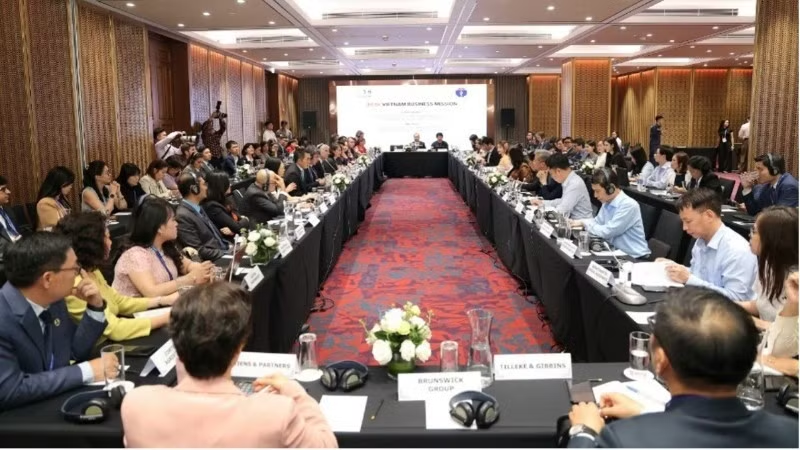
At recent meetings between Vietnamese Government leaders and the USABC, the US business community emphasised that, alongside long-term investment commitments in Viet Nam, the Government should design regulatory policies based on scientific assessment, real-world data, and the specific impact of each product category.
Such an approach would not only enable regulators to make more accurate decisions but also encourage businesses to invest responsibly in innovation.
Regarding tobacco — a sector subject to strict regulation in many countries — US enterprises proposed that product classification should be based on risk levels and scientific evidence for each type, thereby creating a more flexible framework aligned with technological developments and societal needs.
This would help the Vietnamese Government better control the harms of tobacco use in a manner that is both effective and adaptable to real-world conditions, while also creating further incentives for foreign enterprises to contribute responsibly to tobacco harm reduction efforts in Viet Nam.

According to Ankur Modi, Cluster Head for South Asia and IndoChina at Philip Morris International (PMI), a considerable body of scientific research on smoke-free tobacco products has already been published worldwide by reputable sources, including regulatory authorities and healthcare systems in countries such as the United States, the UK, Japan, Germany, and Switzerland.
Therefore, the challenge facing countries today lies not in a lack of data, but in establishing mechanisms to access, synthesise, and evaluate information in a scientific manner, in line with domestic conditions and practical realities.
Policies must keep pace with technological innovation and practice
According to statistics from the World Health Organisation (WHO), Viet Nam has more than 15 million adult smokers and ranks among the 15 countries with the highest number of smokers globally, yet the success rate of smoking cessation remains low.
This presents a policy challenge: how to strike a balance between protecting public health and achieving tobacco harm reduction goals in line with real-world conditions.
In this context, Ankur Modi stressed that policies must not only keep pace with developments but also place people at the centre, ensuring that policy decisions are both effective in governance and aligned with the needs and realities of society.
To realise this approach, he recommended clarifying and standardising information, particularly by clearly distinguishing between different categories of tobacco products, in order to avoid misconceptions and concerns not grounded in scientific or real-world evidence.

In addition, smokers should not be limited to a binary choice between quitting entirely or continuing to suffer harm, but could be offered alternative solutions based on scientific and technological advances. This approach has been studied and adopted by many countries with the aim of reducing risks for users and the wider community.
To achieve this, one key requirement is the standardisation of information and clear differentiation between product categories. A lack of distinction among tobacco products may lead to public misunderstanding and inconsistency in policy-making based on scientific evidence.
For instance, in international documents published by the World Health Organization (WHO), heated tobacco products are clearly distinguished from e-cigarettes, with the former showing the lowest level of appeal among young people across all product categories and with no recorded cases of poisoning or illicit substance mixing.
At the same time, international experience is regarded as a valuable reference, as many countries have implemented effective regulatory models. This enables Viet Nam to adopt approaches suited to its domestic conditions, rather than mechanically applying external models or imposing outright bans.
Shifting from a management mindset to a development-oriented approach aligned with practical realities not only demonstrates the Government’s commitment to supporting businesses, but also opens up opportunities for Viet Nam to capitalise on new waves of investment, particularly in high-tech and innovation-driven sectors.
In the long term, a flexible, science-based, and people-centred policy system will not only attract high-quality capital flows but also empower domestic enterprises to enhance competitiveness and integrate more deeply into global supply chains.
A new context requires new approaches. As product models and technologies continue to evolve, policies must also adapt — not only to keep pace, but to lead development.
This is the key for Viet Nam to continue affirming its position as an attractive destination for international investors, while ensuring a balance between economic growth and long-term social interests.