An urgent requirement
The Ho Chi Minh City Department of Construction has proposed waiving fares for all bus passengers across the city for the remaining months of 2026. The free-fare policy would apply only to intra-city routes, while bus services connecting Ho Chi Minh City with neighbouring provinces would not be covered.
With a population of more than 14 million and around 10 million private vehicles, most of them concentrated in the urban core, the city’s public transport system currently meets only about 2% of travel demand.
According to the Ho Chi Minh City Institute for Development Studies, the city has become a “motorbike city”, with around 800 motorbikes per 1,000 residents, while the figure for cars stands at roughly 100 per 1,000 residents.
Many experts believe that with mounting environmental pressure, rapid population growth, and the surge in private vehicle ownership, the city must increase the share of journeys served by public transport, particularly through high-capacity systems such as metro lines.
Associate Professor Vu Anh Tuan, Director of the Transport Research Centre at the Vietnamese-German University, stressed that developing public transport is an urgent necessity, adding that greener vehicles must also be promoted at a time when fossil fuel supplies are increasingly volatile.
Sharing this view, architect Do Xuan Son of Ho Chi Minh City University of Technology noted that the city currently has only around 2,400 buses, while land allocated for transport infrastructure accounts for just 10% of total urban land. He added that to develop an effective public transport system, the city would need at least 5,000 buses.
Improving infrastructure and service quality
Free bus travel is a humane and progressive policy, but if it is the only measure taken, it will still fall short of addressing congestion, environmental degradation, and the broader challenge of sustainable transport. Many residents have pointed out that fares are only part of the issue; infrastructure, service quality, and lengthy travel times are even more significant.
Tu Van Huan, a resident of Tan Thoi Hiep Ward (formerly District 12), said: “Travelling by motorbike to my office near Ben Thanh Market takes about 45 minutes each way. By bus, it takes around two hours. People will not easily give up their motorbikes simply because bus travel is free. They will only switch when buses offer roughly the same journey time and a similar level of convenience.”
Speaking to Nhan Dan, architect Ngo Viet Nam Son said: “The current route network has not been planned in a systematic or integrated manner. The biggest issue is that buses are concentrated on only a few main roads, meaning passengers can reach only a limited number of destinations.”
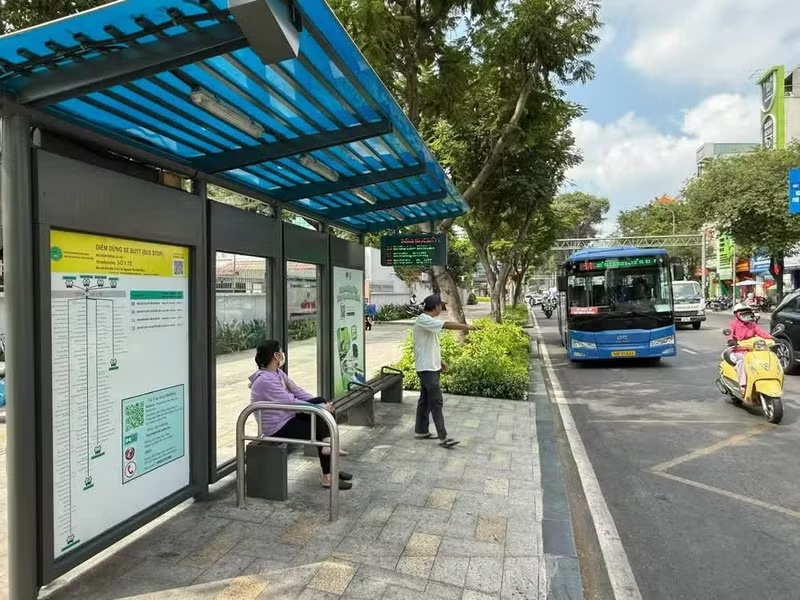
According to Son, changing people’s travel habits must begin with infrastructure. The city needs to build a comprehensive network of bus shelters to protect passengers from sun and rain, and to plant more trees at stops to make waiting more comfortable. Bus routes should also be adjusted so that stops are located directly at the entrances of hospitals, schools, and markets.
On a broader level, the city should introduce policies encouraging the development of mixed-use office and commercial complexes around bus stops, fostering an integrated environment in which commuters can step off a bus and walk directly to their workplaces.
In a recent proposal submitted to the Ho Chi Minh City People’s Committee, the Department of Construction outlined a range of solutions. The agency plans to review and reorganise the entire bus network to ensure greater synchronisation, while prioritising infrastructure investment and improving operational quality.
Authorities will restructure the existing route system, overhaul underperforming routes and introduce new services, including electric buses and smaller vehicles, to improve access to residential areas.
The Department of Construction also plans to adjust routes, stops, and operating hours in line with actual demand, while increasing service frequency on busy corridors during peak hours. Bus schedules will also be synchronised with metro services and other modes of transport to reduce waiting times and improve intermodal connectivity.
Alongside the development of bus infrastructure, we also need to expand the elevated railway system, extend no-parking zones for cars or raise parking fees. These measures would help reduce the number of private vehicles entering the city and, in the long term, gradually reduce both congestion and reliance on private transport
Architect Do Xuan Son