Thanks to the prioritisation of resources for socio-economic development, ethnic minority and border areas in Dong Nai have seen people’s living standards steadily improved.
Settling down on new land
The resettlement area in Sub-zone 42 (located in the border area of Dak O Commune) has now been transformed. The scenes of fires burning and smoke billowing in the early days, when residents first arrived to clear land and make a living, are gone.
In their place are the green expanses of rubber plantations, newly cultivated gardens and rows of newly built houses. This transformation shows that local people have truly settled down and built stable livelihoods.
In 2000, due to hardship, the family of Nguyen Van Ut left their hometown in Kien Giang Province to settle in Village 6, Dak O Commune. In the early days, they faced countless difficulties and had to stay temporarily with relatives.
To earn a living, they cleared forest land to grow cassava and maize, which became their main sources of income. In 2006, more than one hectare of forest land was reclaimed by the authorities after being illegally encroached upon.
Ut recalled: “After our forest land was taken back due to illegal clearing, my family was allocated land for cultivation and resettlement in Sub-zone 42. Since receiving production land, we have planted rubber and cashew trees, intercropping cassava as a short-term crop to support longer-term investments, which has made life less difficult. I was also supported by the State with funding to build a house. I truly do not know how to express my gratitude to the Party and the State.”
With production land and a new house, Ut’s family escaped the hand-to-mouth existence and flimsy bamboo shelters exposed to wind and rain. Today, his family, along with hundreds of other households resettled in Sub-zone 42, enjoys stable living conditions, while their children attend school regularly. From a place that once lacked almost everything, the resettlement area now has electricity, roads, schools and clean water fully in place.

According to Phung Hiep Quoc, Secretary of the Dak O Commune Party Committee, Dak O is a border commune covering more than 246 square kilometres, with a population of over 19,000 people from 14 ethnic groups, of whom ethnic minorities account for nearly 40%.
“In recent years, thanks to the Party’s and the State’s comprehensive investment, Dak O has been transformed. Transport, electricity, water supply, schools and health stations have been built and upgraded, creating favourable conditions for people to develop production and improve their livelihoods. Many residential areas and border markets have been formed, boosting trade and ensuring social welfare. This has strengthened great national unity, contributing to the consolidation of national defence and security and the safeguarding of national sovereignty,” he said.
At a border residential cluster in Thien Hung Commune, the villages give off a warm and familiar feeling, as if they have existed for a long time. Yet locals explain that this is in fact a residential area newly established just a few years ago, adjacent to a militia outpost. Built on flat land, the area has concrete internal roads connected to the district’s transport network by an asphalt road. From here, it takes less than 10 minutes to reach the border patrol road or the commune centre.
Pham Van Tuan, a member of the Tay ethnic group, was allocated land and housing in this residential area next to the border militia outpost in Thien Hung Commune in 2022. Welcoming the New Year, he and other residents happily celebrated together, confident in their now stable lives.
“Living in border areas is difficult,” he said. “But having overcome the early hardships, everyone now feels secure and determined, working together to build an increasingly prosperous community.”
Preserving heritage, opening pathways for community-based tourism
Urbanisation and the impacts of the market economy are causing many traditional cultural values in ethnic minority areas to fade. Numerous festivals, languages, scripts, traditional clothing and handicrafts face the risk of disappearing, as younger generations show less interest in inheriting them. This reality underscores the urgent need to preserve, restore and promote ethnic cultural identity, linking conservation with sustainable development and livelihoods.
In Dong Nai, over recent years, communes with large ethnic minority populations such as Tho Son, Bom Bo and Tan Hung have made efforts to revive and enrich traditional festivals, viewing them as distinctive strengths for developing community-based tourism.
In Tan Hung Commune, ethnic minorities make up 32% of the population. Cultural spaces associated with villages and hamlets, historical relics and folk beliefs together create a rich and diverse cultural identity.
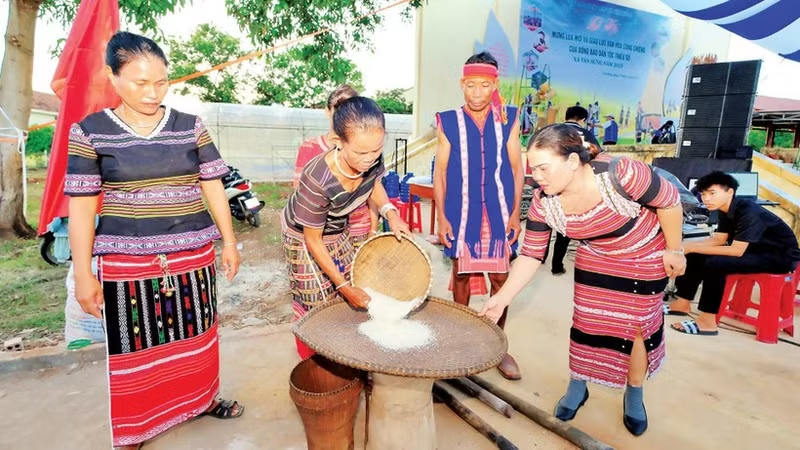
Mac Dinh Huan, Secretary of the Tan Hung Commune Party Committee, said: “The Party Committee, local authorities and residents regard the promotion of ethnic cultural values as an important driver of economic development, the building of advanced new rural areas and the strengthening of community solidarity. Recently, we revived the new rice festival of the Xtieng people, which attracted large numbers of local residents and visitors from across the country. This demonstrates that the cultural values of ethnic minorities are a significant asset that many people care deeply about.”
He added: “From this, we aim to promote ethnic minority cultural values through tourism by integrating identity - costumes, customs, festivals, languages, cuisine and handicrafts - with community-based tourism to create sustainable livelihoods. This helps improve living standards, ignite ethnic pride and empower communities as the main custodians of heritage, thereby preserving traditions while enriching the locality, educating visitors and dispelling prejudices, fostering positive cultural exchange.”

Dong Nai is home to many festivals listed as national intangible cultural heritage, including the Cau Bong Festival of the Kinh people; the Sayangva Festival of the Choro ethnic group; the Dua Tpeng (Pha Bau) Festival of the Khmer people in Loc Hung Commune; the Ba Ra Temple Festival in Phuoc Long Ward; the Ong Temple Festival; and the death anniversary of Nguyen Huu Canh in Tran Bien Ward. In 2025, the province prepared a dossier proposing the recognition of the Long Tong (field-descending) Festival of the Tay people as national intangible cultural heritage.
With a rich, diverse and distinctive festival system, Dong Nai needs to identify festivals as unique tourism products capable of creating a strong, distinctive imprint. First and foremost, the province should invest in conserving festival spaces and reviving traditional rituals linked to community life, while avoiding excessive commercialisation that could erode original values.
According to Vo Tan Duc, Deputy Secretary of the Provincial Party Committee, Dong Nai aims by 2030 to attract more than 11 million visitors, with tourism revenue reaching nearly VND 12 trillion. To achieve this target, alongside appropriate mechanisms and policies, the province must strengthen linkages and cooperation, forming high-quality tourism service value chains to foster shared growth. It should also step up the application of scientific and technological advances in business operations and brand building to enhance the quality and competitiveness of tourism products.