In recent years, the mobile library system has opened a green journey for reading culture, carrying books across high mountain passes and deep streams to villages, industrial zones, and schools far from urban centres, sowing the seeds of literacy within communities.
Expanding coverage
Looking back to the early days, when the concept of mobile libraries was still new, book-laden vehicles set out despite many limitations. Roads were poor, vehicles lacked modern equipment, and reading materials were limited in both quantity and variety. Yet the aspiration to bring knowledge to remote areas inspired librarians to persevere in their work.
At that time, each trip consisted mainly of boxes of books packed by hand, with small book-presentation sessions held under school verandas or inside village cultural houses. From these quiet beginnings, however, the foundations were laid for a new service model. Today, mobile libraries integrate digital technology and have become a bridge that narrows the gap between knowledge and communities.
On misty mornings in highland schoolyards, the moment the library vehicle doors swing open is always the most eagerly anticipated. At first the children shyly hang back behind their friends, but within minutes they are absorbed in the pages of brightly coloured comic books. Groups sit along classroom verandas, reading attentively and forgetting even their break time.
At schools serving the Van Kieu and Pa Co ethnic communities in Quang Tri Province, students not only enjoy new books but also experience computer sessions provided by the “Light of Knowledge” project. With fingers still clumsily tapping the keyboards, bursts of laughter erupt when they watch an interesting documentary clip for the first time or try an online quiz.
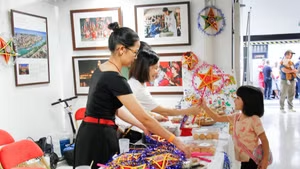
Every stop of the library bus becomes a small festival of childhood: children queue neatly to borrow books, enthusiastically join quizzes, or draw pictures of their favourite characters. After the excited cry of “The book bus is here!”, small hands tug at their teachers’ sleeves to ask about more titles, accompanied by promises that “next time the bus comes, I will have finished these books.”
According to statistics since 2019, the Quang Ngai Provincial Museum and Library has organised more than 165 mobile library trips, serving nearly 67,500 readers and circulating more than 73,000 items. Each vehicle carries around 2,500 books along with exchange activities, quizzes, drawing sessions, and technology-based games, turning reading time into a lively experience.

In Quang Tri Province, since receiving the “Multimedia Mobile Library Bus – Light of Knowledge” project in 2019, the provincial library has organised nearly 90 service trips annually to mountainous areas inhabited by Van Kieu and Pa Co communities. In 2025 alone, 45 trips served 9,000 readers, circulating 27,500 books and newspapers and facilitating 850 computer sessions.
In Dien Bien Province, the model “Books seeking readers” brings library vehicles to ethnic minority boarding schools, border guard stations, and educational facilities in border areas. Not only do these journeys carry books but they also help to cultivate reading habits, self-learning skills, and a spirit of lifelong learning among students.
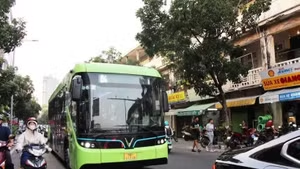
In Ho Chi Minh City, the General Sciences Library has operated mobile digital library vehicles since 2007. It now runs eight specialised vehicles serving students, workers, and visually impaired readers in suburban areas, industrial parks, and at major cultural events.
The combination of printed books and digital libraries, laptops, STEM content, and free library cards has helped erase geographical barriers to knowledge access. If traditional libraries are destinations, mobile libraries are companions on the journey. By moving beyond fixed spaces, this model actively reaches readers, especially in places where infrastructure remains limited.
Persistent challenges
The green journey of mobile library vehicles has shown both vitality and profound social significance. Yet behind children’s smiles and impressive service statistics lies a reality that raises many concerns. The model still faces numerous challenges, ranging from financial resources and infrastructure to human resources and the need to innovate content in the context of rapid digital transformation.
First is the question of funding, one of the core issues determining the sustainability and expansion of activities. Most mobile library vehicles today are funded by the state budget or initial support projects. After the start-up phase, regular operating costs such as fuel, vehicle maintenance, equipment replacement, acquisition of new books, and software upgrades weigh heavily on local libraries.
Each journey may last several days, travelling across winding mountain roads where landslides are an ever-present risk during the rainy season. Without timely investment, interruptions in service are difficult to avoid.
Beyond book collections, information resources also require continuous renewal. Today’s readers, especially students born in the digital age, need access to books on science, technology, foreign languages, digital skills, and reference materials aligned with the new educational curriculum. This requires projects to carefully select and regularly update appropriate titles, otherwise, mobile libraries may struggle to maintain long-term appeal.
Although many vehicles are equipped with computers, internet connections, and digital library systems, unstable network infrastructure in remote areas often complicates the operation of these devices. Moreover, building open databases and interconnecting resources among local libraries requires synchronised technical platforms and staff with information technology expertise. Yet in many places, library personnel remain few in number and must handle multiple responsibilities.
Another challenge lies in sustaining reading habits after each library vehicle departs. Mobile libraries operate periodically, in some places only once a month. Without close coordination with schools, local authorities and community organisations to establish “satellite bookshelves”, reading clubs, and book-based storytelling activities, the ripple effect may fade. Building a reading culture is a long-term process that requires the coordinated participation of many actors rather than relying solely on the arrival of library buses.
Regarding this issue, Ninh Thi Thu Huong, Director of the Department of Grassroots Culture, Family and Libraries under the Ministry of Culture, Sports and Tourism, emphasised that the model’s greatest success lies in changing community awareness. When children eagerly await the arrival of the book bus; when parents and teachers proactively collaborate to build local book collections; and when local authorities regard the development of reading culture as part of a sustainable development strategy — these are the true signs that a foundation of knowledge is being strengthened. Linking mobile library activities with programmes and projects aimed at developing reading culture towards 2030 is therefore an important step in establishing a legal framework and stable resources.
At the same time, greater social participation is needed, mobilising businesses, organisations and individuals to contribute. From the perspective of state management, the Director of the Department of Grassroots Culture, Family and Libraries affirmed that the cultural sector will continue improving mechanisms and policies, enhancing the capacity of library staff, and promoting the sharing and interconnection of resources among localities. Above all, however, the decisive factor remains people.
Every challenge also opens opportunities for innovation. The green journey can therefore become a journey that overcomes barriers of both resources and mindset. For these vehicles to continue rolling forward sustainably, coordinated efforts are needed from the cultural and education sectors, local authorities, and society as a whole. Long-term investment policies, modern training programmes for library staff and flexible public-private partnership models are essential. Above all, it is vital to maintain the belief that investing in reading culture is investing in the future.