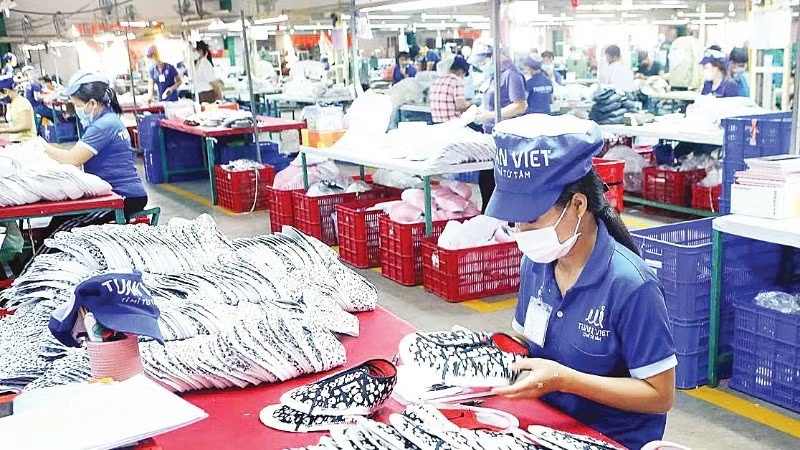
The province is working to improve mechanisms and policies, remove barriers, and create favourable conditions for private enterprises to grow robustly and sustainably.
Opportunities to optimise resources
Dong Nai hosts a large business community, dominated by private sector and foreign-invested enterprises that together accounts for more than 75% of the province’s total import-export turnover. A transparent investment environment and improved transport infrastructure, with several key national projects, most notably Long Thanh International Airport, are considered foundational factors supporting private sector development.
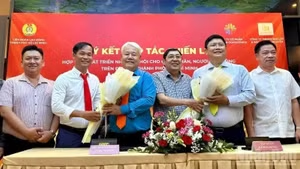
According to Nguyen Duy Hung, Director of Hung Thinh Phat Co., Ltd., the business community has been highly impressed by Resolution 68. Amid rapidly changing business conditions and market developments, the two-tier local government in Dong Nai has implemented governance measures with commitment and decisiveness. Provincial leaders have paid greater attention to enterprises, particularly when it comes to small and medium-sized enterprises.
“Recently, with the province’s support, we launched the Dong Nai Logistics Association, aiming to bring together the business community and gradually raise the share of logistics and trade services to 25-28% of the province’s economic output in the 2025-2030 period. This is one of the most practical actions in implementing Resolution 68 in Dong Nai,” Hung said.
Le Nu Thuy Duong, Vice Chairwoman and Chief Executive Officer of Long Thanh Golf Investment and Trading Joint Stock Company, described the resolution as a “turning point” in mindset, placing the private sector at the centre as a key driver of Viet Nam’s economy. It introduces more favourable policies while creating a more level playing field for private enterprises.
Dong Nai possesses many advantages to become a new growth pole in the Southeast region, located at a gateway linking Ho Chi Minh City with the South Central Coast, the Central Highlands and the Mekong Delta, while developing rapidly across sectors such as modern industry, logistics, high-tech agriculture, and urban services.
For enterprises such as Long Thanh Golf, the resolution serves as a genuine impetus to continue long-term investment and to further enhance their role.
Vu Thi Ngoc Diem, Chief Executive Officer of Dai Hoang Kim Automation Machinery Manufacturing Joint Stock Company, shared that recent support policies from both central and provincial authorities have strengthened business confidence, enabling enterprises to pursue long-term investment and proactively expand production and operations.
In 2026, the company plans to build on its strengths in mechanical engineering, focusing on research, design and the production of new product lines, while gradually expanding into steel structure fabrication and industrial factory construction.
Significant development potential
Regarded as the country’s industrial hub, Dong Nai still has substantial room to develop next-generation industrial parks, particularly green and smart parks capable of attracting high-tech industries. Beyond industry and logistics, the province also benefits from abundant land and favourable natural conditions suited to large-scale, high-tech agricultural development. In short, it is an ideal location for private enterprises to thrive.
According to the Dong Nai Department of Finance, since the issuance of Resolution 68, nearly 8,100 new enterprises have been registered in the province, with total registered capital exceeding 62.1 trillion VND (2.3 billion USD). The surge in both the number of enterprises and registered capital during the 2021-2025 period clearly reflects the effectiveness of the province’s policy implementation. To date, Dong Nai has more than 115,000 private enterprises, with total registered capital of approximately 810.85 trillion (30.7 billion USD).
The province aims to establish around 36,000 new enterprises in the 2026-2030 period; ensure that over 40% of businesses engage in innovation; achieve an average private sector growth rate of 10-12% per year; contribute 55-58% of economic output and 35-40% of total state budget revenue; and provide employment for approximately 84-85% of the workforce.
To realise these goals, the Dong Nai Provincial Party Committee issued various policies to put the objectives of Resolution 68 into practice. Recently, the Provincial People’s Committee has also implemented a plan to carry out the Prime Minister’s decision approving an inter-sectoral legal support programme for small and medium-sized enterprises and household businesses for the 2026-2030 period.

Nguyen Kim Long, Standing Vice Chairman of the Dong Nai Provincial People’s Committee, stated that the province remains committed to supporting businesses by continuing to improve the investment environment, providing maximum support for enterprise development, and standing ready to remove obstacles. Provincial leaders, along with departments and local authorities, treat business challenges as their own in order to deliver timely and decisive solutions.
The business community expects that effective implementation of Resolution 68 will unlock the province’s inherent advantages, remove bottlenecks, further improve the investment climate, and create space for both citizens and enterprises to contribute towards the goal of Dong Nai becoming a centrally governed city in the near future.
According to Dang Van Diem, Chairman of the Dong Nai Business Federation, access to land and production sites, green credit and support for integration into supply chains are among the most pressing needs of enterprises.
Translating Resolution 68 into practice brings both opportunities and challenges, requiring the business community to act proactively, seize opportunities, and pursue sustainable growth.