Important foundations
Strategic technologies are breakthrough and highly transformative technologies identified by the State for priority investment and development. These technologies help strengthen national self-reliance, create competitive advantages, safeguard national defence and security, and promote sustainable socio-economic development.
The development of strategic technologies is gradually attracting the engagement of the entire political system, the business community, intellectuals, scientists and society as a whole.
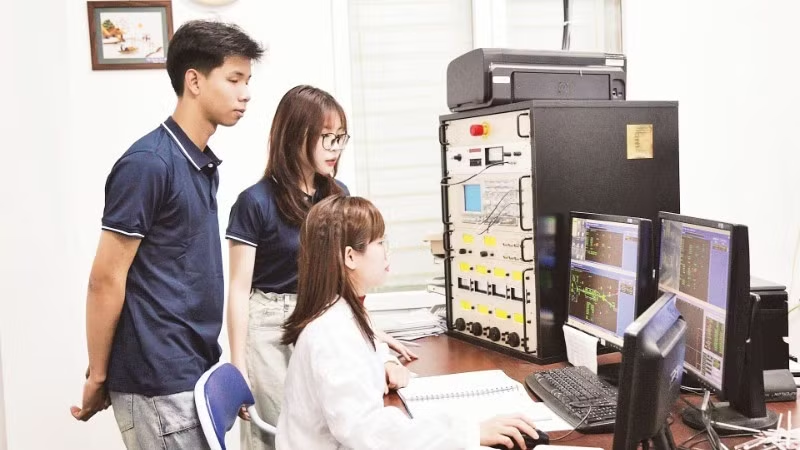
Prof. Dr. Tran Hong Thai, President of the Viet Nam Academy of Science and Technology, stated that in recent years the institution has cooperated with domestic and international agencies and organisations to effectively implement numerous scientific research, technological development and innovation projects closely linked to the practical needs of industries, sectors and localities.
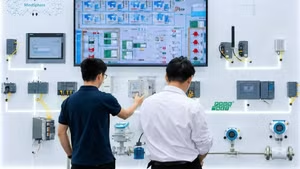
The Viet Nam Academy of Science and Technology has recently reviewed, screened and selected a portfolio of 112 technologies deemed ready for transfer and practical application, in line with the development requirements of various sectors and industries. These include several notable technologies such as integrated solutions combining artificial intelligence (AI), the Internet of Things (IoT), cloud computing/edge computing, automation and robotics to enhance monitoring and operational management capabilities for industrial and energy systems; the Digital Core Platform (Low-code technology platform); and genetically modified rice varieties with high gamma oryzanol content.
Assoc. Prof. Dr Bui The Duy, President of Viet Nam National University, Ha Noi, stated that the university has established research institutes specialising in strategic industrial technologies, including semiconductors, quantum technology and AI4SD, as well as outstanding centres receiving priority investment in major resources. The university has also developed 16 key research programmes focusing on strategic technology areas such as semiconductor chips, artificial intelligence, robotics and automation, unmanned aerial vehicles (UAVs), cybersecurity, advanced biomedical technologies, new materials and energy, quantum technology and sustainable development.
From the business perspective, Tran Manh Bao, Chairman of ThaiBinh Seed Group Joint Stock Company, shared that the company has consistently pursued a development strategy based on science and technology. More than 25 years ago, the company invested in establishing a crop research institute staffed by highly specialised scientists, while maintaining close cooperation with domestic and international research institutes and universities. To date, the company has researched, bred and obtained national recognition for more than 40 high-quality crop varieties, which now account for 20% of Viet Nam’s rice cultivation area, contributing significantly to improving productivity, quality and production efficiency for farmers.
Continuing to concentrate resources
The scientific and technological achievements of research institutes, universities and enterprises have initially created an important foundation for broader development breakthroughs in general, and strategic technology development in particular. However, amid current demands for innovation, the development of strategic technologies must enter a new phase characterised by more concentrated resources, larger-scale investment, greater modernisation and a more strategic approach.
The conclusions delivered by General Secretary and President To Lam at the thematic session on strategic technologies of the Standing Board of the Central Steering Committee for Science and Technology Development, Innovation and Digital Transformation highlighted the urgent need for a fundamental shift in mindset and methods of implementation.
The Prime Minister has issued Decision No. 21/2026/QD-TTg, identifying a list of 10 strategic technologies and 30 strategic technology products divided into two groups, while also assigning specific strategic technology development tasks to ministries, sectors and localities.
The achievements made by research institutes, universities and enterprises in science and technology development have laid an initial foundation for breakthroughs in scientific and technological advancement in general, and strategic technology development in particular.
According to experts, under the Party and State’s policies and the determined direction of leaders at all levels, the key task in developing strategic technologies is to create concrete products with high added value, strong practical applicability, commercialisation potential and high localisation rates, thereby making genuine contributions to improving labour productivity and the competitiveness of the economy.
In addition, ministries, sectors and agencies need to strengthen international cooperation and introduce mechanisms encouraging foreign-invested enterprises in Viet Nam to transfer technology. Efforts should also focus on effectively leveraging networks of overseas Vietnamese intellectuals and experts, while shifting decisively towards the mindset of producing substantive products, real value and tangible effectiveness.
Science and technology programmes, missions and innovation initiatives should aim to solve the country’s major challenges, with output products, practical effectiveness and commercialisation capacity serving as key criteria for evaluating performance.
At present, research institutes, universities and enterprises are also adapting and introducing solutions and targets to implement the Party and State’s policies and directives on strategic technology development.
For example, the Viet Nam Academy of Science and Technology is developing a project to strengthen its capabilities to match those of advanced institutions in the region and worldwide, with plans to invest in strategic technology research directions and research centres.
Viet Nam National University, Ha Noi is implementing projects including the design of low-power open-source RISC-V processor IP cores for IoT devices; the development of Lab-on-a-chip systems for early detection of lung cancer cells; and intelligent control systems integrating multiple UAVs for search and rescue operations and large-scale monitoring. Meanwhile, ThaiBinh Seed Group plans to invest approximately 500 billion VND during the 2026–2030 period in research infrastructure, biotechnology laboratories, data centres and smart testing systems.
According to Minister of Science and Technology Vu Hai Quan, Viet Nam is facing a major opportunity to achieve breakthroughs in its new stage of development, making it essential to further unlock all resources for science, technology and innovation. Therefore, the scientific community, businesses, universities, research institutes, ministries, sectors, localities and society as a whole must work together to build a dynamic, open and effective innovation ecosystem so that science, technology and innovation can truly become the primary driving force for Viet Nam’s rapid and sustainable development.