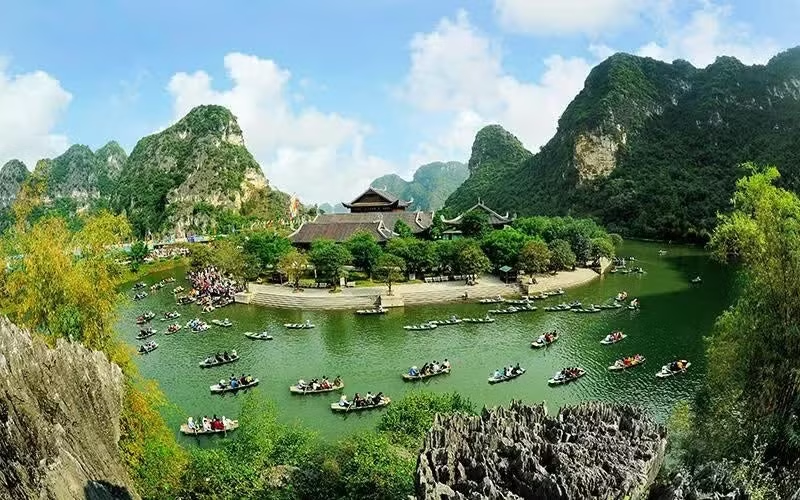
In recent years, Ninh Binh has combined conservation with development, with management involving the state, businesses, and communities. Local people have both directly protected heritage and benefited from tourism activities.
Heritage becomes products and services that create livelihoods
Tran Song Tung, Member of the Standing Board of the Provincial Party Committee and Permanent Vice Chairman of the People's Committee of Ninh Binh Province, said that following the merger, the province has a development space of nearly 4,000 square kilometres, a population of more than 4.4 million, and a cultural resource system of outstanding scale, density, and diversity. The province currently has 5,071 inventoried heritage sites, 1,114 of which have been officially recognised, including one world cultural and natural heritage site, one representative intangible cultural heritage of humanity, 10 special national relic sites, 269 national relic sites, and 835 provincial-level relic sites, along with 22 national treasures and 42 national intangible cultural heritages. These constitute cultural capital for the development of tourism, cultural industries, and the creative economy.
Tourism is the sector that most clearly demonstrates this transformation. In 2025, the province welcomed more than 19.4 million visitors, up 26.61% from 2024, including more than 2.2 million international visitors. Total tourism revenue exceeded 21,238 billion VND, up 36.72%. In the first eight months of 2026, the number of visitors to tourism sites and attractions reached approximately 19.8 million, up 24.1%, including more than 2.2 million international visitors. Total revenue was estimated at more than 20,611 billion VND, up 23.4% year on year.
More importantly, tourism has generated spillover effects across transport, accommodation, trade, cuisine, agriculture, traditional craft villages, the arts, and creative services. Local people earn incomes from the values they have preserved and have become genuine stakeholders in the process of conservation and development. This provides the conditions for the relationship between heritage conservation and economic growth to develop in a positive and sustainable direction.
Breakthroughs in institutions to remove bottlenecks
In reality, Ninh Binh still has relatively few high-value-added products, while visitor spending and length of stay do not fully reflect the appeal of its heritage system. Links between heritage, tourism, cultural industries, trade, and craft villages remain insufficiently strong. Some heritage spaces face localised overcrowding during peak seasons, while many areas rich in resources have not been effectively connected. Recognising these bottlenecks, the Executive Board of the Provincial Party Committee issued Resolution No. 07-NQ/TU (dated January 30, 2026) on the Strategy for the Development of Cultural Industries and Tourism in Ninh Binh Province until 2030, with a vision to 2045. The province has determined that the development of the heritage economy must follow the principles that conservation is the foundation; creativity increases value; local people are at the centre and are the key stakeholders; businesses are the driving force; and the state creates the framework as well as governs and regulates benefits.
For many years, the province has incorporated integrated heritage conservation into urban and rural planning, tourism, transport, and the green economy, while identifying protection zones, carrying capacity, architectural and environmental standards, and mechanisms for project control. The province will connect cultural, historical, belief, and ecological centres into complementary product corridors. This approach will both expand the value chain and extend visitors' stays, while redistributing the flow of visitors, reducing pressure on key areas, and improving the economic efficiency of heritage.
The province is currently focusing on completing mechanisms for mobilising resources and reinvesting in heritage conservation. Accordingly, the state budget will focus on planning, conserving core values, essential infrastructure, data, and tasks that the private sector cannot replace. Social resources will be mobilised through public-private partnerships, commissioned services, the lawful use of public assets, and business models that are compatible with the value and carrying capacity of heritage sites.
Developing the heritage economy does not mean exploiting heritage at all costs but it means organising the process so that cultural values are preserved, creatively developed and responsibly circulated within the economy. When heritage values generate products, jobs, and revenue, and that revenue is subsequently reinvested in conservation, a sustainable cycle will be formed. Many localities hope that a legal framework for the heritage economy will soon be established, particularly regarding mechanisms for public-private partnerships and the use of public assets associated with heritage. Developing a set of indicators to measure the contribution of the cultural and heritage economies to growth will also create corresponding growth momentum, turning “heritage into assets” in localities.