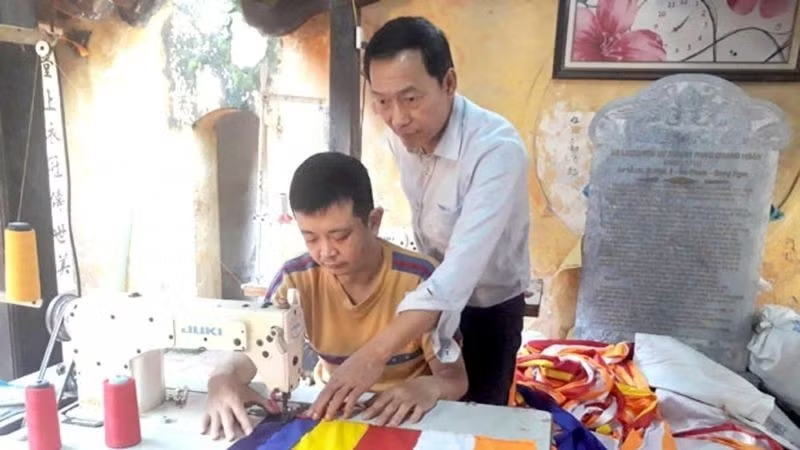
According to statistics, Viet Nam currently has more than 7 million persons with disabilities, accounting for 7.06% of the population aged two and above. Of this number, 58% are women; 28.3% are children; and nearly 29% are classified as having severe or extremely severe disabilities. Viet Nam is among the countries with a relatively high rate of disability in the Asia–Pacific region and worldwide.
At the international level, Viet Nam has demonstrated consistent commitments to advancing the rights of persons with disabilities: it has signed and ratified the United Nations Convention on the Rights of Persons with Disabilities; ratified ILO Convention No. 159 on Vocational Rehabilitation and Employment (Disabled Persons); and joined the Marrakesh Treaty to expand access to books and printed works for people with visual impairments.
These steps reflect Viet Nam’s determination to ensure inclusion and prevent discrimination against persons with disabilities.
As Minister of Health Dao Hong Lan, Chairwoman of the National Committee on Persons with Disabilities in Viet Nam, said at a disability-related event in early December, caring for, protecting, and promoting the rights of persons with disabilities has always received special attention from the Party and the State. This is a consistent policy that has been implemented continuously over the years.

Speaking with Nhan Dan Newspaper, Dinh Thi Thuy from the Department of Social Protection under the Ministry of Labour, Invalids and Social Affairs (now the Ministry of Home Affairs) stressed that the entire system attaches great importance to persons with disabilities, supported by a range of policies to safeguard their rights.
Thuy suggested strengthening and streamlining the operations of specialised social associations representing the disability community in a consistent manner from the central level down to localities. She noted that the model of the Ha Noi Association of Persons with Disabilities, recognised by the Ha Noi People’s Committee as a specialised association and permitted to operate down to commune and ward level could serve as a useful reference.

Dinh Thi Quynh Nga, Chairwoman of the Board and Director of the Pink Heart Cooperative (Ha Noi), where 60 workers are persons with disabilities – accounting for 87% of the cooperative’s total workforce – shared that key barriers today remain workplace infrastructure, transport infrastructure, and insurance. In addition, vocational training support is still limited.
In discussions, Standing Vice Chairman of the Viet Nam Federation on Disability, said the federation’s activities are wide-ranging and diverse, focusing on helping draft and contribute to amendments to disability-related laws and policies to make them more practical and monitoring the implementation of the Law on Persons with Disabilities and the international convention on the rights of persons with disabilities. In addition, it also provides training on policy advocacy as well as policy dissemination and legal counselling for persons with disabilities – particularly mobilising resources to help them secure livelihoods, access free vocational training and find jobs, so they can proactively integrate into society.
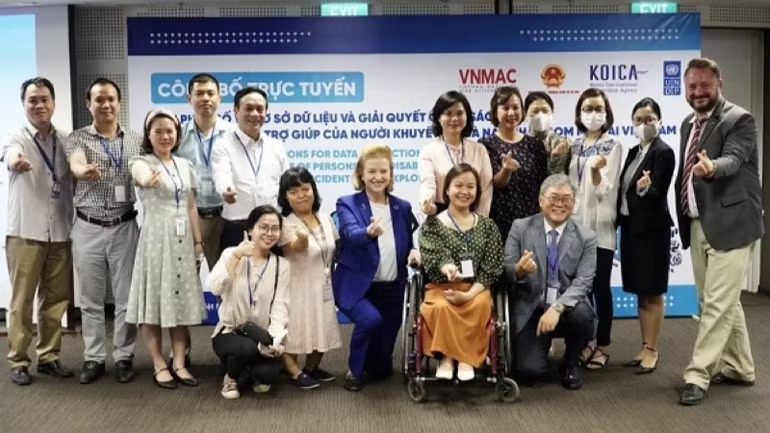
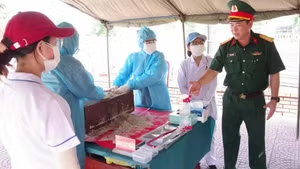
Meanwhile, in another exchange, Major General Nguyen Dinh Hien, Director General of the National Action Center for the Remedy of Chemical and Environmental Consequences (NACCET) and Commander of the Chemical Corps under the Ministry of National Defence, emphasised that for the Viet Nam People’s Army, caring for persons with disabilities, war invalids, sick veterans, and victims of Agent Orange/dioxin is not only a political task but also “a command from the heart” – a reflection of the ethic of gratitude and the traditions of “Uncle Ho’s Soldiers” over the past 81 years.
According to Major General Nguyen Dinh Hien, Viet Nam is among the countries most severely affected by war. Millions of persons with disabilities, including victims of Agent Orange/dioxin, continue to face long-lasting impacts across generations.
Viet Nam is among the countries most severely affected by war. Millions of persons with disabilities, including victims of Agent Orange/dioxin, continue to face long-lasting impacts across generations.
Major General Nguyen Dinh Hien, Director General of NACCET and Commander of the Chemical Corps under the Ministry of National Defence
“Facing that reality, with the attention of the Party, the State, and the Ministry of National Defence, we have always regarded the care and support for persons with disabilities – especially victims of Agent Orange – as an honourable mission and a sacred responsibility of the Viet Nam People’s Army toward the people,” he said.
It is clear that promoting an inclusive society for persons with disabilities is not the task of a single sector, a single organisation, or a single day of the year. It is a long-term journey for society as a whole.
With the Party and State’s attention, the engagement of authorities at all levels, and the determination of persons with disabilities themselves, Viet Nam can move toward building a society where no one is left behind – where every person has the opportunity to contribute according to their abilities.