This is not only a core task of the banking sector but also a strategic lever enabling enterprises to transform their business models, thereby contributing to the realisation of the goal of ushering the economy into a new phase of development.
From strategic orientation to enabling action
Building on the achievements of previous terms, the Resolution of the 14th National Party Congress has identified the development of a green economy and a circular economy as a strategic choice and one of the key pillars for propelling the country into a new era of nation’s rise. To realise this vision, the Government has resolutely directed the implementation of Decision No. 1658/QD-TTg on the National Green Growth Strategy for the 2021–2030 period, with a vision to 2050. Viet Nam’s strong commitments at COP26 have now been translated into measurable, highly enabling actions by state management agencies.
As the “lifeblood” of the economy, the State Bank of Viet Nam has taken early and concrete action. Beyond merely supplying capital, it has issued numerous monetary and credit mechanisms and policies that integrate environmental protection considerations, thereby guiding and directing social capital flows into green and clean production sectors.
Breakthroughs from practical governance
Despite facing challenges related to financial resources and market awareness, the banking sector has made efforts to achieve breakthroughs in completing the legal framework and implementing specialised credit programmes.
By the end of 2025, total outstanding loans for green sectors had reached nearly 780 trillion VND. Although accounting for 4.19% of total outstanding credit, the impressive growth rate (14.62% in 2025) reflects a positive shift. This transformation bears a strong imprint of Decision No. 21/2025/QD-TTg of the Prime Minister on green classification criteria.
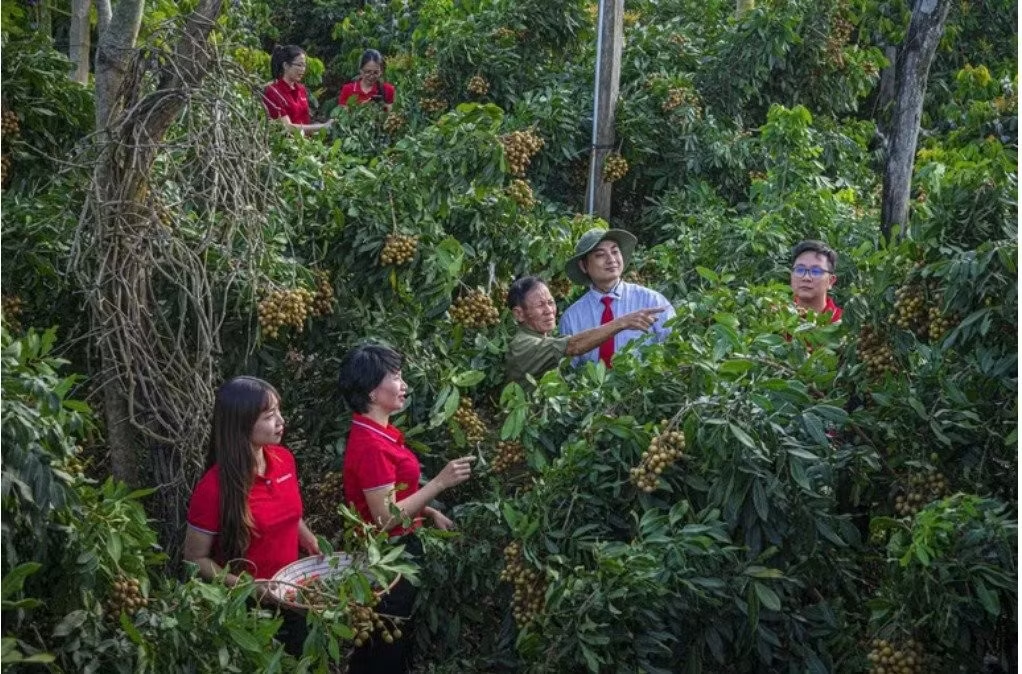
In implementing Resolution No. 198/2025/QH15 of the National Assembly, the State Bank of Viet Nam is advising on policies to support an interest rate subsidy of 2% per year for the private sector implementing green projects. The application of Environmental, Social, and Governance (ESG) standards has become an inherent requirement of the system.
Credit programmes for high-tech agriculture, value chain-based OCOP production, and high-quality, low-emission rice projects in the Mekong Delta (under Decision No. 1490/QD-TTg) demonstrate flexible governance, with preferential interest rates not exceeding 4% per year for priority sectors.
Agribank: The leading force in green agricultural credit
Within this overall picture, the Vietnam Bank for Agriculture and Rural Development (Agribank) has emerged as an exemplary model. Vuong Van Quy, Deputy Head of Agribank’s Credit Policy Department, affirmed that, as a key state-owned commercial bank in the agricultural and rural sector, Agribank has prioritised allocating capital to sustainable projects, renewable energy, and high-tech applications.
Currently, Agribank is vigorously implementing major credit packages: a high-tech agriculture lending package of at least 50 trillion VND; a 10-trillion-VND green credit package for individual customers; and a 2-trillion-VND OCOP credit package.
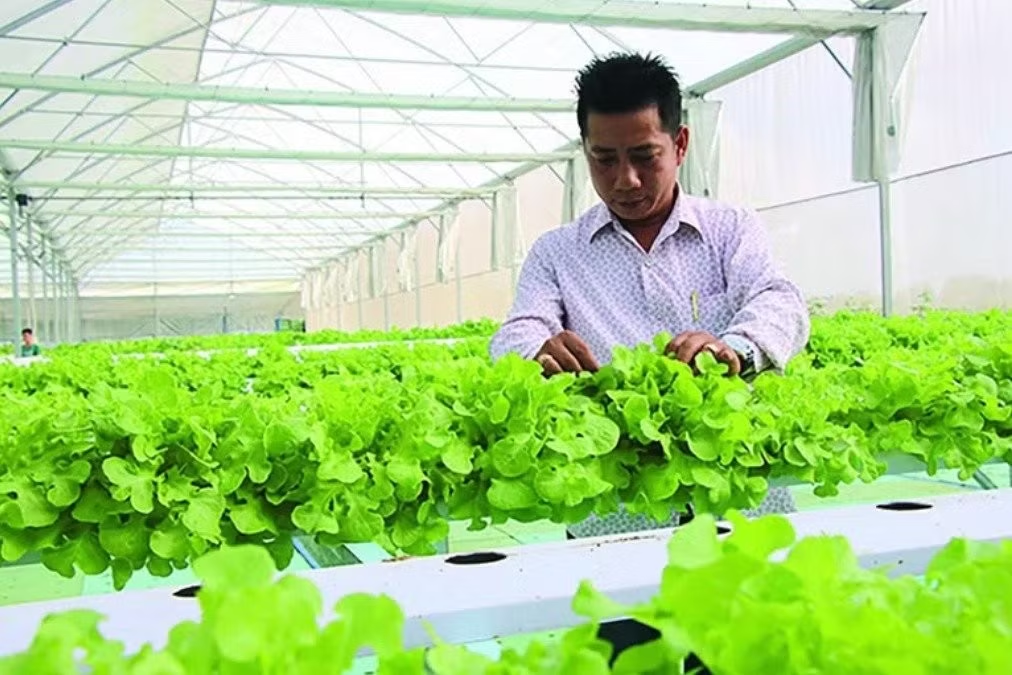
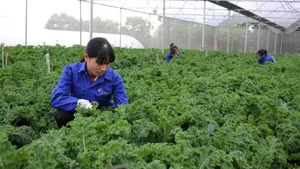
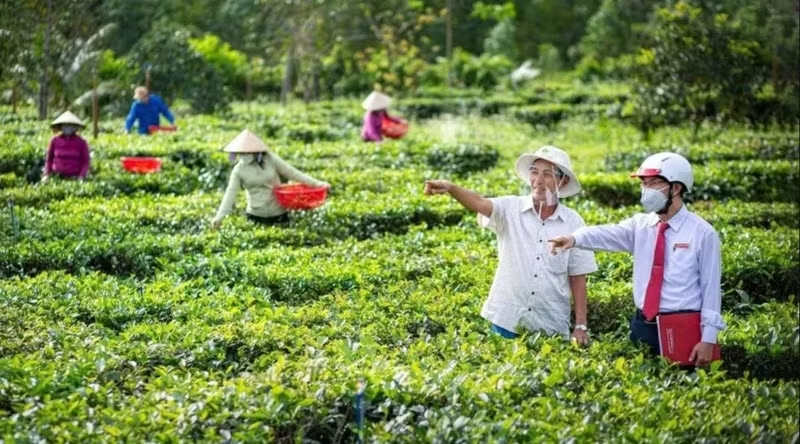
Large-scale model fields and circular farms from the Central Highlands and the Mekong Delta to suburban areas of Ha Noi and Ho Chi Minh City, supported by Agribank capital, provide vivid evidence of policy being translated into practice. On this foundation, Vietnamese agricultural enterprises are presented with opportunities to enhance productivity; meet stringent standards of the EU, Japan, and the US; and transform strongly on the basis of digital trade.
The need for synchronised and systemic solutions
Despite many positive outcomes, bottlenecks remain: the legal framework for environmental risk management is still being refined; international green capital, though abundant, involves stringent procedures; and there is a shortage of specialised human resources in sustainable finance.
To effectively and sustainably promote green credit and organic agricultural credit, the Government, ministries, sectors, and the State Bank of Viet Nam need to continue implementing comprehensive and systemic support solutions. Accordingly, it is necessary to strengthen connections between Agribank and other banks with international green financial funds to access medium- and long-term capital at preferential costs; while continuing to refine and issue policies to promote the development of green economic sectors and create favourable conditions for credit institutions to expand lending for environmentally friendly projects.
At the same time, communication efforts to raise public awareness of green consumption, the green economy, and sustainable development should be intensified, alongside the establishment and effective operation of a carbon market. For the State Bank of Viet Nam, it is essential to issue a complete legal framework for environmental and social assessment; develop ESG databases to support appraisal and risk management; and coordinate with international organisations to train and enhance professional capacity in sustainable finance and ESG for banking staff.
In practice, in recent years, the State Bank of Viet Nam’s monetary and green credit solutions have not merely been economic instruments, they have been a concrete manifestation of the Party’s will to build an independent and self-reliant economy associated with environmental protection.
In the 2026–2030 period, with support from preferential policies and the proactiveness of the banking system, green financial resources will continue to be unlocked, creating strong momentum for the country to successfully achieve the goals set out in the Resolution of the 14th National Party Congress, enabling Viet Nam to confidently enter a new phase of robust and sustainable development.