Movement from the grassroots
In Vung Tau Ward, the model of commune-level police ensuring urban order has been implemented methodically, with the participation of the entire political system. Vo Van Thanh Sang, Vice Chairman of the Ward People’s Committee, emphasised that this work has a significant impact on socio-economic life, especially tourism, thereby contributing to the restoration of urban discipline.
In Di An Ward, enforcement campaigns have been carried out simultaneously, focusing on urban order “hotspots”. Functional forces not only handle violations but also require business households to sign commitments and mobilise them to remove non-compliant awnings and signage. Illegal parking areas have also been fully addressed.
Tran Thi Thanh Thuy, Vice Chairwoman of the Ward People’s Committee, said that after administrative unit merger, Di An has a large population, rapid urbanisation, and serves as an important transport hub. Therefore, restoring urban discipline has been identified as an important task to support sustainable socio-economic development goals of the locality.
In Phuoc Thang Ward, an area once considered a “hotspot” for illegal construction, after the merger and the implementation of a two-tier local governance model, authorities have decisively handled 160 violations related to urban order and construction.
Nguyen Viet Dung, Chairman of the Di An Ward People’s Committee, affirmed: “Our consistent viewpoint is not to tolerate violations; however, in the handling process, we must also ensure the legitimate rights of residents.” Thanks to this firm but flexible approach, no new violations have arisen in the locality in the first three months of 2026.
Located at the western gateway of the city, with a large population, An Lac Ward has long faced challenges in managing urban order due to a high number of small-scale business households and many spontaneous markets that have existed for decades.
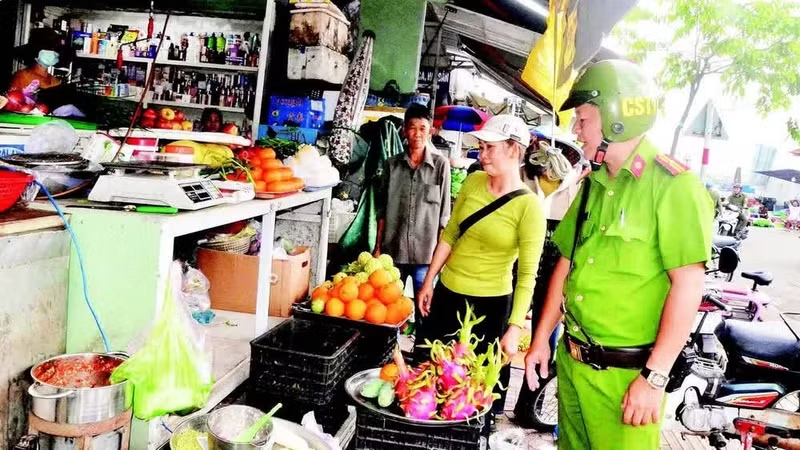
Determined to address this issue, the authorities have combined “strict enforcement” with “persuasion and support”. Business households are guided to reorganise their activities without encroaching on pavements, while those in difficult circumstances are considered for appropriate support. The most notable difference in An Lac Ward’s approach is in post-inspection.
After restoring order, functional forces continue to closely monitor the area and promptly handle any new violations, preventing a recurrence of the situation in which violations are cleared only to be re-encroached upon. The clear changes seen in Vung Tau, Phuoc Thang, An Lac wards and many other localities demonstrate strong determination at the grassroots level in restoring urban order.
Synchronising solutions
Alongside local authorities, since mid-March, Ho Chi Minh City Police have piloted a commune-level police model to ensure urban order. According to Lieutenant Colonel Vo Hong Bao, Deputy Head of the Police Department for Administrative Management of Social Order under the Ho Chi Minh City Police, the pilot implementation is one of the key tasks. After just over a month of reviewing roads as well as areas around hospitals, schools, and markets, the initial results show that many areas have seen positive changes, with a significant improvement in public order.
Lieutenant Colonel Vo Hong Bao stressed that a notable aspect of this approach is the shift in mindset: instead of short-term campaigns, it is being implemented with a long-term orientation, addressing root causes. The city police aim not only to restore discipline but also to improve residents’ quality of life. Notably, during implementation, most residents have understood and supported the effort. Coordination among different levels and sectors has been strengthened, and the role of leaders has been enhanced.
Vice Chairman of the Ho Chi Minh City People’s Committee Bui Xuan Cuong said that after administrative unit merger, the city has more than 14 million residents and over 13 million personal vehicles. While the efforts of functional agencies have brought positive changes, re-encroachments on pavements still occur. The city will tighten discipline, strictly handle the responsibility of leaders if prolonged violations occur, strengthen inspection and supervision, and complete regulations on the transparent and public use of pavements.
Colonel Nguyen Dinh Duong, the deputy director of the city police, emphasised that restoring urban order must adhere to the principles of “transparency, objectivity, no avoidance, no favouritism, but flexibility and reasonableness.” The city focuses not only on handling violations but also on ensuring people’s livelihoods.
Solutions such as arranging appropriate business locations and organising legal parking areas are being studied and implemented, while communication and public awareness campaigns continue to be identified as key tasks. The city also encourages the promotion of “self-managed pavements” models, mobilising the participation of the Fatherland Front, mass organisations, and local communities in monitoring and maintaining urban order.
Practical implementation shows that efforts to restore order and improve the urban landscape in Ho Chi Minh City are on the right track: firm but not extreme, strict but humane. Effective grassroots models, coordination action across the political system, and the sense of responsibility of leaders have created visible changes.
The journey to build a civilised, modern, and compassionate urban area cannot be completed overnight. However, with a methodical approach that places people at the centre and harmonises discipline with support, the city is gradually addressing long-standing challenges. This forms a sustainable foundation for Ho Chi Minh City to grow into a highly liveable urban centre in the future.