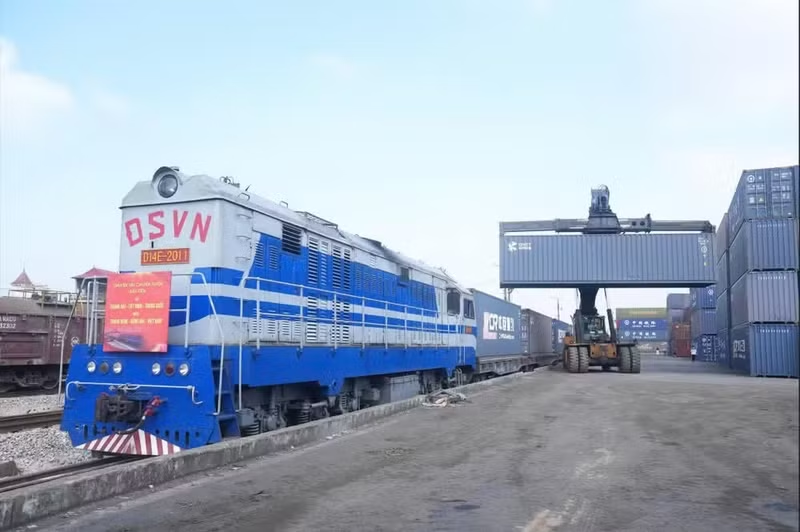
From dedicated trains running deep into the hinterland
International intermodal railway transport between Viet Nam and China has recorded continuous double-digit growth in recent times. In 2025 alone, intermodal transport volume reached more than 1.43 million tonnes, up nearly 24% from the previous year, becoming one of the fastest-growing areas of the railway sector.
In early June 2026, the first dedicated international freight train departing from Qinghai province in China arrived in Viet Nam. After completing necessary procedures, the cargo continued to be transported to Dong Nai, directly connecting with industrial centres in the southern region.
At the same time, the railway sector is planning to operate more dedicated freight trains. What is noteworthy about this model is that goods are transported continuously from deep inside China to Viet Nam, significantly reducing transshipment stages that often increase costs and prolong delivery time.
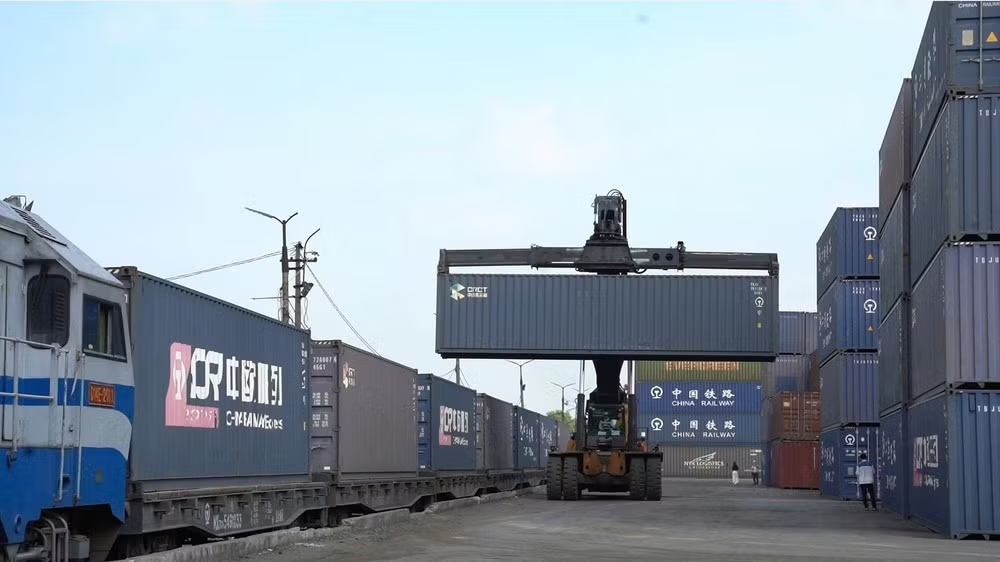
Optimising logistics efficiency: The challenge of cutting time and costs
For logistics and import-export enterprises, the core benefit of the direct and seamless dedicated train model lies in supply chain optimisation. Previously, under traditional transport methods through disconnected stations, goods had to be repeatedly loaded, unloaded and transshipped, pushing up costs and wasting time. A less-than-container-load shipment from Qinghai province to Ha Noi would normally take around 12 to 15 days.
Yang Song, Director of Songying Tay Ninh Supply Chain Co., Ltd. in Qinghai province, China, the pioneering company operating this train route, said: “The biggest advantage of the direct train is that it helps businesses save significantly in both time and costs.”
Thanks to seamless operation, the travel time from Qinghai to Ha Noi has been shortened to only about four days. The total transport time from Qinghai province to Ho Chi Minh City now takes just seven days.
According to Yang Song, once the route is operated stably, logistics costs could be reduced by 10-20%, depending on the type of goods, thereby enhancing the competitiveness of enterprises in both countries.
Expanding the Viet Nam-China logistics corridor
As Viet Nam’s logistics costs still account for around 15-20% of GDP, promoting the role of railways is seen as an important solution to reduce pressure on road transport, while improving the efficiency of seaports and logistics centres.
At present, the North-South railway line connects major logistics hubs such as Song Than, Trang Bom, Dieu Tri, Da Nang, Vinh, Giap Bat and Yen Vien. Meanwhile, the international intermodal system through Dong Dang and Lao Cai enables Vietnamese goods to connect with China, Central Asia and Europe.
However, railway transport currently accounts for only around 1-2% of the market share, showing that there remains vast room for development if infrastructure and logistics connection points are invested in synchronously.
According to Nguyen Chinh Nam, Deputy General Director of the Viet Nam Railways Corporation, the goal in the coming time is not only to increase the number of international intermodal trains, but also to form cross-border logistics corridors with large and stable transport capacity.
Key projects such as the Lao Cai-Ha Noi-Hai Phong railway line, the upgrading of the Ha Noi-Dong Dang line, and logistics centres at Yen Vien and Song Than will play an important role in connecting goods from industrial parks and seaports to the Chinese and international markets.
Nam said that, along with new infrastructure projects under implementation, the railway sector is also actively preparing human resources, technology and international cooperation to meet growing transport demand between Viet Nam and China.
The emergence of dedicated trains running from deep inside China to Viet Nam is not merely the opening of a new transport route. It is a signal that railways are gradually affirming their position in the national logistics chain, while expanding the space for economic cooperation between Viet Nam and China.
Once strategic infrastructure projects are completed and the multimodal logistics network is synchronously connected, railways will have the opportunity to become one of the important transport pillars of the economy.