Identifying challenges and opportunities to build growth scenarios
An overview of the first quarter of 2026 shows that the international landscape has been affected by a number of adverse factors, particularly geopolitical tensions in the Middle East, which have driven up fuel prices. This has in turn led to higher costs for air transport and tourism services.
Although visitors from the Middle East account for only around 0.2% of Viet Nam’s total international arrivals, the indirect impacts on consumer sentiment, travel spending, and business operations have been quite evident.
Against this backdrop, the Viet Nam National Authority of Tourism has identified several key opportunities to stimulate growth, including the trend of international travellers shifting towards safer, closer, and more affordable destinations; increasing flows from nearby markets; and opportunities for Viet Nam to further reinforce its image as a safe, friendly, and attractive destination.
At the same time, the sector faces challenges such as rising airfares, disruptions to international flight routes, tightening global spending trends, and fierce competition from other Southeast Asian countries in terms of visa policies, promotion, and demand stimulation.
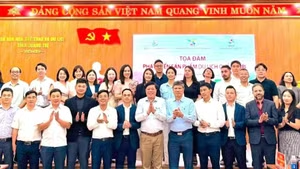
Nguyen Trung Khanh, Head of the Viet Nam National Authority of Tourism, said: “The Viet Nam National Authority of Tourism has proactively prepared reports in line with assigned tasks, focusing on growth scenarios and key tasks and solutions for the tourism sector in 2026 and the 2026–2031 period.”
Based on an analysis of favourable and unfavourable factors, the authority has developed two growth scenarios for 2026.
Under the high-growth scenario, assuming early stabilisation of the global situation, controlled conflicts, and effective support measures, the sector aims to meet the Government’s targets of 25 million international arrivals, 150 million domestic tourists, and total revenue of 1,125 trillion VND.
In this scenario, the first quarter has already recorded more than 6.7 million international arrivals and 37 million domestic tourists. The second quarter is projected to reach about 5.6 million international arrivals and 44 million domestic tourists; the third quarter, 5.6 million and 45 million respectively; and the fourth quarter, around 7 million international arrivals and 24 million domestic tourists.
The alternative scenario assumes prolonged geopolitical tensions, continued global economic slowdown, or the emergence of natural disasters and epidemics. In this case, the sector is expected to reach around 22.5 million international arrivals and 130 million domestic tourists.
Under this scenario, the second quarter is projected to record about 5 million international arrivals and 35 million domestic tourists; the third quarter, approximately 4.8 million and 35 million respectively; and the fourth quarter, about 5.9 million international arrivals and 23 million domestic tourists.
The Viet Nam National Authority of Tourism has proposed continuing a comprehensive review of the implementation of Politburo Resolution No. 08, while improving visa policies to make them more convenient and flexible for potential markets and high-spending visitor segments. It also recommends launching national-scale tourism stimulus programmes and establishing Viet Nam tourism promotion offices in key overseas markets.
Shifting mindset, governance methods, and target approaches
According to Deputy Minister of Culture, Sports, and Tourism Ho An Phong, the tourism sector has recently emerged as a bright spot in the country’s socio-economic landscape, playing a pioneering role in driving recovery. However, as it enters a new development phase, the scope for extensive growth is narrowing, requiring a fundamental shift in mindset, governance, and approaches to targets.
“In the initial period after the Covid-19 pandemic, high growth rates were expected due to a low base and strong market rebound. But as the sector expands, maintaining high growth becomes much more difficult. Growth must increasingly rely on quality, efficiency, and real value added,” he said.
In this context, the sector can no longer focus solely on visitor numbers but must shift towards economic contribution, growth quality, and overall efficiency. The key is not just how many visitors arrive, but how much they spend, how long they stay, how tourism benefits other sectors, its contribution to GDP, and the sustainability of destinations.
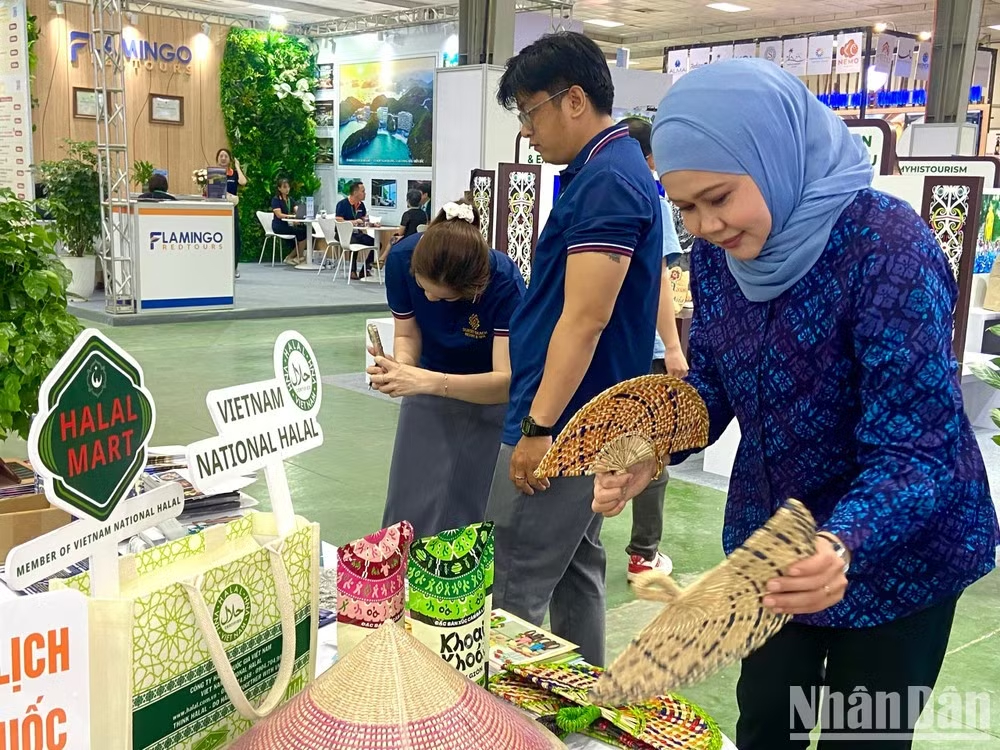
Based on this orientation, the sector needs to restructure its product system towards high-quality segments, increase the proportion of 4–5 star accommodation, and develop premium resort products, high-quality entertainment, specialised tourism transport, and value-added services.
Ho An Phong noted that the same resources can generate vastly different economic outcomes if they are developed into high-quality products, positioned correctly, and sold at higher value, while also reducing pressure on the environment and infrastructure. This is the necessary path for sustainable tourism development in the coming period.
At the same time, a new statistical indicator system should be developed to fully reflect tourism’s real contribution to the economy. Beyond accommodation revenue, it should measure spillover effects across aviation, transport, telecommunications, finance, retail, real estate, food services, and related sectors. Only by quantifying tourism’s full contribution to GDP can growth be managed scientifically.
In terms of markets, the sector should continue its strategy of diversifying international markets while placing particular emphasis on the domestic market as a key driver of consumption and local economic value chains.
Viet Nam has gradually expanded into potential regions such as South America, South Asia, and emerging markets. India continues to grow exponentially, the Russian market is recovering strongly, while Northeast Asia remains a core source of international arrivals. Amid global uncertainties, prioritising nearby markets with strong recovery potential and convenient connectivity is considered an appropriate strategy.
The tourism sector can no longer focus solely on visitor numbers but must shift towards economic contribution, growth quality, and overall efficiency. The key is not just how many visitors arrive, but how much they spend, how long they stay, how tourism benefits other sectors, its contribution to GDP, and the sustainability of destinations.
Deputy Minister of Culture, Sports and Tourism Ho An Phong highlighted the clear effectiveness of open and flexible visa policies, describing them as a key lever for market expansion. However, he stressed that any proposal to broaden visa policies must be carefully prepared, with detailed impact assessments for each market segment and each level of visa exemption, to ensure practical effectiveness and strong grounds when advising the Government.
The sector must clearly define growth responsibilities for each locality, industry, and service area, including identifying key tourism destinations and setting specific KPIs for accommodation, revenue, transport, products, entertainment, and visitor growth, along with monitoring and evaluation mechanisms.
In addition to traditional growth drivers, new areas should be further explored, including rail, inland waterway and cruise tourism, medical and wellness tourism, agricultural tourism, and MICE tourism.
In particular, cross-border rail tourism with China and further to Europe should be developed through themed routes, transnational tours, and iconic travel experiences. For waterway and cruise tourism, it is essential to integrate tourism services and develop dedicated logistics ecosystems to fully leverage Viet Nam’s maritime and riverine advantages.