Pham Sy Liem, Vice Chairman of Vietnam General Association of Construction, granted an interview to a Nhan Dan (“The People”) reporter on the issue of traffic congestion in major urban areas.
Q: How do you assess the traffic congestion in Hanoi and Ho Chi Minh City in recent years?
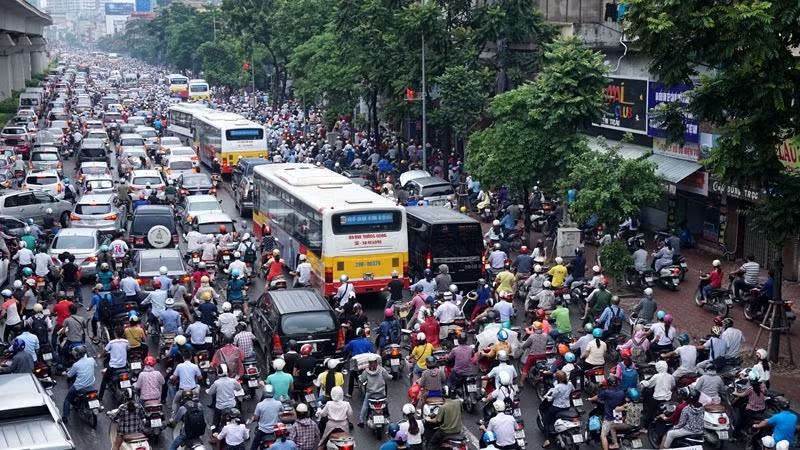
A: The traffic congestion in the two cities is more and more serious in terms both of space and of time. To date, suitable measures to solve the problem have not been taken.
Q: Although numerous measures have been proposed, they have not been synchronously implemented, resulting in an inefficient use of State resources and dissatisfaction among the people. What do you think about this?
A: Traffic congestion in urban areas is a global problem that has been studied by policymakers and scholars around the country for many years.
International experience has shown that it is essential to comprehensively and methodically survey the real situation in order to gain a thorough acquaintance with the causes of congestion in each area.
Measures can be divided into strategic and operational groups, and making plans is the most important strategy, including land use and transportation planning. For example, the plan for the construction of the Royal City urban area was not developed in concert with the transportation plan for the areas around Nga Tu So, and a 50-storey building at the Giang Vo Exhibition Centre is being built while Ngoc Khanh Street and the Giang Vo–De La Thanh junction are very narrow, which certainly causes serious traffic jams.
In recent years, flooding due to heavy rains and high tides have also caused traffic congestion; therefore, planning for drainage and dealing with high tides is in need of urgent implementation.
Q: Hanoi has recently proposed limitations on individual personal vehicles to reduce traffic congestion. However, it is very necessary to ensure favourable conditions for commuters, particularly alternative public transportation. What do you think about this?
A: All people and the authorities see the importance of using public transportation instead of personal vehicles; however, the rapid bus project was halted after only building bus stations, and the progress of the elevated railway project is very slow.
Q: In your opinion, which solutions do Hanoi and Ho Chi Minh City need to implement to reduce traffic congestion?
A: Both cities are enjoying strong development and have become “global cities,” or hubs of the global economy in Vietnam.
Traffic congestion is a factor with a great impact on the competitiveness of the two cities. In order to solve this problem, the authorities should set out a comprehensive system of measures rather than separate ad hoc solutions. International experience is very useful in planning and raising social awareness at a time when commuting requires a great deal of time and patience.
Q: How do you forecast the traffic situation in these two major urban areas in the time ahead?
A: In management work, it is very essential to “walk the walk,” which will decide whether the traffic situation will get better or worse. However, as demonstrated by the experiences of developed countries, the realities of urban traffic are constantly changing, creating new challenges for those managing it.
Thank you very much!

Pham Sy Liem, Vice Chairman of Vietnam General Association of Construction