Persistent bottlenecks
One of the most visible constraints on logistics development in the North Central Region is the limitation of transport infrastructure.
In Thanh Hoa Province, many east–west routes have yet to meet expressway standards. Several mountainous sections are characterised by steep gradients and tight curves, restricting the movement of heavy-duty and oversized cargo vehicles. Similarly, National Highway 7 in Nghe An Province has not kept pace with rapidly growing freight demand.
Meanwhile, in the Vung Ang Economic Zone and the Cau Treo International Border Gate Economic Zone (Ha Tinh Province), both intra- and inter-regional transport infrastructure remain poorly synchronised. The remaining industrial land bank is also limited, falling short of demand for large-scale industrial investment.
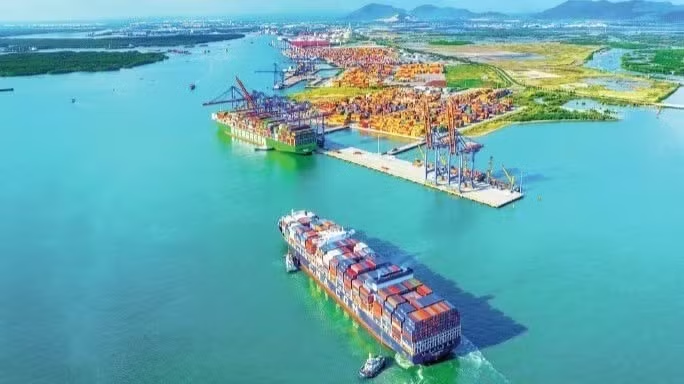
Logistics infrastructure across the region also faces considerable shortcomings. The Nghi Son port area (Thanh Hoa) lacks a dedicated container terminal, with cargo handling still conducted at general-purpose berths using insufficient specialised equipment. This results in prolonged loading times and higher costs for businesses. Container shipping frequency remains low, while the imbalance between exports and imports forces companies to reposition empty containers from Hai Phong, further increasing logistics costs.
Both Nghe An and Quang Tri provinces lack large-scale logistics centres capable of coordinating inter-regional flows. Cua Lo Port has yet to attract direct international shipping routes, meaning that most cargo must still be transshipped via northern ports.
The lack of multimodal connectivity — particularly between railways, inland waterways, and seaports — means that goods are predominantly transported by road. Surveys indicate that many enterprises in Thanh Hoa and Nghe An continue to export via Hai Phong Port due to more competitive costs and shorter transit times compared to ports in the North Central Region.
Although administrative procedures have improved, challenges remain. At several border gates, customs clearance times are inconsistent, and the application of digital technologies is not yet fully synchronised.
Coordinated solutions for breakthroughs
In response to these challenges, local authorities have been proactively implementing a range of solutions to better leverage the East–West corridor.
According to Mai Xuan Liem, Standing Vice Chairman of the Thanh Hoa Provincial People’s Committee, the province is continuing to study investment in transport links connecting Thanh Hoa with the north-western region and neighbouring Laos, while upgrading Tho Xuan Airport with a view to becoming an international airport.
At the same time, Thanh Hoa is accelerating the development of the Nghi Son seaport system, with a focus on container terminals, specialised ports, and dredging shipping channels. The province is also considering plans for a general port on Me Island to expand development space. Alongside infrastructure investment, Thanh Hoa is strengthening cooperation with Houaphanh Province (Laos), promoting trade facilitation, developing bonded warehouses and logistics services, and reforming import–export procedures.
Meanwhile, Nghe An is pursuing a more structured approach through a long-term logistics development strategy. Nguyen Manh Loi, Deputy Head of the Southeast Economic Zone Authority, noted that the province is prioritising infrastructure development, with Cua Lo deep-water port identified as a key project capable of accommodating vessels of up to 100,000 tonnes.
Transport projects such as the Vinh–Thanh Thuy expressway and the upgrading of National Highway 7 are also being accelerated. Once completed, these routes will form a seamless transport corridor linking seaports to border gates, significantly reducing logistics costs.
Nghe An is developing a logistics model based on a “hub–satellite–border” structure to optimise cargo flows and enhance supply chain efficiency. The province is also encouraging enterprises to use local logistics services to form integrated service chains.
Pham Van Hoa,
Director of the provincial Department of Industry and Trade
Notably, Nghe An aims to attract investment in high-tech industries such as electronics, semiconductors, and precision engineering to generate stable cargo flows for the logistics sector. At the same time, it is stepping up administrative reform, promoting digital customs, and designing incentive policies to attract major logistics corporations.
Ha Tinh Province is expediting procedures to expand the Vung Ang Economic Zone while proposing the establishment of a free trade zone to capitalise on its strategic geographical advantages, including the Vung Ang–Son Duong deep-water port complex and favourable transport connections.
According to Tran Viet Ha, Head of the Ha Tinh Economic Zone Authority, the Cau Treo International Border Gate Economic Zone is being developed into a hub for high-tech agriculture and forestry associated with ecological landscapes, alongside border trade, eco-tourism, industry, handicrafts, and logistics, while ensuring harmony with socio-cultural factors and promoting Viet Nam–Laos economic cooperation.
In Quang Tri Province, efforts are focused on developing multimodal infrastructure. Priority is being given to National Highway 15D — the shortest route connecting My Thuy Port to La Lay border gate — to reduce transport distances and enhance competitiveness.
The province is also implementing major projects such as the Cam Lo–Lao Bao expressway, upgrading National Highway 12A, and studying the development of the My Thuy–Lao Bao railway, gradually completing a multimodal transport network. A key breakthrough initiative is the Lao Bao–Densavan cross-border trade economic zone, which is expected to evolve into an international logistics and trade hub in central Viet Nam.
Le Duc Tien, Vice Chairman of the provincial People’s Committee, emphasised that to fully unlock the East–West corridor, Viet Nam, Laos, and Thailand need to harmonise technical standards, transport procedures, and data connectivity to shorten customs clearance times and reduce costs.
At the same time, promoting green logistics and digital transformation will be essential. The application of technology in warehousing, transport, and customs management can help optimise operations, reduce costs, and enhance competitiveness.
Provinces in the North Central Region are increasingly strengthening cooperation to build an integrated logistics value chain. Rather than competing individually, they are moving towards functional specialisation based on strengths in bulk cargo, energy products, minerals, and containerised goods.
This approach not only optimises resources but also helps establish a logistics network strong enough to attract multinational transport corporations. At the same time, institutional reforms are needed to create a transparent and conducive investment environment to draw major logistics enterprises to the region.
Once large-scale, multimodal logistics centres are established, the North Central Region will be better positioned to integrate more deeply into global supply chains. The removal of bottlenecks and the implementation of coordinated solutions are opening up significant opportunities for logistics development in the region. With improved infrastructure, enhanced institutions, and stronger regional linkages, the East–West corridor is set to become a key growth driver, positioning the North Central Region as a major international trade gateway for Viet Nam.