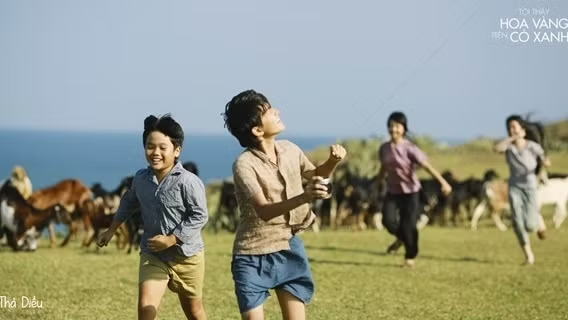
A thriving year for Vietnamese cinema
While only just over 20 films were released in 2013 and 2014, the figure recorded this year hit more than 40. This is an encouraging sign for Vietnamese cinema as for years, Vietnamese cinema has been in a weaker position than foreign imported films. Most of the films were introduced during the Tet (traditional lunar New Year) festival or summer, but new films also debuted at other times in the year.
Vietnamese cinema is making a comeback and is winning the hearts of the audiences, as is illustrated through the films’ box office gross: ’49 Ngay’ (49 Days); VND 60 billion; ‘Quy Tu Bat Dac Di’ (Unwilling Son), VND44 billion; ‘Chang Trai Nam Ay’ (Dandelion), VND 42 billion; and ‘Trung So’ (Winning the Lottery), VND 35 billion.
A series of films on the themes of youth, love and friendship that recently hit the box-office, such as ‘Yeu’ (Love), and ‘Em La Ba Noi Cua Anh’ (Miss Granny), also brought a fresh breath into the entertainment market and have been applauded by youngsters, who account for the majority of cinema goers.
While commercial films have gradually improved their box-office gross, art movies have also seen significant improvements in gaining the affection of audiences.
The 19th Vietnam Film Festival (VFF) was recently wrapped up in early December with the Golden Lotus Award going to ‘Toi Thay Hoa Vang Tren Co Xanh’ (Yellow Flowers on the Green Grass) by director Victor Vu. The fest was warmly welcomed by the public thanks to many high-quality film submissions, good organisation, and the increase in exchanges between film producers, artists and audiences. Free screenings of competing films, held in major cities, were crowded and received positive response from the audiences.
It is not to mention the films which are produce as an order from State and mostly focus on themes of national history and revolutionary wars. The most well-regarded films in this category in recent times are 'Nguoi Tro Ve’ (The Returnee) by director Dang Thai Huyen and her colleagues from the People’s Army Film Studio, which made a surprise on its premier day thanks to its truthful and moving footage in dealing with a seemingly dry scenario of post-war Vietnam; and ‘Thau Chin o Xiem’ (Thau Chin in Thailand), a film recounting the period of time when Uncle Ho worked in Thailand as a revolutionist.
In addition, Vietnamese representatives have also competed and won prizes at many international film festivals. ‘Dap Canh Giua Khong Trung’ (Flapping in the Middle of Nowhere), a film by director Nguyen Hoang Diep has bagged a series of awards in Italy, Switzerland, Slovakia, France and Hanoi International Film Festivals. The film was also selected to be screened at the Toronto International Film Festival in Canada and Busan International Film Festival in the Republic of Korea.
‘Cha Va Con Va…’ (Big Father, Small Father and Other Stories), a drama directed by Phan Dang Di was among the nominations for the best film at the 65th Berlin International Film Festival, and was nominated for the Young Film Producer Awards at the China Hong Kong film festival.
The 2015 Golden Lotus Award winner ‘Yellow Flowers on the Green Grass’ was honoured as the Best Film at the Silk Road International Film Festival in China.
The documentary category also witnessed some stand outs after years of quiet. The two stand-out names are ‘Chuyen Di Cuoi Cung Cua Chi Phung’ (The Last Journey of Madame Phung), a documentary by Nguyen Thi Tham about the everyday life of a group of transgender homosexual artists travelling around rural areas of Vietnam’s south region and delivering performances for locals there, and ‘Lua Thien Nhan’ (Thien Nhan’s Fire), a film that reveals an abandoned boy’s journey towards regaining normal body functions and starting a new life thanks to his foster mother. The films have reached viewers’ hearts have seen positive social response thanks to the production with a focus on embracing human fate and dealing with social issues.
The Vietnam-European Documentary Film Festival last June brought Vietnamese documentaries closer to the public.
Planting the seeds of hope
To make such achievements in both commercial and audience’ praise, Vietnamese filmmakers have worked to meet the demand of audiences from different social backgrounds. In addition to working out an interesting plot and aesthetic cinematography concept, media and communication campaigns play a significant role in the movie’s success.
The double victory of ‘Yellow Flowers on the Green Grass’ at 19th VFF in two categories of Golden Lotus Awards presented by the jury and the Most Favourite Film as voted by audiences, and its box-office record of nearly VND 80 billion (US$3.59 million) has fueled hope for Vietnamese cinema.
As a film produced by an order from the Department of Cinema - Ministry of Culture, Sports and Tourism and executed by a private film studio, this sound co-ordination can be a key to the production of more films successful in both commercial and arts. In this partnership, the State plays a role in directing the film’s theme, content and budget investment while the private film studios are responsible for casting, facilities and media.
Independent films are also a promising area for sponsorship and competing at international film festivals. Equipped with passion and vitality, today’s generation of film makers have been active in finding their own way in producing films and advertising them to the audiences.
The comebacks of many Overseas Vietnamese directors such as Victor Vu, Cuong Ngo, Linh Bui and Le Van Kiet and the rise of young talented directors who were well-trained at home such as Phan Gia Nhat Linh, Do Quoc Trung, Ta Nguyen Hiep and Tran Dung Thanh Huy are expected to give strength to Vietnamese cinema in the long-term.
The progress of Vietnamese cinema has shown that by grasping audiences’ taste and making proper investments, Vietnamese films can rise to fully capture their market share and compete at international arenas. Recent positive adjustments in the State’s policies, together with changes in thinking seed hopes for a successive golden era of Vietnamese cinema.