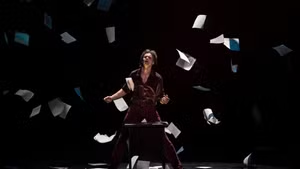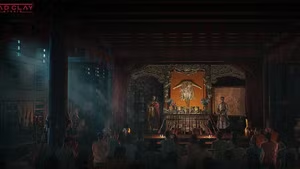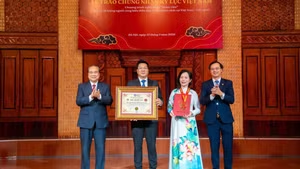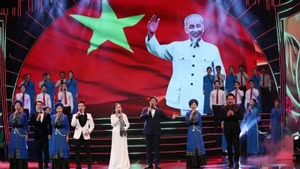
The film, set during the national resistance war against the US, took home the prestigious Golden Lotus award, the Audience Choice award and most of the major individual awards, including the Best Leading Actor and Actress, Best Scriptwriter and Best Scenic Artist awards. The resounding triumph has branded Dung as a ‘cinematic phenomenon’, a passionate veteran director who considers film production a way to express his patriotism.
Nhan Dan: Wars are considered to be stories of the past. Older people often think that younger generations, who are born during peacetime, cannot understand war, so they cannot produce a work on the theme. However, from your first film, Duong Thu (Letters), you chose to explore the topic.
Director Bui Tuan Dung: I can make films about wars because I do understand them. I was born into a family in which my parents, brother and sister served in the army. Although the wars were over when I was growing up, I have spent a lot of time studying about wartime. A wartime film, even if it is approached in a right way, can be merely a documentary. The value of the film is based on the feedback of the audiences’ emotions, on what effects the film has on them, which often lies underneath expressions.
We can consult with a soldier about how actors should perform their role but not about the character’s soul. Making a film about human beings is very different from working with them. A film is a cultural product whose value is determined by the viewers’ appreciation.
Directors in each period try to establish themselves in Vietnamese cinema by taking responsibility for their era. The way a film is made and the aim of the film are set by directors in my generation; therefore the product is different than that of our predecessors.
It is quite expensive to make a wartime film, and the industry is facing a serious reduction in funding from the State. Scanty budgets have forced many veteran directors to cut corners on creating the proper environment for their films. How did you deal with this obstacle?
Before working as a director, I worked in several positions on a film crew and gathered a lot of experiences and personal contacts, which save me from needing to seek solutions to this problem.
Legend Makers received VND8.6 billion from the State, and I managed to find another VND2.5 billion from other supporters.
Money is needed for every part of a film’s production. But intellectual effort is also a kind of investment, so if you lack of money, you should invest more intellect in your work.
It is difficult to recreate a context which existed decades ago. Additionally, Vietnam hasn’t got a standard studio. How did you deal with these difficulties?
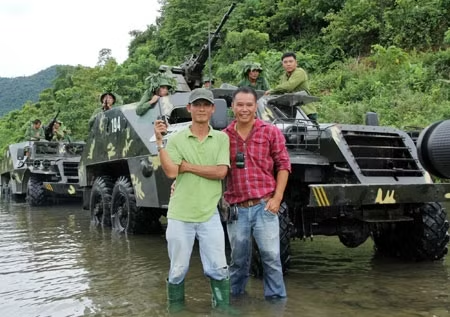
Legend Makers takes place in 1969 along the Truong Son range. The film’s scenes were shot in three different places: Son Tay district in Hanoi, Huong Son district in Ha Tinh and Tien Hai district in Thai Binh province. Our most imposing scene featured dozens of armored vehicles, military trucks, jeeps, and one aircraft. We did the montage and technique making of the film in Vietnam. The sound for the film was completed in Bangkok, Thailand in one week with the support of cameraman Ly Thai Dung and audio expert Banh Bac Hai.
Can you describe how you are when you’re working in the studio?
I don’t speak in a loud voice. Seldom am I in a furious mood at the studio. In the early period of making the film, I asked all relevant units to submit a specific working schedule to ensure smooth co-ordination among them and to maintain discipline in the crew. I welcome every argument, exchange and proposal about the film, but it must be put on the table before we start the filming. There is only one commander in the studio, and the director’s verbal command is an order. I often give instructions for the crew to follow.
What if someone doesn’t follow your instructions, or he thinks he’s right and asks you to follow his lead?
Then he or she would do better to leave the set. Making a film is an industrial production rather than a work of improvisation, like producing a painting or composing a poem!
People often talk about the role of education, reflection, settlement and prediction of cinematic works for social issues. Can your works undertake these ‘tasks’?
For me, a film is a human cultural product about humankind. Social issues cannot be addressed through a film or a newspaper article.
While the country has plenty of pressing issues, you are interested in films about its past – Legend Makers tells a story that happened 44 years ago. Is dealing with the present so difficult and complicated that you’ve decided to ignore it?
No, it is not. I have made two films on current themes so far: Hanoi, Hanoi (2006) and Vu Dieu Tu Than (The Death Dance) (2007). If filmmakers intend to feature today’s issues, they can deal with works about olden times and wartime. If an artwork does not embrace the breath of life, it cannot be attractive, and it is a failure. A film is a collection of vibrations conveyed from filmmakers to audiences; it does not directly ‘educate’ viewers, but instead inspires their emotions and encourages their civic responsibility.
My films have touched on today’s problems. Legend Makers features many epic sacrifices and it sends a strong message in the context of current pressing issues on the East Sea, national territory, oil and gas. The social issues and one’s attitude to the country urged me to express my patriotism. It is not only featured through words but also through the characters’ destinies, the actors’ performance, the set, audio, score, feel and film arrangement.
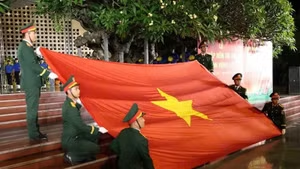
Have you ever seen the flag-lowering ceremony in Ba Dinh square? You should see it. At 9 pm, every day, in any weather condition, uniform soldiers at the Ho Chi Minh Mausoleum High Command march in step with military music. It raises a very inspirational emotion within the hearts of spectators, and it really touches my heart.
It seems that you want viewers to think about their responsibilities to their country after watching Legend Makers.
When evaluating a film, film critics often say that it has stolen tears and smiles from the audience. However, this was not my goal in producing Legend Makers. Tears, smiles, or dramatic feelings for a film can happen just once or twice a year. Above all, I want my film to touch the audience’s hearts. Legend Makers moved audiences when it was screened at the Cinematography Department in September, at the National Cinema Centre in September, and at the Lotte Cinema in Ho Chi Minh City in November for journalists and those working in the cinema industry. Although it is an epic cinematic work, I want the audience to have tears welling up in their eyes rather than bursting into tears. It is time for the Vietnamese people to raise a strong spirit rather than tremble with a flabby will.