At the heart of Brussels' historic centre, Cinéma Aventure welcomed audiences from a wide range of countries to screenings of documentary films about Viet Nam. The three-day programme in Brussels marked the conclusion of Viet Culture in Motion 2026, which comprised 14 screenings across four cities in three European countries: France, Belgium and the Czech Republic.
Organised by Art Space, the programme showcased films including “Ha Noi 5 giac quan” (Ha Noi through five senses), Mac Hau (Behind the curtain), Trai ghe (The boatyard), Tinh hoa gom moc nung cui (The essence of wood-fired raw ceramics), Cong chu len non (Bringing literacy to the mountains), Lang huong Quang Phu Cau (Quang Phu Cau incense village), Tan huong nhung gian truan (Embracing hardships) and ZENG, introducing Vietnamese stories to both overseas Vietnamese communities and international audiences.
Vietnamese stories in a Brussels cinema
Cinéma Aventure is tucked away behind a narrow passage in Brussels' old quarter. Before each screening, visitors made their way through the alley into the cinema, where an exhibition featuring images of Vietnamese people, traditional crafts and cultural life welcomed them.
The event took place during the European summer holiday period, when cultural activities are generally quieter. Nevertheless, the screenings attracted audiences of different generations and nationalities, including local young people spending their weekends at the cinema, groups travelling from cities such as Liège, Mons and Ghent, and overseas Vietnamese eager to reconnect with familiar images of home.
One particularly moving story involved an overseas Vietnamese man in his late seventies. Despite disruptions to the metro network and roadworks that made travelling difficult, he persevered in reaching the cinema and stayed until the end of the session to meet the filmmaking team.
The programme also attracted international audiences discovering Viet Nam through cinema for the first time. Maxel, a Belgian resident of Spanish origin, said: "I've always been fascinated by East Asian cultures. These films were my first introduction to Viet Nam, and I'm certain I'll arrange a visit to your country before long."
According to the organisers, the positive reception from audiences in France, Belgium and the Czech Republic demonstrates that everyday stories about Vietnamese people and culture can resonate strongly, even with those encountering the country for the first time.

Telling the nation's story through everyday life
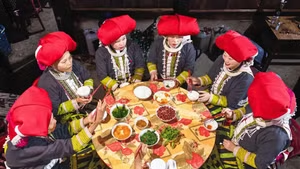
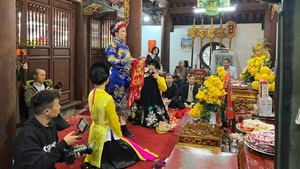
Rather than focusing on major historical events or familiar national symbols, the films explore slices of ordinary life: a traditional craft village, a family meal, a tuong (classical drama) performance, the daily lives of older people, or classrooms in remote mountainous areas.
Through modest stories and ordinary people, the filmmakers offer fresh perspectives on culture—not simply as a heritage to be preserved, but as a living legacy that younger generations continue to embrace and reinterpret in contemporary society.
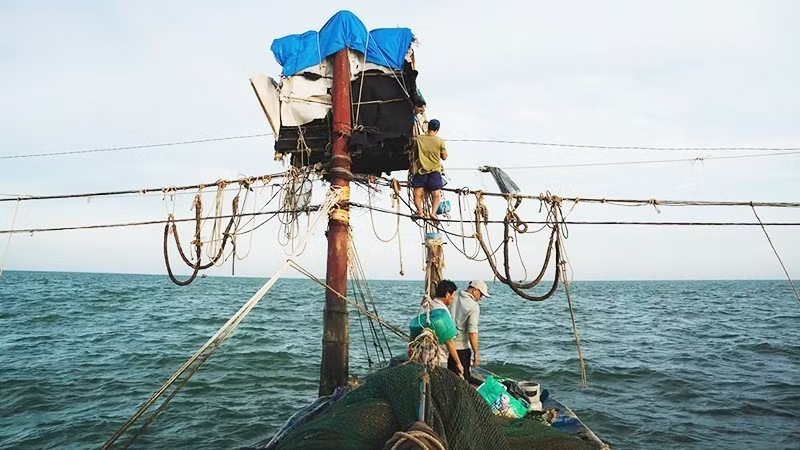
Director Tran Nhut Long, whose documentary ‘Embracing hardships’ follows the lives of men living on boats and became one of the festival's standout works, said: "Once you become attached to a place, you develop enough affection—and a little courage—to tell its story. I wasn't trying to create a perfect image. Instead, I chose to become friends with the people in the film and live alongside them so I could capture an authentic reality—one rich in identity, with values worth cherishing, but also with aspects that deserve recognition and change."
Through real stories, real people and everyday experiences, the films present a portrait of Viet Nam that is both familiar and constantly evolving.
This is also how these young filmmakers have chosen to connect with international audiences—not by relying on familiar stereotypes, but by sharing genuine stories about people and everyday life.
Cinema connects communities
Quynh Iris Nguyen-de Prelle, representative of the Viet Nam-Pacific Intercultural Centre in Brussels, a co-organiser of the programme, said: "Vietnamese culture is more than ao dai and spring rolls. It also embraces artistic, interdisciplinary events and activities that engage local communities here. Film is an art form with a natural appeal that speaks for itself, without requiring extensive explanation or interpretation."
Vong, an overseas Vietnamese living in Mons, Belgium, shared: "We're getting older and can't travel much anymore, but these films brought images of our homeland so close to us. They touched memories we've carried in our hearts for a very long time."
Nghiem Pham Phuc Anh, representing the organising committee of Viet Culture in Motion, said: "Our aspiration is to help nurture a generation of young people capable of telling Viet Nam's story to the world in their own voices. We have no shortage of identity, remarkable values or inspiring stories. What we need are more opportunities, better tools and a supportive environment so these stories can be told creatively, in a contemporary way, and reach international audiences."
Behind films lasting only a few dozen minutes lies months of preparation by independent production teams. As independent projects, team members took on multiple responsibilities beyond directing or filming, participating in almost every stage of production—from researching topics and developing scripts to filming, editing and post-production. Working with limited budgets and equipment demanded perseverance, self-directed learning and the ability to perform multiple roles throughout the filmmaking process.
Beyond overcoming production challenges, the filmmakers also faced the complex task of "translating" culture so that their works could resonate with international audiences while remaining faithful to their original spirit. From translating specialised terminology into English, French and other local languages to conveying culturally specific concepts, contexts and nuances of Vietnamese life, the process involved far more than simple translation. It required finding ways to make Vietnamese cultural experiences accessible and meaningful to international audiences.
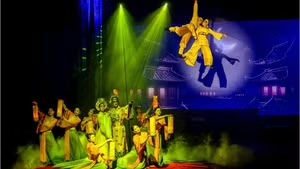
Le Mai Phuong, a member of the production team behind Mac Hau, a documentary portraying the lives of tuong performers behind the curtain, reflected on the film's central message: "It begins with respect. Don't look at traditional arts with pity or sympathy. Look instead at the resilience of the people who keep them alive. Preserving tradition doesn't mean clinging rigidly to the past. In our film, Thanh Phuong works as a DJ to support her passion for tuong, while we use modern cinematography and contemporary editing techniques to tell its story. Every young person can use their own modern strengths to carry tradition forward and breathe new life into it. As long as we don't forget, that flame will never go out."