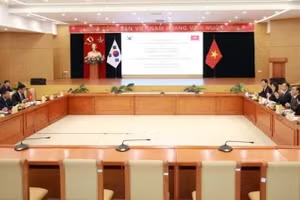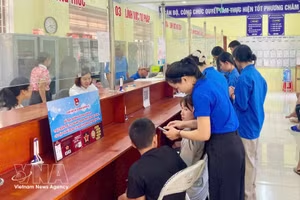
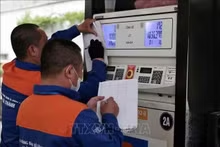
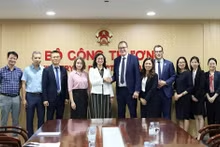

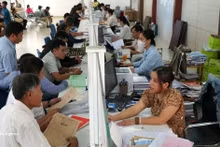
Deputy Prime Minister Nguyen Van Thang has instructed the Ministry of Finance (MoF) and the State Bank of Viet Nam (SBV) to urgently review and incorporate feedback from relevant ministries to finalise plans to decentralise administrative procedures, halve compliance costs and processing time, and eliminate all unnecessary business conditions.
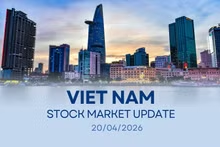
Viet Nam’s benchmark VN-Index increased by 1.10% to 1,837.11 points on April 20.
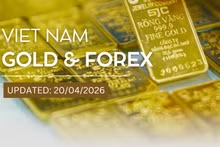
Global gold prices on April 20 declined amid mounting fiscal pressures in many countries as oil prices remain elevated, while the situation in the Middle East continues to be highly unpredictable. Domestically, SJC-branded gold bar prices fell, ending the trading week at 171.3 million VND per tael.

Amid the global shift in investment flows, Viet Nam is increasingly seen not only as a promising and attractive destination, but also as a test of its policy adaptability in the era of technological innovation.

The Government has issued Resolution No. 109/NQ-CP, updating and supplementing the Government’s Action Programme to implement the Resolution of the 14th National Party Congress and Conclusion No. 18-KL/TW of the Party Central Committee on the five-year socio-economic development plan, national financial plan, public debt borrowing and repayment, and medium-term public investment plan for the 2026–2030 period, aligned with the goal of achieving double-digit growth.

Viet Nam is stepping up its global energy engagement as it participates in an international bidding round for oil and gas exploration in Algeria.
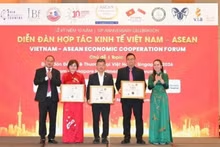
Over the past decade, the Viet Nam–ASEAN Economic Cooperation Forum has successfully affirmed the value of Vietnamese brands in the ASEAN regional market.
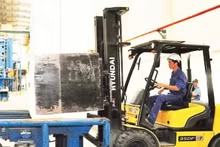
Recent shocks stemming from geopolitical conflicts, volatile energy prices, and rising logistics costs have had an almost immediate impact on domestic production and business activities. This situation requires enterprises to maintain growth momentum while strengthening their adaptability and resilience.
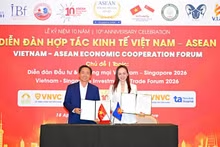
On April 18, Arobid Technology Joint Stock Company and the International Business Federation Viet Nam Singapore (IBF Viet Nam Singapore) signed a memorandum of understanding (MoU) within the framework of the Viet Nam–Singapore Investment and Trading Forum 2026 and the 10th anniversary of the Viet Nam–ASEAN Economic Cooperation Forum 2026 held in Singapore.
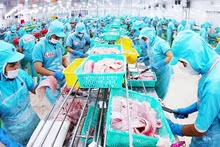
In the course of the national digital transformation, cross-border e-commerce is emerging as a new driver of exports, expanding growth space for Vietnamese enterprises.
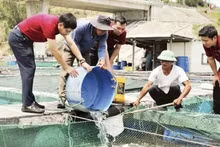
A succession of natural disasters in 2025 not only caused severe economic damage but also undermined the livelihoods of millions of households. In that context, the banking system has acted as a financial pillar, helping to unblock capital flows, restore production and rebuild lives.

On the basis of the long-standing friendship and cooperation between Viet Nam and China, as well as close ties between their aviation authorities, the Civil Aviation Authority of Viet Nam has asked the Civil Aviation Administration of China to direct relevant fuel suppliers to ensure sufficient and stable supplies for Viet Nam.

Dak Lak is known as the 'capital' of Vietnamese coffee, with rich, fertile basalt red soil ideal for agriculture. The coffee provides livelihoods for thousands of locals and has developed a unique cultural space, closely tied to the socioeconomic life, customs and identity of local communities.

Vietnamese fresh produce and processed foods are increasingly recognised for their quality, with items such as cashew nuts, coffee and spices gaining popularity among Middle East consumers. In 2025, Viet Nam’s farm produce exports to the UAE exceeded 445 million USD, up nearly 24% year-on-year.
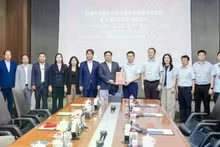
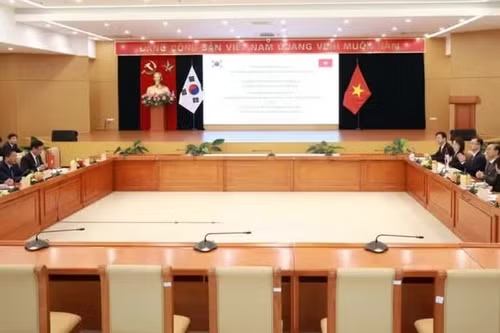
During an investment promotion visit to China, Phu Tho Chairman Tran Duy Dong granted BYD Electronics Viet Nam an investment certificate to increase its total investment capital by 479.8 million USD.
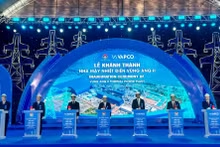
On 18 April, the inauguration ceremony for the Vung Ang II Thermal Power Plant was held at the Vung Ang Economic Zone in the central province of Ha Tinh.
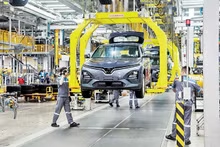
As Viet Nam enters a new stage of development with aspirations for rapid and sustainable growth, the goal of achieving double-digit growth is gradually becoming a strategic requirement.

The Ho Chi Minh City Department of Science and Technology held a ceremony on April 17 to launch the city’s Venture Capital Fund, which will be managed by the Ho Chi Minh City Venture Investment Fund Joint Stock Company (HCM VIF JSC).

With strong support from the Party Central Committee to become a centrally governed city, Dong Nai Province is having “golden” opportunities for a powerful breakthrough. It is not seeking a new label, but is steadily establishing a new position in line with its stature, role, and development requirements.

The Agriculture and Environment Magazine, in coordination with the People’s Committee of Ho Thau Commune (Tuyen Quang Province) organised a conference themed “Promoting the value of ancient Shan Tuyet tea regions in developing circular agricultural tourism in Ho Thau Commune” on April 17.