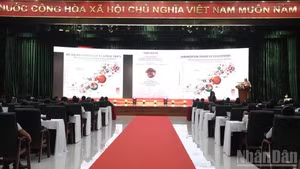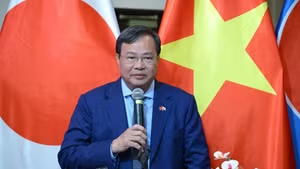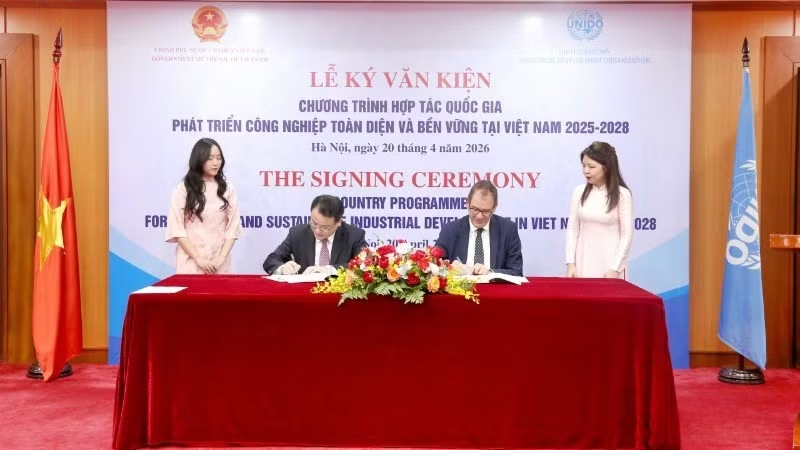
The programme was signed by Deputy Minister of Finance Tran Quoc Phuong and UNIDO Director General Gerd Müller at a ceremony held in Ha Noi, attended by representatives from Viet Nam’s Ministries of Foreign Affairs, Industry and Trade, Agriculture and Environment, Science and Technology; the Viet Nam Academy of Science and Technology; leaders from Ha Noi, Hai Phong, and Bac Ninh provinces; development partners; and UN Resident Coordinator in Viet Nam Pauline Tamesis.
Speaking at the event, UNIDO Director General Müller emphasised that UNIDO and Viet Nam have developed a close relationship for over four decades, with the bilateral partnership having evolved from individual projects into integrated and scalable solutions combining policy advice, technical assistance, and investment mobilisation.
Looking ahead, both sides will continue to strengthen cooperation to develop a modern, competitive, and sustainable industrial sector in Viet Nam.
Under the framework, UNIDO will support Viet Nam’s transition towards greener, more circular, and inclusive industrial systems, helping to raise domestic value and strengthen competitiveness.
For his part, Deputy Minister of Finance Tran Quoc Phuong stressed that the programme provides a clear cooperation framework aligned with Viet Nam’s socio-economic development strategies, supporting the country’s goals of becoming an upper middle-income economy by 2030 and a high-income economy by 2045, while facilitating the realisation of its commitment to net-zero emissions by 2050.
The Viet Nam–UNIDO country cooperation programme for 2025–2028 has an estimated budget of 72 million USD, focusing on three priorities – accelerating the shift to green industry and a circular economy; enhancing industrial competitiveness and sustainable value chains; and strengthening industrial policies, institutional capacity, and partnerships.
Since 1978, UNIDO has worked with Viet Nam on more than 170 projects spanning small- and medium-sized enterprise development, quality infrastructure, energy efficiency, cleaner production, and sustainable supply chains.
Building on this foundation, the new programme will scale up integrated interventions that combine policy support, technical expertise, and investment facilitation.
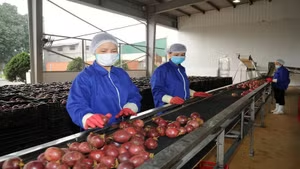
It also opens up new cooperation opportunities in the agro-processing industry, particularly in high-potential value chains such as rice and tea, focusing on value addition, compliance with sustainability standards, climate resilience, and improvement of rural livelihoods.