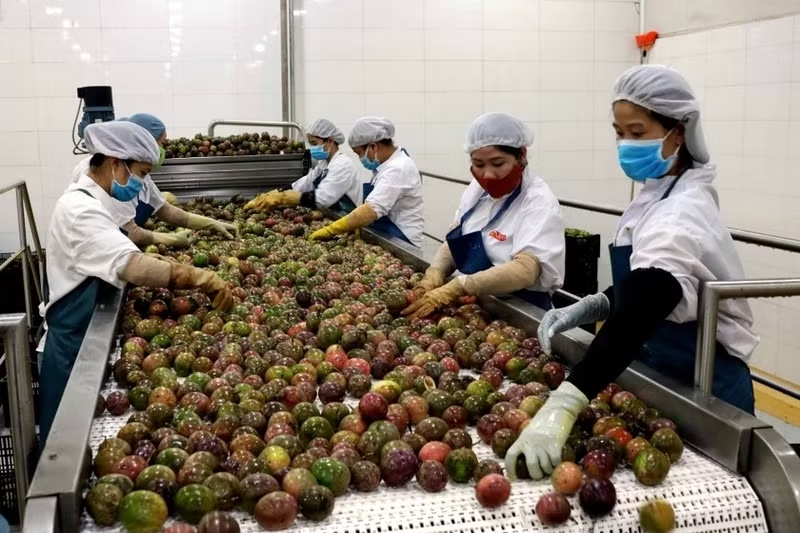
By early 2025, the national passion fruit cultivation area was estimated at between 12,500 and 15,000 hectares, concentrated mainly in the Central Highlands provinces of Gia Lai and Dak Lak, as well as the northern mountainous region of Son La.
Average yields reach 35–45 tonnes per hectare, with high-tech farming areas achieving as much as 70 tonnes per hectare. With stable prices, each hectare generates revenues of 250–350 million VND, with net profits three to four times higher than those from traditional industrial crops.
Viet Nam now ranks among the world’s top ten passion fruit exporters, competing with major producers such as Brazil, Colombia, Ecuador, and Peru, while leading in concentrated juice production.
Viet Nam now ranks among the world’s top ten passion fruit exporters, competing with major producers such as Brazil, Colombia, Ecuador, and Peru, while leading in concentrated juice production.
In the context of deep international integration, opening access to demanding markets is a key priority for Viet Nam’s agricultural sector.
On 25 March 25, 2026, Deputy Minister of Agriculture and Environment Hoang Trung held a working session with a delegation from the US Department of Agriculture (USDA) led by Luke Lindberg, Under Secretary for Trade and Foreign Agricultural Affairs.
At the meeting, the US side confirmed completion of the technical evaluation for fresh Vietnamese passion fruit. Deputy Minister Hoang Trung urged the US to accelerate recognition of additional irradiation facilities and approval of the vapour heat treatment (VHT) method.
In response, Luke J. Lindberg affirmed that priority would be given to finalising technical procedures in time for the 2026 harvest season. This is regarded as a crucial step to enable Vietnamese passion fruit to penetrate global supply chains more deeply.

The news has sparked excitement across villages in key growing areas such as Gia Lai and Son La.
K’Sor Phuoc, a farmer in Dak Doa Commune (Gia Lai Province), shared: “Hearing that passion fruit is about to enter the US market, we’re all thrilled. Previously, we worried about unstable outlets, but now with businesses guaranteeing purchases and expanding markets, we have even more motivation to farm cleanly.”
In Son La Province, Luong Thi Mai, a farmer in Chieng Mung Commune, said that thanks to passion fruit, her family now enjoys a stable income and can afford proper education fees for the children. “I hope our local passion fruit will soon appear on US supermarket shelves,” she added.
To maintain credibility in the US market, experts recommend strict control of planting area codes and pesticide residues.
With four-party cooperation among the state, scientists, businesses, and farmers, Vietnamese passion fruit is expected to create a new success story, reinforcing the global standing of Vietnamese agricultural products.