To realise this objective, one of the key pillars identified by the Party and the state is the development of strong economic groups capable of leading, creating spillover effects and elevating the entire economy.
A series of important resolutions of the 13th Politburo — such as Resolution No. 57-NQ/TW on breakthroughs in science and technology development, innovation and national digital transformation, Resolution No. 68-NQ/TW on private sector development, and Resolution No. 79-NQ/TW on state sector development — all converge on a common point: building leading economic groups that gradually expand regionally and globally, acting as “locomotives” pulling along the development of small and medium-sized enterprises, thereby strengthening national internal capacity.
This is not merely a matter of business scale, but a matter of restructuring the economy, where large corporations act as nuclei within value chains, generating spillover effects in technology, productivity, and competitiveness.
“Locomotives” of the economy in Nearly 40 Years of Doi Moi
Looking back over nearly 40 years of Doi Moi, the indispensable role of economic groups in the development process is evident. From an underdeveloped agricultural economy, Viet Nam has gradually risen to become one of the most dynamic economies in the region, with impressive growth rates and high openness.
Throughout this journey, both state-owned and private economic groups have consistently played a pivotal role. According to Nguyen Ngoc Canh, Deputy Governor of the State Bank of Viet Nam, these groups are the “backbone” of the economy, making significant contributions to GDP and the state budget, creating millions of jobs, and directly implementing key national projects.
Beyond quantitative contributions, corporations also play a role in enhancing the quality of growth. Through investment in key sectors such as energy, infrastructure, processing and manufacturing industries, and modern services, large enterprises have helped shape a more modern and efficient economic structure.
Notably, corporations have also been at the forefront of building the national brand. Many enterprises have gradually brought Vietnamese products and services to international markets, helping to elevate the country’s position within global value chains.
From a financial perspective, the banking system plays an important “enabler” for the development of corporations. Given their large scale and strong credibility, corporations are always a key customer group for credit institutions and are prioritised for funding to implement major projects of socio-economic significance. This support not only ensures project progress but also creates spillover effects for the entire economy.
However, in the new context, the role of corporations must go beyond “leading growth” to “leading transformation”, shifting from a growth model based on natural resources and cheap labour to one driven by technology, innovation, and high productivity.
From “Assembly” to “Mastery”
One of the most important measures of leadership capacity is the ability to master technology and participate deeply in global value chains. This is also a major bottleneck for Viet Nam’s economy over many years.
According to Vice Chairman of Vingroup Le Khac Hiep, the automobile industry is a typical example. For a long time, the industry mainly remained at the assembly stage, with a low localisation rate and heavy dependence on external supply.
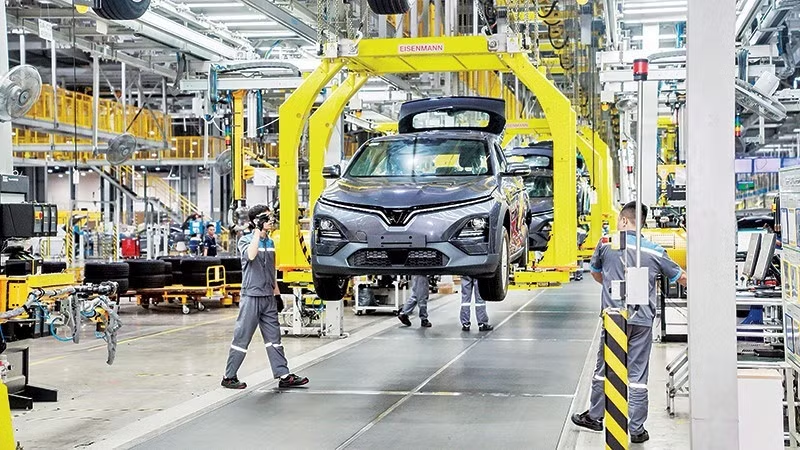
The emergence of VinFast has opened a completely different approach. Instead of following the assembly path, the enterprise has chosen to build a synchronised, highly automated manufacturing complex, with the ambition of mastering the entire value chain, from research and development to production, while gradually conquering core technologies.
Notably, VinFast does not develop as a standalone enterprise, but acts as a nucleus within an industrial ecosystem. By connecting and leading suppliers, the company has contributed to forming a domestic production network, gradually restructuring Viet Nam’s automobile industry.
The localisation strategy is identified as a key factor. With the localisation rate of electric vehicles having reached about 60% by 2025, and targeting 80% when battery cell production begins domestically in 2026, VinFast is creating an important foundation for the enhancement of self-reliance.
When a lead enterprise masters core technology, the entire ecosystem behind it has the opportunity to develop. This is precisely the spillover effect that industrialised countries such as Japan, the Republic of Korea, and China have successfully leveraged to achieve leaps in development.
Restructuring the Private Sector
Alongside the state sector, the private sector is increasingly affirming its role as a key driver of the economy. After nearly 40 years of Doi Moi, this sector has made remarkable progress, contributing around 50% of GDP and creating the majority of jobs.
However, according to Dau Anh Tuan, Deputy Secretary General of the Viet Nam Chamber of Commerce and Industry (VCCI), the private sector still faces many paradoxes. The number of enterprises is large, but quality is not commensurate; they are dynamic but lack depth; their contribution is significant, yet their position in global value chains remains limited. One of the biggest issues is the small scale of enterprises. Nearly 97% of private enterprises are small and medium-sized, with most having fewer than 10 employees. This scale makes it difficult for businesses to invest in technology, innovation, and market expansion.
The sectoral structure is also not yet reasonable, with many large enterprises concentrating in areas such as finance and real estate, while processing and manufacturing industries — the foundation for long-term growth — have not received adequate attention.
For the private sector to truly play a leading role, Tuan stressed the need for a strong restructuring process. The focus should be on shifting towards production and technology sectors; increasing investment in research and development; building linkage ecosystems between large and small enterprises; and enhancing governance capacity in line with international standards. At the same time, the development of capital markets in depth is a necessary condition for enterprises to access long-term resources to serve major projects and strategies for expanding into international markets.
Meanwhile, according to Associate Professor, Doctor Tran Dinh Thien, Viet Nam’s core issue today is not merely a shortage of enterprises, but a lack of sufficiently strong corporations to take the lead. A modern economy cannot operate effectively without leading enterprises.
He put forward two important propositions: to become an economic powerhouse, there must be strong corporations; and to form value chains, there must be leading enterprises. These are vital conditions.
Experiences from Japan, the Republic of Korea, and China show that success does not come from widespread, fragmented support, but from concentrating resources to develop “locomotives”. These enterprises then pull along the entire ecosystem behind them.
Conversely, if policies continue to be applied in an “equal distribution” and fragmented manner, the economy will only produce small, scattered enterprises that lack the capacity to compete internationally. Therefore, a new approach is needed: selecting key sectors, key value chains, and leading enterprises for focused support. For instance, in the automobile manufacturing sector, leading firms could be chosen as a focal point, thereby establishing sufficiently strong support mechanisms for their development while enabling other enterprises to participate.
However, support must go hand in hand with responsibility. Leading enterprises need to have clear commitments to efficiency, transparency, and spillover capacity, avoiding a situation where incentives are granted without generating real value.
Thien also emphasised that for economic groups to fully play their leading role, the key factor remains institutions. A transparent, stable, and predictable business environment will provide the foundation for enterprises to confidently make long-term investments. In this context, mechanisms such as procurement, quotas, and financial policies need to be improved to enable the private sector to participate more deeply in key areas of the economy.
The role of the state should be clearly defined: not to directly intervene in business operations, but to focus on creating a competitive environment, protecting property rights, and supporting enterprises in enhancing their internal capacity. At the same time, particular attention should be paid to limiting the criminalisation of economic relations, reducing legal risks, and building trust within the business community.
Viet Nam also needs to avoid falling into the “FDI dependency trap” by strengthening the capacity of domestic enterprises and gradually participating more deeply in global value chains.