Quang Binh is just in early summer but it is already hot. The hot sun and strong Foehn winds made it quite difficult for those who work outdoors. When we arrived at the rubber forest area in Ray Village, Tay Trach Commune, Bo Trach District (Quang Binh), we witnessed a group of officers and staff of MAG Team 7 still working hard.
Under a tent covered with a tarpaulin tied to several rubber trees, Mr Le The Tam, Captain of the MAG 7 Team, happily welcomed us but also requested to follow some strict procedures according to the project's regulations. Along with Mr Tam, there was an officer from the engineering force of the Quang Binh Provincial Military Command, whose task was to guide and supervise the activities here.
Mr Tam said that Ray Village is located along the Ho Chi Minh road and is only a few kilometres from the Gianh River ferry, which was once a fierce bombing site of US aircraft during wartime. For decades, although local people have been cultivating, this area still has potential dangers due to the many explosives left over from the war.
Through information from local authorities and people, as well as through surveys and searches of the scene for explosives, the MAG Quang Binh Project decided to send a working team to search for explosives, mainly cluster bombs, to help nearly 1,000 people here stabilise their lives.
From the command hut, Mr Tam and the military officer took us to the site where cluster bomb clearance was being carried out. From afar, under the rubber forest, tree trunks were tilted in the direction of the wind, many red and white technical lines were strung horizontally and vertically; restricted area signs were erected on many sides and of course, at this time, people were not allowed to enter the area where explosives were being searched for.
Many groups of employees wearing grey MAG uniforms were seen carefully and strictly working under the midday sun. Mr Nguyen Thanh Ha, Operations Manager of the MAG Quang Binh Project, said that to deploy explosives detection to clear the land like today at the site, it must go through many steps.
The first step is to assess and identify areas suspected of being contaminated with explosives. In this step, MAG collects evidence based on available historical data and information provided by the community through village meetings, or meetings with people, to assess the level of contamination and discuss areas that need to be cleared of explosives.
Next is the survey step, directly intervening in dangerous areas and confirming the existence of explosive materials. The survey results help MAG determine the boundaries of contaminated areas and have more evidence to accurately identify priority areas for mine clearance.
After identifying contaminated areas, MAG conducts mine clearance to support agricultural development, infrastructure construction and socio-economic development projects for the locality. Mine clearance is carried out based on a strict systematic method, ensuring that every square centimetre of land is thoroughly inspected.
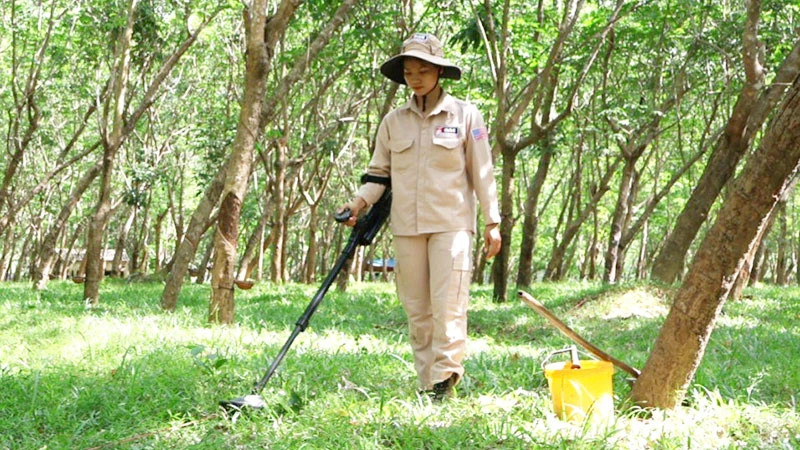
As he spoke, Mr Ha led us to stand in a roped area about 20 square meters wide, considered the closest distance to observe a group of employees clearing cluster bombs. Under the rubber canopy, two people carried a rectangular bomb clearance device, sometimes moving horizontally, sometimes vertically, sometimes slowing down to search more carefully. Suddenly, the device beeped continuously, they stopped to get a tool to mark the location so that another employee could use a smaller detector to check again before digging up the cluster bomb.
“Bomb clearance is a potentially dangerous job, just a small mistake or oversight can cause unpredictable consequences. Therefore when working, employees must be highly focused, careful, meticulous, and pay full attention to the task” - Mr Nguyen Thanh Ha shared.
By chance, at Team MAG 7, we met a female employee when she approached the “square” where we were standing to re-check the location previously marked “with bombs” with a small, long-handled explosives detector. She was holding a shovel and a yellow plastic bucket. She carefully checked the marked location over and over again.
Thanks to the manager, we took a few minutes to chat and learned that she was Dinh Thi Kieu, born in 1992, from My Thuy, Le Thuy District (Quang Binh). Although she has a small figure and a chubby face, when wearing the MAG uniform, Kieu looks quite strong and confident in a job that seems to be only for men. More surprisingly, Kieu used to be a literature teacher. I asked: “What was the opportunity that brought you from a literature teacher to a bomb disposal officer?”.
Kieu shared: “My hometown is in a hilly area where Route 15 passes through, so there are many bombs and bullets left over from the war. Since I was young, I have been in contact with MAG groups that came to my area to clear explosives, observed a lot and found it interesting. As I grew up, I went to teacher training school and then returned to teach for a while. During the summer break, I heard about a project to recruit staff, I applied and was accepted. When I first started working, the work was quite tiring and had potential risks, and being outdoors with women was a big obstacle, but I gradually got used to it. I will always remember when we were clearing mines in Nong Truong Viet Trung Town, Bo Trach District, an old lady ran to us and called out: “Oh, bomb, oh, bomb here”. A moment later, the team came to clear and discovered a real bomb, then handled it safely and brought peace of mind to her family”.
Dinh Thi Kieu added that she had been working with the MAG Project for 10 years and just a few days after being recruited and trained, she fell in love with this job without realising it. She has her own small home here in Quang Binh and her husband also works at MAG. Both of them work hard, mainly outdoors, so she spends her free time with her children.
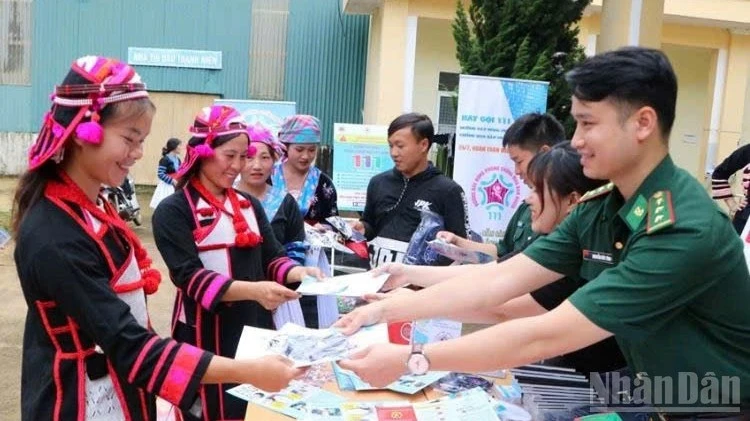
Pham Vu Quynh Chi, the communications coordinator of MAG Vietnam, said that among the staff and employees of MAG Quang Binh, many female employees are very active like Dinh Thi Kieu. Notably, Kieu was recently one of two female MAG employees sent to the US to communicate about the project and bomb and mine accidents, leaving an impression on many people.
According to Quynh Chi, thanks to MAG Vietnam’s expansion of operations in the two provinces of Quang Tri and Quang Binh, young people like her are fortunate to meet many families and listen to their stories about positive changes after many areas of land were cleared of bombs and mines. Each family and residential area is a story, a joy.
The family of Mr Nguyen Van Chien, in Bac Nam Village, Cu Nam Commune, Bo Trach District, near Xuan Son Ferry and Ba Trai Road - were “bomb and ammunition bags” during the war. Sharing with us, Mr Chien also remembers the times he worked in the garden and encountered many explosives, and each time he picked them up and threw them into bomb craters.
But after witnessing an accident related to explosives, he shuddered remembering the times he “innocently” moved bombs and mines. Since then, he has never dared to touch bombs again. Every time he planted trees, he and his wife only lightly dug the surface of the garden, not daring to dig deeper. With a lot of luck, although living in an area containing a lot of explosive materials after the war, Mr Nguyen Van Chien’s family has never encountered any unfortunate accidents related to bombs.
Mr Chien recalled that in his 4,500 m2 garden, bomb disposal workers discovered and disposed of eight cluster bombs, cleaning up the entire land. Since then, the fear of bomb and mine accidents has disappeared, and his family, like hundreds of other households in Cu Nam Commune, have made the most of their land for production and livestock raising, bringing in high economic value. Mr Chien and his wife happily offered us jackfruit, oranges, and bananas, all of which are fruits grown in the garden. Their faces were filled with joy, and we saw in them the belief that the future would be better when they could use land free of bombs and mines to improve their lives.
According to the Quang Binh Department of Foreign Affairs, MAG is a British non-governmental organisation, operating in Quang Binh since 2003, with activities of mine risk education and bomb and mine clearance in contaminated areas. The project successfully detected and detonated 147,371 explosives of various types and conducted 1,755 communication and education sessions on mine accident prevention. With its professionalism and efficiency, MAG's activities are highly appreciated by local people and authorities; contributing to reducing the risk of mine accidents, cleaning up land areas for agricultural production, building infrastructure, and actively contributing to the socio-economic development of the province. In the 2021-2025 period, MAG will continue to implement the project in Quang Binh with a budget of more than 16.25 million USD.