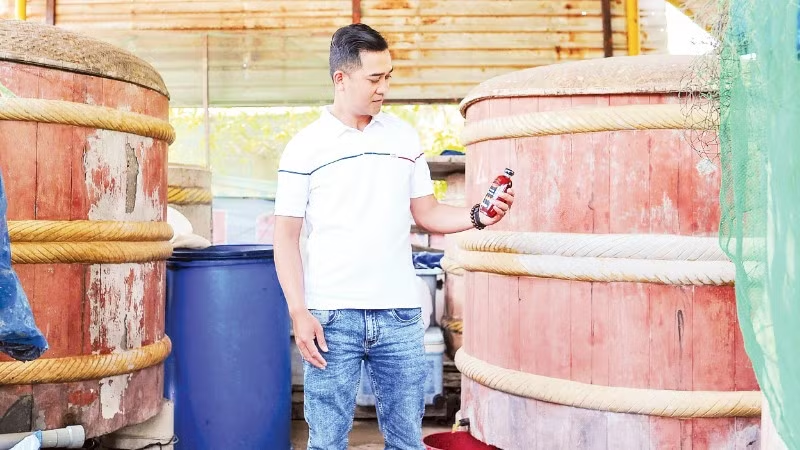
From the salty taste of fish sauce…
One April afternoon three years ago, I visited the fishing village of Nam O, where local residents recounted the centuries-long journey of preserving the distinctive flavour of traditional fish sauce. At that time, many households were busy preparing salt and anchovies for fermentation.
To produce genuine fish sauce, the people of Nam O must patiently draw on the folk knowledge accumulated over generations. The salt must come from Sa Huynh, and the fish must be anchovies, particularly the first catch of the season.
The ratio of salt to fish is not fixed; instead, it depends on the instinct and experience of the artisans, who adjust it according to the weather and the freshness of the fish. The fermentation process must last over 12 months to achieve the right protein content, colour, aroma and overall quality.
Despite such meticulous care, the greatest challenge for traditional fish sauce makers lies in maintaining their devotion to the craft.
Three years later, I returned to Nam O Village, determined to understand the enduring vitality of this craft. The village landscape had changed considerably as the Nam O eco-tourism area gradually took shape.
Tran Ngoc Vinh, Chairman of the Nam O Traditional Fish Sauce Village Association, now in his seventies, shared his concerns about a craft struggling under the pressures of urbanisation, at a time when many traditional trades were fading away.
“Every rural area has its own traditional craft. The crucial question is whether we can preserve it,” he reflected.
Previously, discussions about the craft often centred on the integrity of keeping the fermentation jars free from anything other than fish and salt.
Today, he spoke more profoundly about that same sense of integrity: “To preserve this tradition, we must pass it on to our children. We must not let it disappear.”
I then made my way to Cua Khe fish sauce village, with a history spanning over 100 years. Here, the story of continuity came vividly to life through the transition between two generations of leaders of the traditional craft village.
In a courtyard infused with the characteristic briny aroma, Nguyen Thanh Hai, former head of the village association, explained: “When making traditional fish sauce, your capital is tied up for 12 months. The cost of fish, salt and jars must all be paid upfront. At times, the villagers’ finances were extremely strained. Yet this craft was handed down by our ancestors, and we are determined not to let it fade.”
A stone stele summarising the history of Cua Khe fish sauce village reads: “In the mid-15th century, following the southward expansion, Chief Admiral Le Quy Cong led 12 generals and migrants from Thanh-Nghe to settle in Quang Nam, establishing the two coastal villages of Duy An and Ha Tay, collectively known as Cua Khe. From these two villages, the inhabitants, in their struggle for survival, absorbed Cham cultural influences to develop the fish sauce craft, which became renowned in the southern region.”
…to the enduring taste of the craft
Recent studies on traditional craft villages in Viet Nam suggest that craft village tourism is not merely an economic activity but also an opportunity for culture to sustain itself organically.
However, in many places, tourism and production activities remain poorly integrated. When out of sync, fledgling tourism initiatives often falter under operational costs, creating the quiet frustration of those deeply committed.
Vo Nguyen Tung, head of Cua Khe traditional fish sauce village, shared this concern.
After graduating from university, Tung returned to his hometown to continue his family’s traditional fish sauce business.
In April 2020, together with other dedicated young villagers, he established the Cua Khe Community Tourism Cooperative, aiming to preserve and promote the village’s cultural values through new experiential offerings.
The outbreak of COVID-19 halted these plans, and it was not until 2022 that he welcomed his first visitors.
Tung described his ambitious vision: “On one hand, we focus on producing traditional fish sauce; on the other, we develop distinctive community-based tourism products in line with green and sustainable tourism. They may seem separate, but they share the same goal. Traditional fish sauce alone struggles to compete in today’s market.”
His vision is not a solitary one. In 2023, local authorities released a plan to develop community tourism products linked to preserving and promoting the cultural values of Cua Khe fish sauce village. More importantly, the village itself holds untapped tourism potential.
Alongside its century-old fish sauce-making tradition, the area is a living cultural landscape with 4.5 kilometres of unspoilt coastline, located along the heritage route connecting Hue, Da Nang and Hoi An.
At Cua Khe, traditional coastal practices, such as basket boat rowing, net fishing, beach seining, the whale worship festival, and ba trao singing, are still maintained, especially the ritual honouring the craft’s founding ancestors.
At present, Cua Khe village has around eight homestays and small hotels. The cooperative has hosted more than ten visitor groups for tours and experiences. Yet the sight of an unfinished, deserted check-in spot by the beach brings us back to reality, signalling the risk that a promising initiative may fade prematurely.
Vo Nguyen Tung did not shy away from these challenges. He acknowledged the incomplete elements of Cua Khe’s tourism development, from the lack of proper reception spaces to underdeveloped tour products. In his view, the key to success lies in establishing close collaboration between local authorities, the community and the craft village, and local businesses.
He concluded: “Only when each drop of fish sauce is sold can the craft village truly survive. To achieve that, developing tourism linked to the craft is essential. No matter how valuable natural and cultural resources are, if they cannot be turned into income for local people, they will remain nothing more than untapped potential.”