
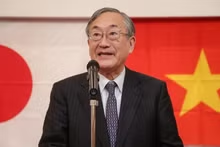
Having devoted more than half a century to the study of modern Vietnamese history and politics, Professor Furuta Motoo describes himself as “a foreign scholar made in Viet Nam.” He learned Vietnamese from Vietnamese teachers and uses the language fluently in his research, teaching, and everyday life.
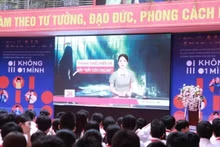
Prime Minister Pham Minh Chinh has signed Decision No. 468/QD-TTg approving a programme to protect and support children in cyberspace for 2026–2030.
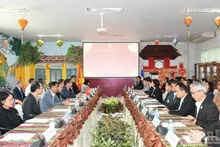
On March 23, in Udon Thani province, Thailand, Ambassador of Viet Nam to Thailand Pham Viet Hung and a delegation of embassy officials held a working session with the Board of Rectors and students of Udon Thani Rajabhat University (UDRU), exchanging views on Viet Nam - Thailand relations over the past 50 years and the role of the younger generation in promoting cooperation between the two countries.

The fifth annual all-Russia Vietnamese translation contest wrapped up its final round in socio-political fields at the Moscow State Institute of International Relations (MGIMO) under the Russian Foreign Ministry on March 21, with competitors going head-to-head in a hybrid format.
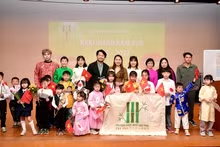
Cay Tre Vietnamese Language School solemnly held the opening ceremony for its K5 course at the Higashi Osaka City Cultural Centre in Japan on March 21. The move officially kicked off the 2026-2027 academic year with Vietnamese-language classes for the community.
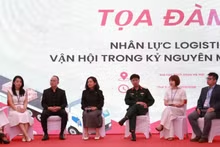
In a bid to strengthen linkages between businesses, educational institutions, and students in logistics and supply chains, and to promote sustainable human resource development, the Viet Nam Association for Logistics Manpower Development (VALOMA) organised the VALOMA LOGFAIR 2026.
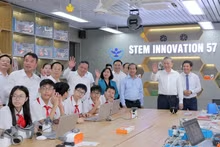
Developing STEM education holds a particularly important position in the Politburo’s Resolution No. 71-NQ/TW on breakthroughs in education and training development. It is recognised as a teaching approach that meets the demands of the new era, where creativity, science, and technology are the foremost resources.
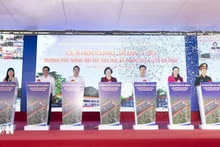
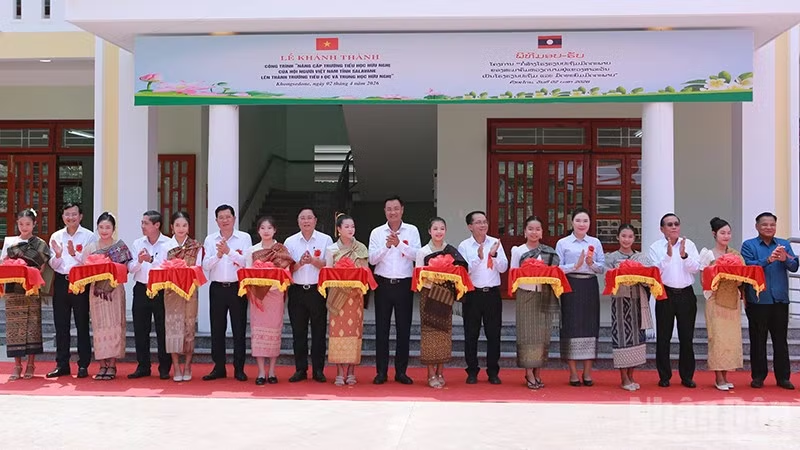
Joining 15 other localities nationwide, An Giang and Nghe An provinces started construction of more inter-level boarding schools in border communes on March 19, underscoring the Party and State’s commitment to expanding educational access and improving human resources development in remote areas.
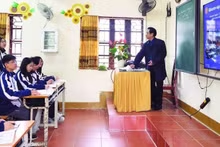
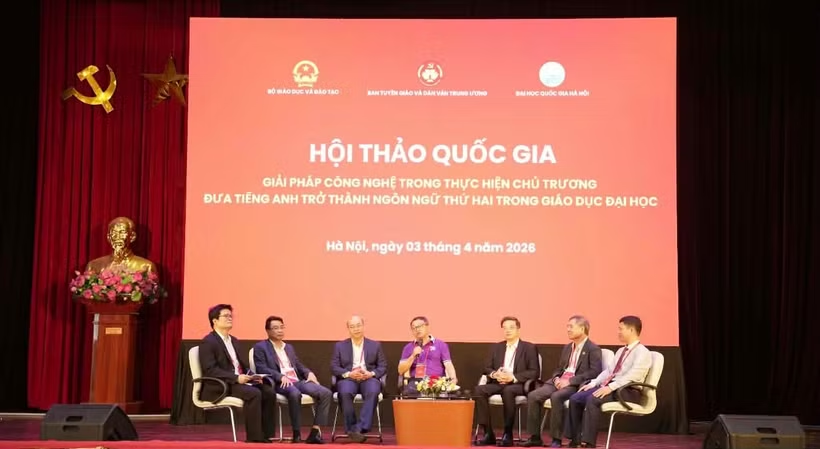
The Prime Minister has issued Decision No. 2371/QĐ-TTg dated October 27, 2025 approving the project “Making English a second language in schools for the period 2025–2035, with a vision to 2045”. To concretise this project, the education and training sector of Lang Son has implemented many solutions to improve the quality of English teaching and learning.
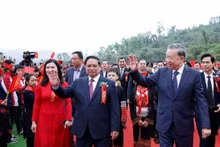
A grand groundbreaking ceremony for primary and secondary boarding schools in border communes was held on March 19 morning, with Party General Secretary To Lam and Prime Minister Pham Minh Chinh attending at the main venue in Dong Dang commune, the northern mountainous province of Lang Son.
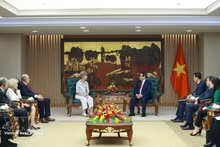
Prime Minister Pham Minh Chinh on March 17 received a visiting delegation from the Eisenhower Fellowships, during which he called for closer and more effective cooperation between Viet Nam and the US in education and training through new and breakthrough approaches, contributing to the development of high-quality human resources in various sectors, particularly emerging fields.

As education undergoes digital transformation, the Internet is becoming an essential part of school infrastructure. This has created an urgent need to design school Internet systems with safety built in from the outset, helping prevent and minimise online risks faced by students.

In recent years, many educational institutions have recognised artificial intelligence (AI) as an inevitable trend in education and digital transformation. To date, general education institutions have developed relatively effective plans to incorporate AI education, contributing to the development of students’ learning capacity, thinking skills and experiential learning.
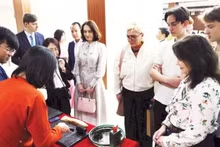
Launched at the beginning of 2026, the Space for Introducing Viet Nam’s World Documentary Heritage and Outstanding National Archival Documents under the State Records and Archives Department in Ha Noi is becoming a vivid visual classroom, contributing to bringing Resolution No. 80-NQ/TW of the Politburo on the development of Vietnamese culture into life through concrete experiences for the younger generation.
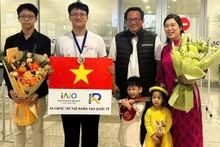
Tran Thuan Hieu, a student at Ha Noi–Amsterdam High School for the Gifted, has earned a silver medal at the 2026 International Artificial Intelligence Olympiad (IAIO).
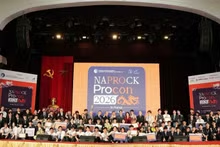
The 17th NAPROCK International Programming Contest (NAPROCK PROCON 2026) was held for the first time in Viet Nam, hosted by the University of Engineering and Technology under Vietnam National University, Ha Noi, in collaboration with the KOSEN Programming Contest Supporters Association (NAPROCK) and the Viet Nam Informatics Association.
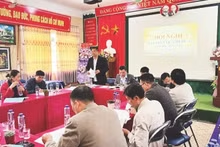
The mission of teachers today is not only to impart knowledge but also to possess compassionate hearts, inspire students, shape their character, and spread positive values to students. Each exemplary teacher helps further strengthen the tradition of “Venerating teachers and respecting morals,” affirming the great role of education in the country’s sustainable development and future.
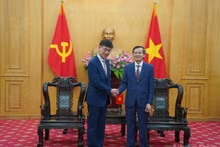
Associate Professor Dr Doan Minh Huan, Politburo member and Director of the Ho Chi Minh National Academy of Politics, on March 4 received Na Ki Hong, General Director of Samsung Viet Nam, and members of the leadership delegation of the company.
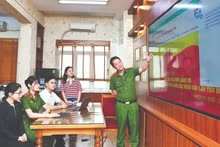
Artificial intelligence (AI) is transforming teaching and learning, making a significant contribution to the progress of modern education. Yet, alongside its promise and opportunities, the rise of AI in universities also brings considerable challenges.
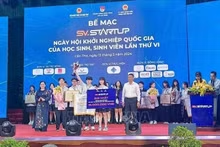
Deputy Prime Minister Le Thanh Long on February 25 signed Decision No. 336/QD-TTg, approving a programme on supporting student entrepreneurship for the 2026–2035 period.