This is one of the objectives aimed at enhancing the quality, competitiveness, and contribution efficiency of higher education institutions, thereby meeting the demands for high-quality human resource training, scientific research, innovation, technology transfer, and international integration.
On August 20, 2026, Deputy Prime Minister Le Tien Chau signed Decision No. 1612/QĐ-TTg approving the scheme to develop and improve the quality of higher education institutions in Ha Noi. The scheme sets a goal of having at least two higher education institutions ranked among the top 150 in Asia by 2030.
Under the scheme, higher education in Ha Noi is identified as a core component of the national higher education system and a strategic knowledge infrastructure for the Capital city, playing a leading role in training high-level human resources, fostering talent, conducting scientific research, driving innovation, and facilitating technology transfer.
The development and quality enhancement of these institutions must align with Ha Noi’s needs regarding high-quality human resources, research and development, and innovation.
Twelve higher education institutions are included in the scheme: Viet Nam National University, Ha Noi; Ha Noi University of Science and Technology; National Economics University; Ha Noi Medical University; Ha Noi National University of Education; Phenikaa University; Ha Noi Law University; Posts and Telecommunications Institute of Technology; University of Transport and Communications; Viet Nam National University of Agriculture; National University of Civil Engineering; and VinUni University.
Among the 12 selected institutions, Phenikaa University and VinUni University are the two representatives from the non-public sector. For higher education institutions with their own development schemes approved by the Prime Minister, implementation shall be carried out in accordance with the objectives and targets of those approved schemes.
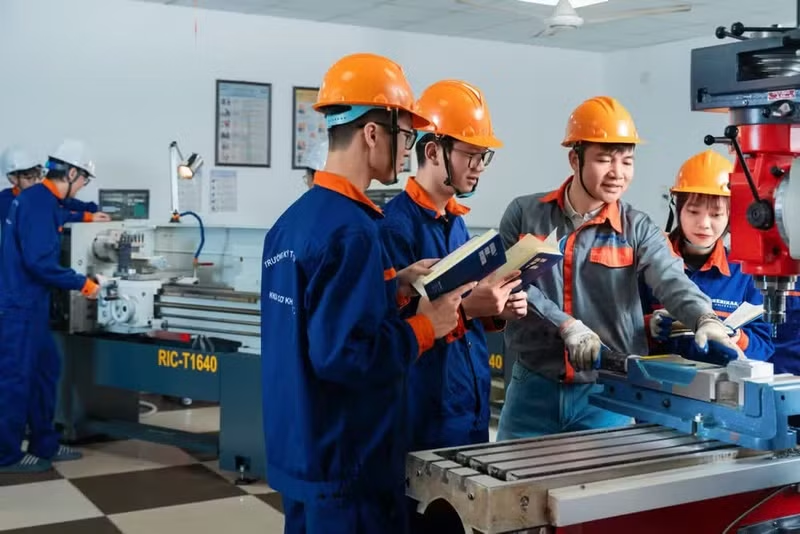
While international rankings serve as a visible indicator, elevating the standing of the capital's higher education sector requires—more importantly—enhancing the quality of research and training, applying research findings in practice, and preparing a workforce for emerging technology sectors.
Enhancing research quality
To achieve the initiative’s goals, key areas such as research quality, academic staff, international cooperation, governance, and the educational environment must be correspondingly upgraded. Experience across higher education institutions demonstrates that, alongside training, research plays an increasingly vital role in boosting a university’s quality and prestige.
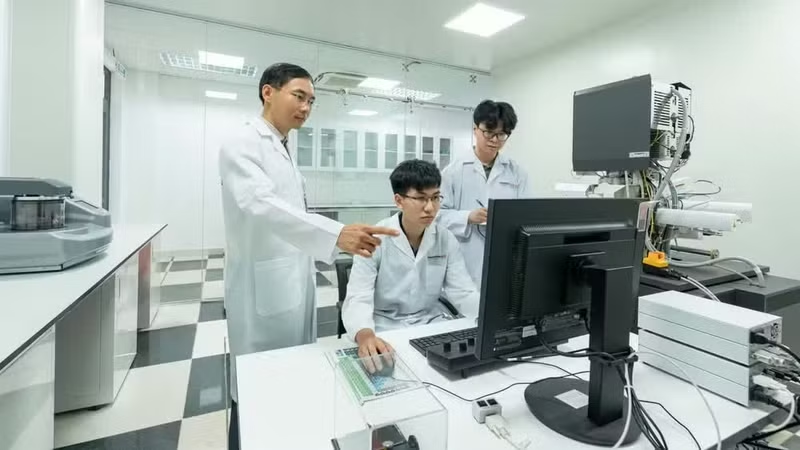
Between 2019 and 2025, Phenikaa University recorded nearly 3,100 international publications indexed in the ISI/Scopus systems; it maintained the top position among Vietnamese universities in the Nature Index for six consecutive years and ranked among the country's leaders in the SCImago rankings.
While publication and ranking results serve as indicators of research capacity, achieving sustainable transformation requires a commensurate enhancement of academic staff quality, international collaboration, the research environment, and training facilities.
For students, the value of research activities lies not only in publications but also in the opportunity to engage with scientific experts, laboratories, research projects, and academic networks during their studies.
Linking research with practical application
Translating research outcomes into technologies, products, and practical value is a key imperative for higher education institutions, particularly as innovation plays an increasingly vital role.
Phenikaa University currently holds over 40 granted patents, with a total of 115 patents and utility solutions under development, focusing on areas such as advanced materials and energy storage, robotics and autonomous systems, digital technology, and smart education.
Alongside research and technology transfer, developing human resources for strategic sectors is a crucial requirement in the evolution of higher education.

The initiative to select 12 higher education institutions mandates quality improvements across multiple dimensions—ranging from education and research to industry collaboration and human resource development. While international rankings serve as an indicator of standing, they are not the sole metric; effectiveness is also demonstrated through research capacity, technology transfer, the commercialisation of research findings, and workforce training.
The ultimate goal is to enhance the quality of education and research, increase contributions to socio-economic development, and create more opportunities for learners. These factors also serve as key criteria for evaluating the substantive progress of the objective to improve higher education institutions in the capital city by 2030, with a vision extending to 2045.