



Improving mechanisms and policies on food safety must aim to best protect public health, helping people feel more secure when using daily food products while creating a transparent and favourable environment for legitimate food producers and traders, said Party General Secretary To Lam on March 11.

In recent years, the National Target Programme for Socio-economic Development in Ethnic Minority and Mountainous Areas has significantly contributed to raising awareness and strengthening the role of women in mountainous regions. As a result, reproductive healthcare for women has gradually improved, and their quality of life has been markedly enhanced.

In recent years, at central hospitals such as Viet Duc Friendship Hospital and Bach Mai Hospital, the image of foreign medical students following Vietnamese doctors in operating rooms, clinics, and professional briefings has become familiar.
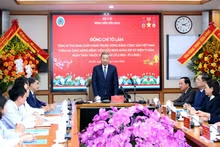
The health sector must remain steadfast in the ultimate goal of universal health coverage, ensuring that every citizen has timely and equitable access to quality medical services, with no one left behind due to geographical, economic or social barriers, Party General Secretary To Lam has stressed.

The work of protecting, caring for and improving people’s health has always received special attention from the Party and the State, with many priority guidelines, policies and objectives being set out and implemented. Thanks to this, Viet Nam has achieved impressive accomplishments, forming an important foundation for the entire health sector to confidently move forward on its journey to become one of the solid pillars in the country’s new era.

The documents of the 14th National Party Congress clearly set out the requirement to effectively implement the National Target Programme on Healthcare, Population and Development, ensuring that all citizens have access to quality primary healthcare services and receive free health check-ups at least once a year.

As the joyful atmosphere of spring fills the streets, many patients still have to remain in hospital and do not know whether they will be able to return home to celebrate Tet. Understanding those feelings, many hospitals have organised vibrant and heartfelt Tet activities to help ease, to some extent, the pain and worries caused by illness.

The Drug Administration of Viet Nam (DAV) under the Ministry of Health has issued a directive requesting localities and relevant units to implement measures to fully meet the demand for medicines for medical examination and treatment, particularly in disease prevention and control during the winter–spring season and the Lunar New Year (Tet) Festival.

Amid growing concerns about food safety, especially during holidays and the Lunar New Year (Tet), the application of technology to monitor and make food origins transparent is becoming an inevitable trend.

In the days leading up to the Lunar New Year (Tet), as many families busily prepare for reunions, at major hospitals, a significant number of seriously ill patients still have to stay for treatment.

On February 2, 2026, in Ho Chi Minh City, the Medical Services Administration under the Ministry of Health organised a conference to roll out tasks for medical examination and treatment in 2026. Member of the Party Central Committee and Minister of Health Dao Hong Lan attended and delivered a keynote address at the conference.

More than 1,000 older people in Ha Noi received free medical check-ups on January 31 as part of a health programme launched by the Viet Nam Young Physicians' Association.

The New Zealand Herald recently published an article by Christine Retschlag describing Viet Nam as a booming wellness and spa holiday destination, noting that the country offers treatments for virtually everyone, from luxury to affordable options.
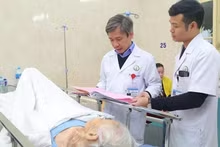
Viet Nam has been highly regarded by the international community for its achievements in meeting health-related development goals. Many indicators of essential health service coverage are higher than the regional average, and several health indicators outperform those of countries at a similar level of development.

On January 27, a workshop on healthcare digital transformation between the United Kingdom and Viet Nam was held in Ho Chi Minh City, providing an updated overview of the progress of digitalisation in Viet Nam’s healthcare sector and raising a number of core strategic issues.

The Mescells Regenerative Medicine and Cell Therapy System (Viet Nam) has officially signed a comprehensive cooperation agreement with Mt. Fuji GX Holdings (Japan) on the transfer of technologies for the production of stem cells and immune cells.

On January 27, the United Nations Population Fund (UNFPA) announced the conclusion of the official visit to Viet Nam by Dr Aleksandar (Sasha) Bodiroza, Acting Regional Director for Asia and the Pacific.

Viet Nam’s Ministry of Health has issued an urgent dispatch requesting hospitals and healthcare facilities to proactively prevent the spread of the Nipah virus following reports of cases in India.

Viet Nam remains among the top 15 countries worldwide with the highest rate of smoking among men, with more than 15 million users. Therefore, the need to add “risk factor reduction” to the Law on Prevention and Control of Tobacco Harms has become increasingly urgent.

The issuance of Resolution No. 72-NQ/TW marks a profound shift in awareness and action in the work of protecting, caring for and improving the people’s health. At the same time, it introduces comprehensive innovation with breakthrough solutions aimed at building a healthy Viet Nam, where all people receive healthcare, live longer, healthier and more wholesome lives, improve their physical wellbeing, raise awareness of health protection, and proactively prevent disease across society.