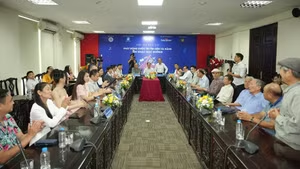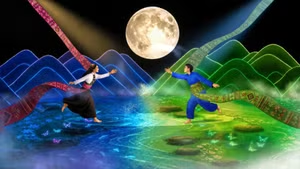
According to Le Van Phuoc, Vice Chairman of the An Giang Provincial People's Committee, the province's cultural space can be identified through its five principal cultural sub-regions: the Bay Nui (Seven Mountains) region, the Hau River region, the Western Sea coastal and island region, the port town of Ha Tien, and the U Minh Thuong Forest. Each sub-region has its own economic structure, social organisation, religious beliefs, and distinctive spiritual and cultural practices, but all are blended into a common flow.
According to Le Van Phuoc, the province is home to 152 officially recognised historical and cultural sites. The United Nations Educational, Scientific and Cultural Organisation (UNESCO) has recognised the Art of Don Ca Tai Tu Music and Song in Southern Viet Nam and the Ba Chua Xu Festival at Sam Mountain as Representative Intangible Cultural Heritage of Humanity.
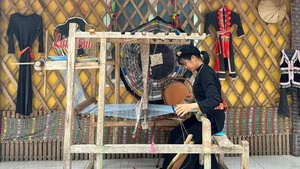
In addition, the province is home to 10 national intangible cultural heritages: the Nguyen Trung Truc Communal House Festival; the Bay Nui Ox Racing Festival; the unique knowledge and techniques of engraving letters on palm leaves; the Ky Yen Festival at Thoai Ngoc Hau Communal House; the Du Ke theatrical performance art of the Khmer people; the life-cycle rituals of the Cham Islam community; the traditional craft of producing Phu Quoc fish sauce; the traditional brocade weaving craft of the Cham people; the craft of producing palm sugar of the Khmer people; and the Chhay Dam drum performance art of the Khmer people.
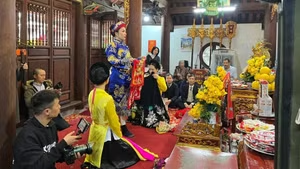
The culture of the Hau River has evolved from the cradle of a river-based civilisation, closely associated with agricultural cultivation, the lives of floating traders, inland waterway trade, and a rich system of folk beliefs. A particular highlight is the National Ba Chua Xu Festival at Sam Mountain, held in Vinh Te Ward, which is both a large-scale religious heritage and a significant driver of the tourism industry.
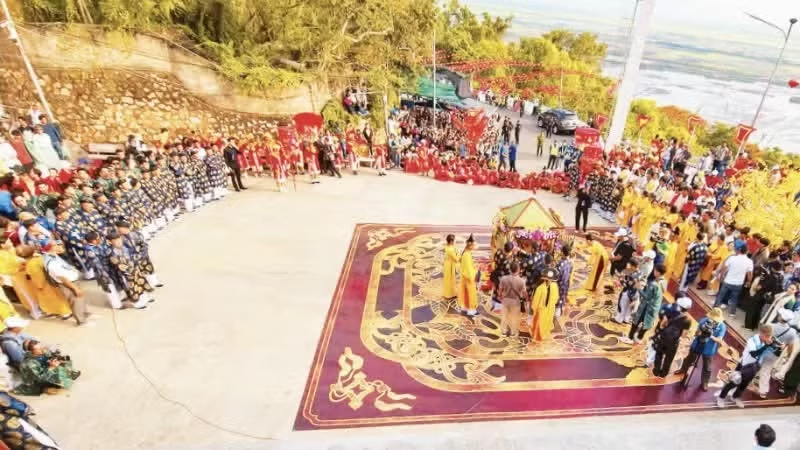
During the peak of the Ba Chua Xu Festival, held annually from the 21st to the 27th day of the fourth lunar month, streams of visitors make their way to Sam Mountain to take part in the celebrations. The festival represents a vibrant meeting point in the cultural traditions of the Kinh, Khmer, Cham, and Hoa communities. One of its most solemn ceremonies is the re-enactment of the procession of the statue of Ba Chua Xu Goddess from the summit of Sam Mountain down to its foot. The mountain, usually tranquil, comes alive with the footsteps of tens of thousands of pilgrims.
Le Thi Ngoc Hieu, a farmer from Dong Thap Province, shared: "This is the tenth time I have had the good fortune to take part in the ceremony. Every time, I climb the mountain very early in the morning before joining the procession accompanying the palanquin carrying Ba Chua Xu's statue down the mountain. We only reach the foot of the mountain late at night. It's exhausting, but joyful. With every step, I quietly pray for favourable weather, abundant harvests, and good fortune."
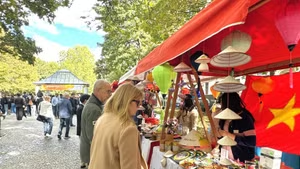
An Giang is also home to the Nguyen Tieu Festival celebrated by the Hoa community in Ha Tien and Long Xuyen, which vividly reflects the cultural traditions of the Hoa people in the province. Meanwhile, the Ramadan and Roya Haji festivals of the Cham community serve as occasions for gathering at mosques, sharing welfare, and maintaining family ties, reflecting the community's strong social cohesion.
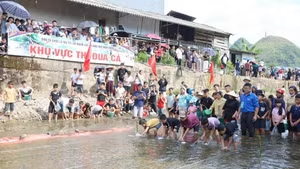
The Khmer Ox Racing Festival in the Bay Nui region marks the beginning of the farming season and embodies an agricultural philosophy rooted in tradition. Along the Kien Luong–Ha Tien coastline, whale worship festivals, fishermen's thanksgiving festivals, and other maritime activities recreate the traditional knowledge of exploiting marine resources and the close relationship between coastal communities and the sea. These festivals create the cultural interaction between the Kinh tradition of whale worship and the folk religious practices of the Hoa and Khmer communities associated with the sea, clearly demonstrating the multicultural character of the Western Sea region.
The province is also renowned for the scenic landscapes of the Ha Tien region, Sam Mountain, the forests and mountains of Bay Nui, the U Minh Thuong cajuput forest and the Western Sea archipelagos. Traditional craft villages likewise possess distinctive characteristics: the Cham people's brocade weaving with its elegant and refined weaving techniques; the Khmer people's traditional pottery with its hand-moulding techniques; and the fish sauce and dried seafood processing industries of the coastal communities of Kien Luong and Ha Tien, with their experience in fermenting fish to create products that bear the distinctive mark of the Western Sea region.
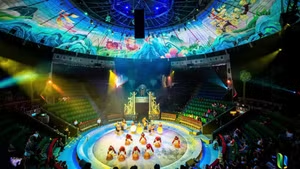
This wealth of indigenous cultural resources has become a powerful driver of tourism development. In 2025, the province welcomed more than 24 million visitors. During the first six months of 2026, it received more than 12 million visitors, including 1.3 million to Ha Tien and more than 3.9 million to Sam Mountain.
Along with its advantages, An Giang is facing many challenges in preserving and promoting its core values. These include the disparity in development speed between modern urban areas and remote border, mountainous, and coastal regions, leading to uneven infrastructure investment and unequal access to cultural life. The growing commercialisation of festivals, driven by tourism growth target, also poses a risk of diminishing their solemnity and distorting traditional values if not strictly controlled and professionally standardised by authorities.
Furthermore, the negative impacts of climate change and environmental changes have significantly reduced the space available for traditional craft villages and community institutions closely linked to the local people’s livelihoods.
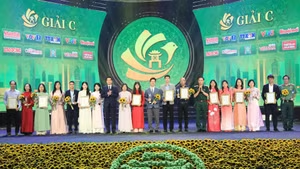
To address these challenges, the Provincial People's Committee has issued the project "Preserving and promoting the cultural identity of An Giang Province" for the 2026–2030 period. The implementation roadmap comprises three key phases. Some of its major priorities are to accelerate the digitisation of cultural heritage, establish a comprehensive and integrated database, and develop the "An Giang Cultural Map" platform to manage, promote, and enhance the province's distinctive cultural values in the digital environment.
The project aims to preserve, restore, and promote the province's heritage system in a comprehensive and systematic manner, ensuring its integrity while enabling it to adapt flexibly to new development conditions. It will establish a complete ecosystem that further positions the province as the cultural, festival, spiritual, coastal, and mountain centre of the south-western region of Viet Nam. The "An Giang Culture" brand will be promoted stronger through inter-provincial events, digital communications, and stronger connections between tourist destinations.