However, the clear commitments recently articulated by the Prime Minister of Timor Leste during his visit to the ASEAN Secretariat show that, although the road ahead remains full of challenges, with determination and sustained efforts, Timor Leste can fully become a “perfect piece” in the picture of the ASEAN Community.
Speaking during his first visit to the ASEAN Secretariat since Timor Leste joined the association, Prime Minister Xanana Gusmao stressed that becoming an ASEAN member is a “historic milestone”, realising the country’s aspiration for integration. In 2011, less than 10 years after gaining independence, Timor Leste submitted its application to join ASEAN.
After 14 challenging years of meeting reform and development requirements, in 2025, the people of Timor Leste burst into joy as the country officially became a member of the “common home”. One journey has come to a close, while a new and demanding chapter opens for Timor Leste to integrate more deeply and truly merge into the shared flow of Southeast Asia.
Official ASEAN membership has granted Timor Leste a “golden passport” to enter a development space filled with broad opportunities.
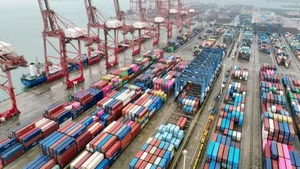
These include access to the dynamic and highly promising ASEAN market of nearly 700 million people, along with an extensive partner network and trade agreements such as the ASEAN–Australia–New Zealand Free Trade Area and the Regional Comprehensive Economic Partnership (RCEP).
It also offers the opportunity to contribute a voice to development policy-making processes, as well as to addressing regional and international issues. If this opportunity is well leveraged, Timor Leste can accelerate economic development, engage more deeply in supply chains and regional cooperation frameworks, and enhance its presence on the global “playing field”.
However, “every beginning is difficult”. Despite having spent a long time preparing for its role as an official ASEAN member, Timor Leste still faces a host of challenges on its integration journey ahead.
Above all are the “hard problems” in the economic sphere. Although endowed with abundant natural resources, Timor Leste’s economy remains heavily dependent on oil revenues.
Petroleum products account for as much as 90% of the country’s total export turnover. The Southeast Asian nation is striving to diversify its economy, but this is not an objective that can be achieved “overnight”.
In addition, President Jose Ramos-Horta has acknowledged that Timor Leste also needs to unblock a number of bottlenecks hindering its development, such as poverty and unemployment.
To keep pace with the development speed of other ASEAN member states, Timor Leste is working to fill existing gaps. Mr Ramos-Horta has candidly affirmed that the country is ready to adapt to become increasingly complete.
In reality, ASEAN’s 11th member has a solid foundation to realise its goals. With rich natural resources, a strategically important geostrategic location linking Southeast Asia with the Indo-Pacific, and a young population — more than 70% under the age of 35 — Timor Leste possesses the vitality of an economy with great potential.
To unlock these potentials, together with the opportunities brought by ASEAN membership, Timor Leste is continuing to build a more effective administrative apparatus, while placing emphasis on developing a skilled workforce that meets the country’s development requirements. ASEAN Secretary-General Kao Kim Hourn believes that the 11th member will inject “new vitality” into the Association.
Joining ASEAN provides Timor Leste with a strong platform for development, but membership itself is only the “key” to opening the first door. The next steps depend entirely on the determination and efforts of the country itself.
Timor Leste’s upcoming integration journey will certainly not be a path strewn with roses, and may be fraught with many difficulties, but if these challenges are overcome, the destination will be a glorious one, bringing lasting prosperity to the nation.