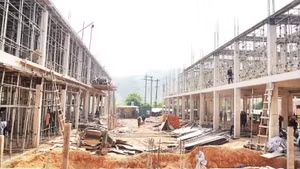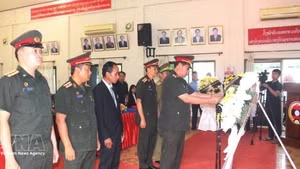
Clear improvements in occupational safety and hygiene
Chu Thi Hanh, Deputy Director General of the Employment Department under the Ministry of Home Affairs, said that amid the nationwide restructuring and streamlining of the administrative system, as well as the impact of global conflicts and tariff policies on domestic economic development, occupational safety and hygiene work has faced significant challenges. However, thanks to the efforts of the entire political system, this work recorded clear improvements in 2025.
Specifically, according to the Employment Department, both the number of labour accidents and the number of injured workers decreased significantly in 2025, especially in the formal employment sector. The number of fatal accidents, deaths, and material losses also declined.
Based on reports from all 34 centrally governed provinces and cities, there were 7,004 labour accidents nationwide (down 1,282 cases, or 15.47% compared with 2024), affecting 7,156 people (down 1,316 people, or 15.53% year on year). Fatal labour accidents totalled 621 cases, a decrease of 63 cases (down 9.33%), including 475 cases in the formal employment sector (down 60 cases, or 11.21%).
The number of deaths due to labour accidents was 658, down 69 cases (9.49%) compared with 2024. In the formal employment sector, there were 508 deaths, down 76 cases (13.01%). Meanwhile, material losses caused by labour accidents dropped sharply from more than 42,565 billion VND in 2024 to 14,026 billion VND in 2025.
Working conditions also improved across many aspects. Among 1,110,082 environmental monitoring samples, 36,655 samples failed to meet permitted standards (accounting for 3.3%), with a decline in most factors that were not meeting standards, especially toxic gases and lighting conditions.
In 2025, about 3 million workers received periodic health check-ups, an increase of 70% compared with 2024. Workers classified as having good health (Grade I and II) accounted for 74%, while Grade III accounted for 21%. Those with weaker health (Grades IV and V) made up 5%, down 6% year on year.
During the 2025 Month of Action on Occupational Safety and Hygiene, many practical activities were widely implemented.
Authorities at all levels, organisations and enterprises visited, supported and provided gifts to 9,611 victims and families affected by labour accidents and occupational diseases. A total of 17,850 inspections and self-inspections were carried out, including 16,400 self-inspections. Nearly 30,000 safety risks and hazards were identified, and almost 11,000 workplace safety rules and procedures were developed, issued and publicly posted.
At the same time, emulation movements on occupational safety and hygiene continued to be promoted by trade unions at all levels. More than 32,000 grassroots trade unions launched campaigns involving 879,604 participants and 12,674 initiatives. A network of more than 210,000 safety officers was established across 22,921 enterprises, contributing to maintaining effective occupational safety practices, promptly detecting risks, and preventing labour accidents and occupational diseases.
Notably, trade unions have issued and are implementing the project on “Promoting the development of a workplace safety culture for the 2025–2030 period”, aiming to shift from “awareness” to “culture” and from “compliance” to “self-discipline” among workers and businesses.
Communication and awareness-raising activities on occupational safety and hygiene were also strengthened and diversified. More than 4.5 million people received safety training while over 5.3 million machines and equipment underwent safety inspections.
Challenges remain
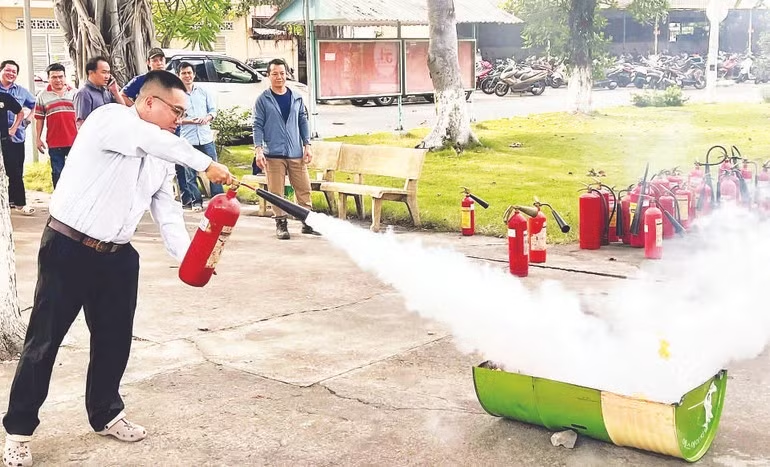
According to the Deputy Director General of the Employment Department, despite efforts and positive results, occupational safety and hygiene still face major challenges.
Firstly, the number of labour accidents, occupational diseases, and serious incidents remains high and has not shown a stable downward trend.
Labour accidents among workers without formal labour contracts have increased. In 2025, there were 146 fatal accidents in this group, up six cases (4.29%) compared with 2024, causing 150 deaths (up seven cases, or 4.9%). The number of seriously injured people reached 1,779, up 89 cases (5.27%), rising in both formal and informal sectors.
Data from the healthcare system showed 17,202 cases receiving emergency treatment or initial care for labour accidents.
Incomplete statistics indicate that total costs related to labour accidents and property damage exceeded 14,068 billion VND, including more than 25 billion VND in property losses and over 126,220 lost working days. Sectors with high numbers of fatal accidents include construction, textiles, footwear, electricity, and mining. Localities with many accidents include Ho Chi Minh City, Ha Noi, Quang Ninh, Hai Phong, and Lao Cai.
In 2025, 865,143 workers who were exposed to harmful factors underwent occupational disease screening, up about 51% compared with 2024. Among them, 51 new cases of occupational disease were diagnosed, accounting for around 0.005% of those examined.
Meanwhile, due to organisational restructuring, the number of units participating in trade union-led safety movements declined. The number of initiatives to improve working conditions also decreased compared with 2024. The workforce responsible for occupational safety management at both central and local levels also experienced fluctuations. In 2025, investigation reports received by the Ministry of Home Affairs accounted for only about 10.73% of all fatal labour accidents nationwide.
The causes include a lack of attention from some employers in complying with occupational safety regulations and improving working conditions; weak and formalistic safety management; insufficient training and awareness among workers; and limited industrial discipline. In some areas, local authorities have failed to prioritise or allocate sufficient resources for occupational safety and hygiene.
Improving the legal and policy framework for occupational safety and hygiene
Chu Thi Hanh emphasised that several key solutions are required to implement the Resolution of the 14th National Party Congress and Directive No. 31-CT/TW (dated March 19, 2024) of the Secretariat on strengthening Party leadership in occupational safety and hygiene.
In the short term, it is necessary to improve the legal and policy framework for occupational safety and hygiene, especially the Law on Occupational Safety and Hygiene, in a more enabling and development-oriented direction. Policies should be developed to promote the prevention of labour accidents and occupational diseases, alongside nationwide emulation movements. Administrative procedures in this field should continue to be reviewed, simplified, and reduced. Communication efforts should be strengthened and violations strictly handled. Greater attention should be paid to safety control at workplaces and along supply chains to support exports.
At the same time, authorities at all levels, especially at the grassroots level, need to allocate adequate human and financial resources to effectively implement occupational safety and hygiene measures in line with ongoing administrative restructuring. Greater attention should also be given to the informal sector, including household production units, craft villages, farms, and fishermen, as well as high-risk industries such as mining, construction, chemicals, mechanics, and electricity.
Employers must improve the effectiveness of occupational safety management, apply digital transformation in safety management, enhance working conditions, and control risks at workplaces. They should also review safety procedures, guidelines, and warnings as well as organise training and share lessons learned from accidents and incidents.
Mass organisations should continue to raise awareness and encourage members and workers to actively adopt measures to improve working conditions and comply with occupational safety and hygiene regulations.