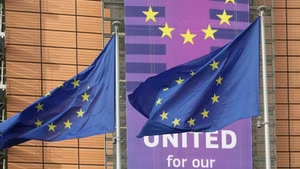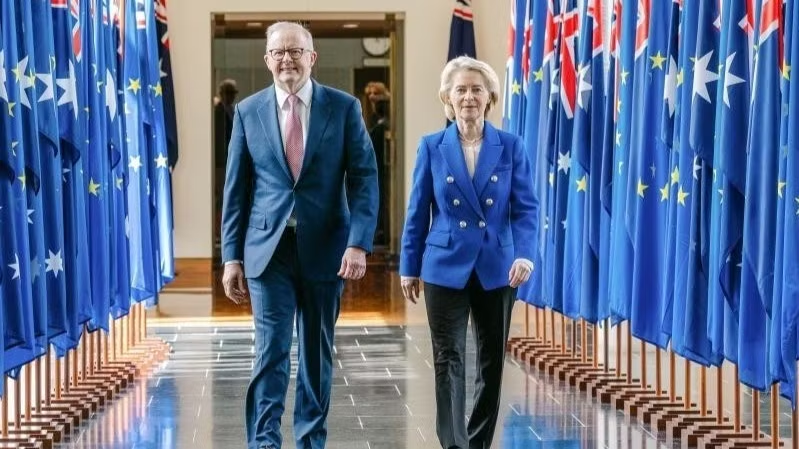
The relatively brief statement was issued following talks between Australian Prime Minister Anthony Albanese and President of the European Commission (EC) Ursula von der Leyen in Canberra. Naturally, this “brief announcement” was the result of more than eight years of tireless negotiations. At times, the process appeared to reach a deadlock, as differences at the negotiating table seemed difficult to bridge.
Another factor that led observers to temper expectations regarding the agreement’s conclusion was the low-key nature of the EU delegation’s visit to Australia, led by von der Leyen. Analysts had assumed that, had the delegation travelled to finalise and sign the FTA, the atmosphere would have been far more celebratory and public. Nevertheless, both sides ultimately achieved a positive outcome, opening up significant opportunities for businesses and citizens of the two economies across the two continents.
The EU and Australia expressed satisfaction in announcing that the agreement will be implemented once internal procedures are completed. It is expected to significantly reduce trade and investment barriers between the two economies and promote deeper cooperation in key sectors such as critical raw materials and defence, particularly amid increasingly unpredictable global trade and security conditions.
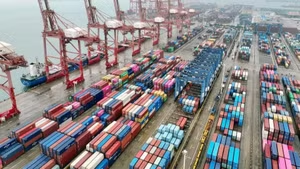
Under the agreement, 99% of EU goods exported to Australia will have tariffs eliminated, a move which, according to EC President von der Leyen, will save up to 1 billion EUR in duties annually.
Conversely, more than 98% of Australian exports will enjoy tariff-free access to the EU market. Prime Minister Albanese noted that the EU’s removal of nearly all tariffs on agricultural products, key minerals, and other goods will generate approximately 10 billion AUD for the Oceanian nation, while also contributing to the stabilisation of global supply chains.
A longstanding sticking point in previous negotiation rounds, seemingly minor issues at first glance, had at times pushed talks to the brink of collapse: beef and lamb. However, following successful compromises, both sides demonstrated flexibility and mutual understanding.
The EU agreed to establish tariff-rate quotas of 30,600 tonnes and 25,000 tonnes per year for Australian beef and lamb exports, respectively. Of these, 55% will be duty-free, while the remainder will be subject to a modest tariff of 7.5%.
Reciprocating the EU’s goodwill, Australia agreed to eliminate tariffs on approximately 75% of electric vehicles, including many originating from Europe.
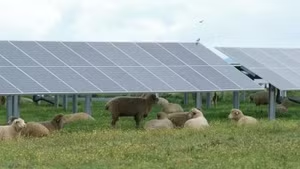
In the field of raw materials, the EU and Australia also agreed to strengthen cooperation to ensure stable supplies of essential resources such as lithium, aluminium, and manganese — key components in battery production and renewable energy technologies. The agreement is expected to provide EU businesses with more reliable access to these supplies.
The FTA has been widely regarded as a mutually satisfactory outcome for both sides. Speaking at a press conference following the talks, EC President von der Leyen stressed that the agreement sends a strong message of core cooperation and mutual trust in a rapidly changing world, where major powers increasingly use tariffs as instruments of pressure.
Prime Minister Albanese affirmed that the agreement stands as a powerful testament to free and fair trade based on international rules. Thus, the successful conclusion of EU–Australia trade cooperation has borne fruit at the very beginning of 2026.