In An Giang Province, alongside the restructuring and reorganisation of infrastructure, textbooks for the 2026–2027 school year have attracted considerable public attention. The nationwide adoption of the “Connecting knowledge with life” textbook series published by Viet Nam Education Publishing House marks a turning point, bringing to a close a period in which the use of multiple textbook series caused considerable disruption to teaching and learning.
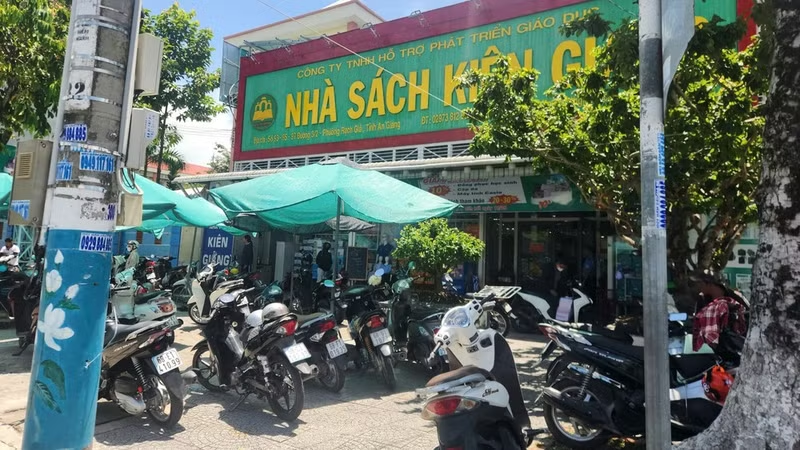
However, this systemic change has immediately created a supply-and-demand challenge in the market. Images of parents crowding into bookshops in recent days, resulting in localised overcrowding, have served as an early warning of potential textbook shortages at the start of the school year.
With hundreds of thousands of students switching to a single textbook series at the same time, pressure on printing, publication and distribution has reached a peak. Without timely measures to regulate supply and demand, shortages, hoarding or delays in textbook deliveries by the start of the school year could directly affect students' right to education.
Against this backdrop, the approach adopted by An Giang's education sector demonstrates pragmatism and responsibility by making it clear that textbooks should not be purchased indiscriminately or wastefully, while no student should be left without textbooks when the new school year begins.
Accordingly, the education sector has asked schools to conduct detailed inventories of textbooks that remain usable and make maximum use of “Connecting knowledge with life” textbook sets already in circulation from previous years. Establishing and expanding shared textbook libraries, as well as collecting and reallocating textbooks between classes and schools, will significantly reduce the need for new purchases.
For textbook series on the former list that are no longer used under the nationwide standardised system, the province has instructed relevant authorities to classify them and assess their condition to determine appropriate measures for managing public assets.
While awaiting the Government's roadmap for providing textbooks free of charge nationwide, An Giang continues to mobilise resources to support disadvantaged groups, including poor students, ethnic minority students and those in border areas. Support from philanthropists and businesses through the socialisation of shared textbook libraries is expected to help ease the financial burden on low-income families ahead of the new school year.
What is happening in An Giang is not merely a matter concerning one locality, but also reflects the broader picture of Viet Nam's education sector during a crucial period of transition. Streamlining 52.2% of school and class administrative units and proactively managing textbook demand demonstrate a clear shift from an “administrative management” mindset towards “development-oriented governance”.
Reorganising schools and classes is not simply a matter of merging two or more schools into one. It is about optimising resources, improving the quality of the workforce, and directing investment towards digital transformation, raising teacher standards and developing smart-school models.
Likewise, adopting a single standardised textbook series does not mean requiring every family to purchase new books. Instead, it provides an opportunity to foster a culture of sharing and thrift through shared textbook libraries in schools.