In this spirit, airspace is no longer viewed merely as a technical domain serving flight operations, but as a development resource, an integral part of national sovereignty and a key component of national competitiveness.
A turning point in thinking and the imperative for reform
For the field of air navigation services, Resolution 79 sets out clear and direct requirements: to improve mechanisms for managing, exploiting and protecting airspace; to modernise air traffic management systems; to ensure airspace safety and security; and to promote controlled trial mechanisms to pave the way for the low-altitude economy, the aviation industry, and new operational models. This is not only a macro-level direction but also a practical mandate for agencies and units directly involved in governing national airspace.
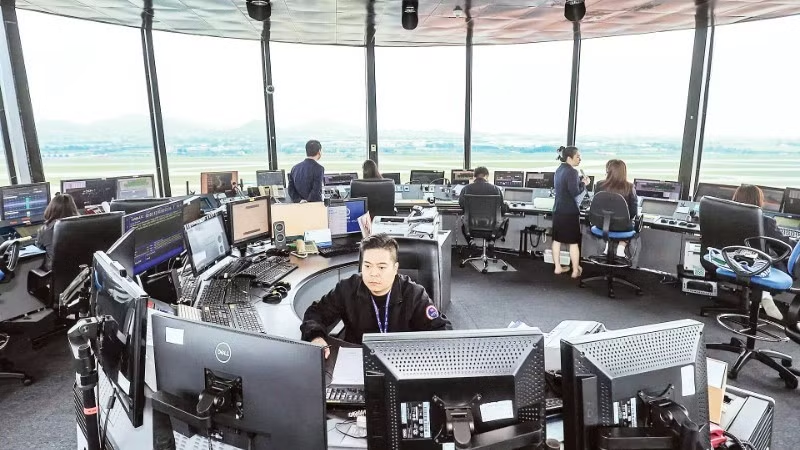
In this context, the Viet Nam Air Traffic Management Corporation (VATM), a wholly state-owned enterprise responsible for providing air navigation services associated with national defence, security, and airspace sovereignty, is currently delivering services across the Ha Noi and Ho Chi Minh City Flight Information Regions (FIRs), covering a responsibility area of over one million square kilometres.
In 2025, VATM ensured absolute safety for all flights within its area of responsibility, handling more than 930,000 movements. Cumulatively, by the end of 2025, the total number of flights safely managed had exceeded 13.5 million.
At the same time, the Ha Noi-Ho Chi Minh City corridor continues to rank among the busiest domestic routes in the world, highlighting an increasing pressure on airport infrastructure, airspace organisation, and national air traffic management capacity.
Accordingly, the implementation of Resolution 79 at VATM must be translated into a new governance mindset, and into an action programme with clear objectives, priorities, measurable indicators, and robust monitoring and evaluation mechanisms.
At the heart of this transformation is a shift from a technical management mindset to one of creating resources from national airspace, and from fragmented operational practices to integrated, cross-sectoral governance driven by data and aligned with international standards.
For the air traffic management sector, the implications of this shift are profound. Airspace is no longer simply an operational domain but an intangible infrastructure of the economy, directly shaping aviation connectivity, logistics, trade, tourism, investment, and international integration.
Therefore, air traffic management is not merely a technical activity but the governance of a strategic state resource, closely linked to sovereignty, foreign affairs, national defence, security, and national reputation.
In this domain, modernisation cannot rely solely on increased investment in equipment or linear expansion of infrastructure. More importantly, it requires simultaneous innovation in operational thinking, improved inter-agency coordination mechanisms, standardised accountability, enhanced implementation capacity, and the establishment of performance measurement systems incorporating both financial and non-financial indicators.
Air navigation services must maintain continuity and high reliability and responsiveness in all situations, including unexpected requirements related to national defence, security, emergencies, or search and rescue.
One of the most significant provisions of Resolution 79 for VATM is the requirement to refine mechanisms for managing, exploiting, and protecting airspace and air defence identification zones; to modernise air traffic management systems; to ensure airspace safety and security; and to implement controlled sandbox mechanisms to promote the space economy, low-altitude economy, and aviation industry.
Modernising air traffic management
As a wholly state-owned enterprise operating in air navigation infrastructure, VATM must continue to be strengthened as a core material force of the state sector in transport, logistics, and aviation digital infrastructure.
This means that airspace governance is not merely a routine technical task, but the management of a strategic resource tied to sovereignty, national defence, security, and Viet Nam’s international standing.
In the coming period, it is essential to further standardise civil-military coordination mechanisms in the allocation, use, and organisation of airspace, guided by the principle of “one airspace, multiple objectives, but a unified operational command” — optimising for development while never compromising safety and security, and maintaining a high level of readiness to respond to urgent national requirements.
The Ha Noi-Ho Chi Minh City route’s position among the busiest domestic air corridors globally reflects not only strong transport demand but also the fact that air traffic flow management has become an indispensable governance tool rather than merely a supporting measure.
The commissioning of the new Ho Chi Minh City Area Control Centre in December 2025 marks an important technical milestone. However, achieving a breakthrough in capacity will require a more comprehensive modernisation architecture.
An appropriate direction is the realisation of a “smart sky” model built on key pillars: modern, multi-layered, and resilient air traffic management infrastructure; optimised airspace organisation and flight procedures aligned with capacity; and advanced air traffic flow management.
The deeper objective is to develop a “digital sky”, where data, standards, digital platforms, and connectivity determine both the quality of air traffic operations and corporate governance.
Resolution 79 also calls on state-owned enterprises to take the lead in investing in science and technology, innovation, and digital transformation, while encouraging the establishment of research and development centres, laboratories, and results-based research commissioning mechanisms.
The low-altitude economy represents a new and rapidly evolving development space, closely linked to national defence, security, public order, and safety.
In light of the requirement under Resolution 79 to implement sandbox mechanisms in this field, VATM must proactively prepare both its policy advisory capacity and its technical system design capabilities.
At the corporate level, an action programme should be promptly finalised and issued, clearly defining objectives, tasks, timelines, lead units, coordination mechanisms, required resources, and performance indicators, and directly linking these with projects, schemes, and workstreams that can be implemented immediately.
Effective implementation within VATM will only be achieved when it is closely tied to leadership accountability, regular reporting, ad hoc inspections, and outcome-based evaluation.