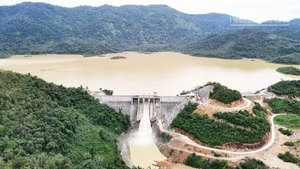
Against this backdrop, promoting comprehensive and long-term solutions to safeguard water resources has become more urgent than ever.
Eight hours a day was the amount of time Damaris, a woman living in rural Kenya, once had to spend simply collecting water. Almost every morning, she would leave her village and begin a journey in search of water for her family’s daily needs. If fortunate, she might find water in Iagha, a small seasonal river. On other days, she would return home with an empty container and deep disappointment.
Damaris’s life changed only when a US-based charity helped install a solar-powered borehole near her home, providing clean water to nearly 300 households in the area and enabling them to meet their needs for daily use, livestock, and farming.
However, not everyone is fortunate enough to escape long days spent searching for clean water like Damaris. According to the United Nations, more than 2.1 billion people worldwide still lack access to safe drinking water. Millions of households continue to rely on water sources located outside their homes. In rural and low-income areas lacking basic infrastructure, many families depend on unreliable sources such as rivers, streams, or distant public taps.
The global water crisis affects millions, but women and girls bear the heaviest burden. The United Nations reports that in two-thirds of households without water at home, women are responsible for collecting it.
Globally, women and girls spend a combined 200 to 250 million hours each day walking to distant wells, rivers, or public taps to fetch water—three times more than men. Cecilia Sharp, Director of Water, Sanitation and Hygiene at the United Nations Children’s Fund (UNICEF), noted that “every step a girl takes to collect water is a step away from education, play, and safety”. The cost of lacking clean water is often devastating, even fatal. Each day, around 1,000 children under the age of five die from diseases related to unsafe water.
Freshwater is not a luxury; it is a fundamental resource underpinning food security, agricultural and industrial development, and social stability. As such, water scarcity carries serious economic consequences. The Global Commission on the Economics of Water (GCEW) warns that without timely intervention, more than half of global food production could be severely threatened by 2050.
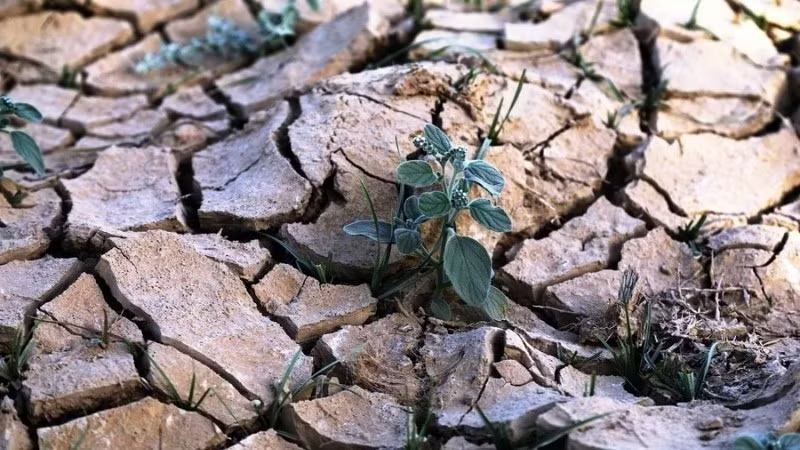
Alarmingly, water scarcity is expected to worsen in the coming years, particularly in regions heavily affected by climate change, rapid urbanisation, and population growth. The United Nations University Institute for Water, Environment and Health (UNU-INWEH) has warned that global water resources are being exploited beyond their capacity to recover, pushing the planet into a phase of “water depletion”. Signs of increasing freshwater scarcity are becoming ever more evident.
Large lakes are shrinking; the flow of major rivers to the sea is being disrupted at certain times of the year; approximately 410 million hectares of wetlands have disappeared over the past five decades; and 30% of the world’s ice has been lost since 1970, reducing seasonal meltwater supplies. In addition, around 70% of major groundwater reserves—used for drinking and irrigation—are showing long-term decline.
These realities serve as a stark warning of the urgent need for global policies to protect water resources. The United Nations has called on the international community to work together to address freshwater scarcity and achieve the Sustainable Development Goal (SDG) of ensuring clean water and sanitation for all by 2030.
![[In Pictures] Bridge columns and underpasses in Ha Noi begin to turn green](https://en-cdn.nhandan.vn/images/nyM650OGFWrOVWc-xajqN-rTZ68Rlmc1fiGJOhBRYHH_N-Xs0TE8Psnfce7ORTs-KVfoJaEblqjNufFrgeF3e2xFkGtLQVaXm04VcmMKBEkANUyiOkpz4zAuIKgydVrrfBxmGez0E_YJIag0u_Uil0E7jpuJXsIxeMmGjoY1-W4/1791863309074-2994714492692222878-2994714492692222878-adb9ff3f4175c70066ed8bb80cfbead9.jpg.avif)