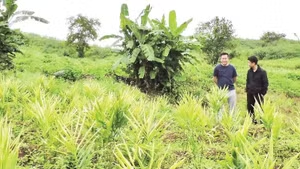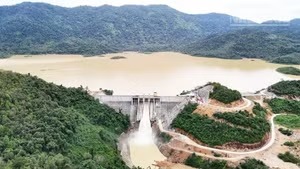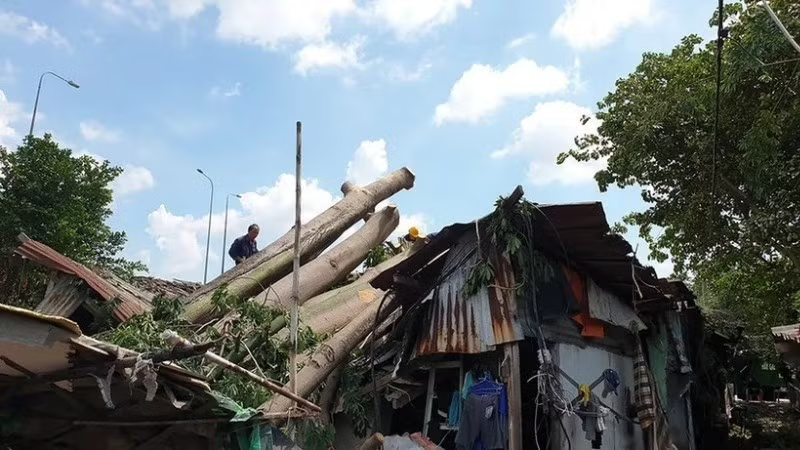
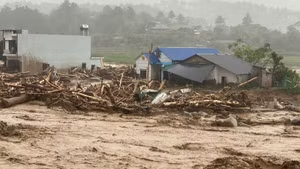
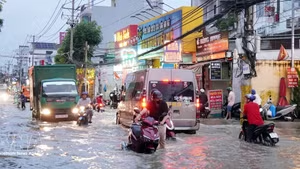
Natural disasters have claimed 419 lives, left people missing, injured 587 others, caused 4,485 houses to collapse and damaged or stripped the roofs from 337,110 homes. A total of 874,187 hectares of rice, crops and other plants were inundated, while 59,125 hectares of aquaculture suffered losses. Total damage is estimated at around 97.064 trillion VND. Compared with 2024, the number of fatalities caused by natural disasters has declined (419 compared with 519), but economic losses have risen (97.063 trillion VND compared with 91.622 trillion VND).
In practice, disaster response has shown that preparedness always plays a pivotal role, first and foremost through monitoring, forecasting and early warning capacity.
In recent years, the State, together with businesses, social organisations and the international community, has invested in strengthening observation and forecasting capabilities. At the same time, rapid advances in science and technology—particularly digital technologies and artificial intelligence—are opening up new opportunities to improve forecasting effectiveness.
In addition to satellite data, many automatic rainfall gauges, radar systems and sensors measuring temperature, wind, water levels, flow velocity and land movement are being deployed. These allow for faster data integration, more accurate localised modelling and timely dissemination of information to the public. However, as natural disasters become increasingly unpredictable and diverse, monitoring and warning work still falls short of practical requirements.
Therefore, to enhance the effectiveness of disaster prevention and control, alongside State investment, it is necessary to further promote socialisation, selecting enterprises with sufficient capacity and resources to invest in applying scientific and technological solutions to develop specific warning models.
At the same time, localities need to study and develop flood and landslide risk simulations by region and severity level, gradually refining them to support proactive warnings. These technologies will only be effective when combined with investment in monitoring equipment, warning systems and a stable operating apparatus that is maintained over the long term.
A typical example is the past 17 years, during which the Community Fund for Disaster Prevention has mobilised social resources to install nearly 1,000 automatic rainfall measurement and flood warning stations. It is currently continuing to coordinate support for salinity monitoring equipment, landslide warning systems, the development of digital warning platforms and grassroots disaster response teams; management is integrated via smartphone and computer applications through dedicated software.
To enhance the effectiveness of disaster prevention and control, alongside State investment, it is necessary to further promote socialisation, selecting enterprises with sufficient capacity and resources to invest in applying scientific and technological solutions to develop specific warning models.
In the longer term, stakeholders need to increase investment in basic research on different types of natural disasters, establish scientific foundations and advanced forecasting models, and modernise multi-layered monitoring and observation systems.
Efforts should be intensified to apply remote sensing technologies, satellite imagery, unmanned aerial vehicles (UAVs), artificial intelligence (AI) models and data science for big data analysis in forecasting, warning, monitoring, supervision and disaster risk management. It is necessary to move towards completing and operating a national database system on natural disasters and climate change; to build a digital disaster management platform applying AI for risk assessment and zoning, and to update disaster risk maps to support command and control in disaster prevention and response.
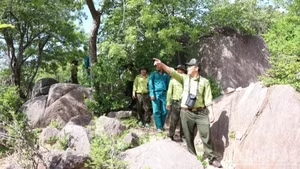
Socialisation should continue to be promoted in investment in modern equipment, vehicles and essential supplies suited to the requirements of search and rescue operations in each disaster scenario and each region and locality, especially at the commune level in high-risk areas that are frequently cut off.

![[In Pictures] Bridge columns and underpasses in Ha Noi begin to turn green](https://en-cdn.nhandan.vn/images/nyM650OGFWrOVWc-xajqN-rTZ68Rlmc1fiGJOhBRYHH_N-Xs0TE8Psnfce7ORTs-KVfoJaEblqjNufFrgeF3e2xFkGtLQVaXm04VcmMKBEkANUyiOkpz4zAuIKgydVrrfBxmGez0E_YJIag0u_Uil0E7jpuJXsIxeMmGjoY1-W4/1791863309074-2994714492692222878-2994714492692222878-adb9ff3f4175c70066ed8bb80cfbead9.jpg.avif)