This marks a consistent continuation of the strategic direction to develop human resources in tandem with innovation, contributing to nurturing a proactive and creative spirit, enhancing the capacity to master knowledge and technology, and moving towards a knowledge-based economy and sustainable development.
The programme is designed in close alignment with Party and State resolutions, aiming to create a strong shift in entrepreneurial culture within schools.
In recent years, alongside ongoing educational reforms, the start-up spirit has gradually been introduced into the school environment through idea competitions and innovation support programmes.
However, in practice, these activities still face certain limitations. Many ideas remain confined to the scope of competitions, lacking experimental environments, connections with businesses and investors, as well as sufficiently robust support mechanisms to develop into marketable products and services.
Against this backdrop, the programme “Supporting pupils and students in entrepreneurship for the 2026–2035 Period” places emphasis on establishing a comprehensive and substantive start-up ecosystem within educational institutions.
Schools are expected not only to organise activities but also to put in place clear support mechanisms, effective implementation units, service systems, and transparent evaluation processes, with a view to standardising the quality of start-up support.
Notably, the scope of implementation is expanded across multiple levels of education. Accordingly, school pupils will gradually be equipped with entrepreneurial knowledge and skills appropriate to each stage, linked to local realities and career orientation. This underscores that entrepreneurship is not solely a matter for higher education but should be nurtured from an early stage through the development of creative thinking and problem-solving abilities.
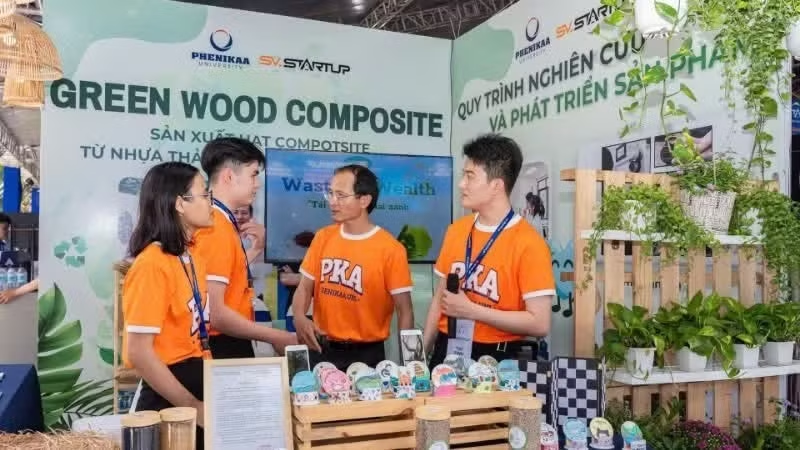
Alongside completing the ecosystem, the programme highlights the need to ensure outputs for start-up projects. Strengthening connections between educational institutions, businesses, investors, and local authorities is identified as a key factor in turning innovative ideas into reality.
Significantly, the orientation towards diversifying financial resources for school-based entrepreneurship is clearly set out.
To translate these directions into practice, in addition to mechanisms, policies, and resources, the coordinating role of state management agencies — particularly the Ministry of Education and Training — together with the involvement of ministries, sectors, and localities, will be decisive.
Integrating start-up support tasks with related programmes and schemes, improving coordination mechanisms, and ensuring adequate resources and implementation conditions will contribute to consistency and effectiveness in execution.
At the institutional level, innovation in the organisational mindset and operational approach of educational institutions plays a crucial role. Schools and teaching staff are not only providers of knowledge but also companions, mentors, and inspirers of creativity among learners. An open academic environment that encourages experimentation and accepts necessary failures will form the foundation for building innovative capacity and a sustainable entrepreneurial spirit.
Therefore, the success of the programme “Supporting pupils and students in entrepreneurship for the 2026–2035 Period” should not only be measured by the number of projects or start-up models, but also by the extent to which it spreads creative spirit, action-oriented capacity, and adaptability among learners. When the start-up spirit is nurtured in a substantive way within schools, the creative ideas of the younger generation will have the conditions to flourish, thereby contributing new drivers to the country’s development.