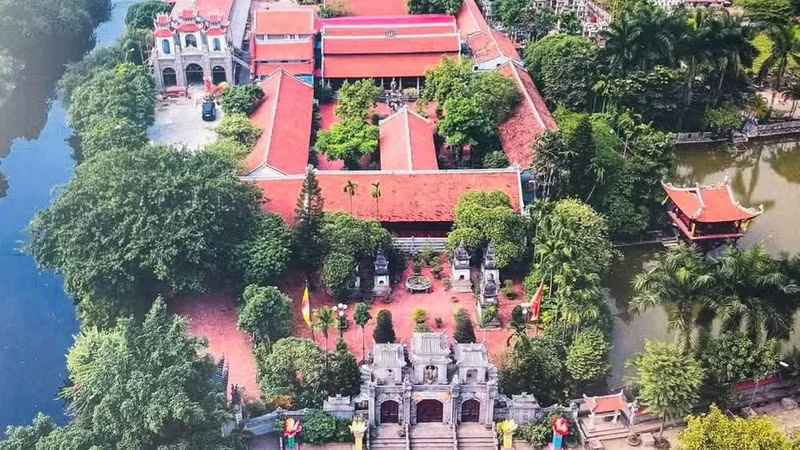
According to a preserved stone stele dating back to 1632, Dao Xuyen Pagoda predates the 17th century and has undergone numerous renovations. Belonging to the Linji (Lam Te) school of Mahayana Buddhism, the pagoda was once known as the “Dao Xuyen Ancestral Site” because, in addition to the Buddha, it honours the founding monk who established the Son Mon association in Bac Ninh.
Facing southeast, the pagoda exhibits an architectural style characteristic of many ancient Vietnamese pagodas. The complex comprises a three-entrance gate, a front hall, a main sanctuary, two corridors, an Ancestral House, a Mother Goddess House, a stele pavilion, and a stupa garden, creating a harmonious blend of worship space and traditional landscape.
Among the artefacts preserved at the pagoda, the most notable is the 16th-century statue of Guanyin (Quan Am) with a thousand hands and a thousand eyes, which was recognised as a National Treasure in 2015. It is the only statue in Ha Noi dating back to the Mac Dynasty.
Carved from jackfruit wood and finished with red lacquer and gold leaf, the statue stands 1.32 metres tall — or 2.55 metres including its hexagonal lotus pedestal. Featuring 42 large arms at the front and 652 smaller arms arranged in layers to form a halo, the statue exemplifies the exquisite craftsmanship of Vietnamese Buddhist sculpture from that era. Notably, the eyes are sculpted with such depth that viewers, regardless of their angle, feel as though the statue is gazing directly at them.
The artefacts preserved at the pagoda bear witness to its formation and evolution over the centuries. Preserving the statues, stone steles, and ancient architecture not only safeguards the site's tangible value but also sustains the cultural and spiritual space that connects the pagoda to the local community.
Beyond its architectural and artistic significance, Dao Xuyen Pagoda also serves as a site defined by important activities of the revolutionary movement. Between 1941 and 1945, the pagoda served as a clandestine base for the Party Central Committee and the Northern Regional Party Committee. It housed the secret headquarters of the Gia Lam District Party Committee and functioned as a training site for revolutionary cadres.
The pagoda grounds house a secret bunker that was used to shelter and protect cadres during enemy raids. A space ostensibly devoted exclusively to religious practice thus became a sanctuary that nurtured the people’s revolutionary struggle.
Venerable Thich Thanh Quy, the Abbot of Dao Xuyen Pagoda, noted that during the resistance war against French colonialists, the pagoda served as a site for printing and distributing revolutionary propaganda materials. At that time, the pagoda dedicated two chambers — originally for the worship of the Mother Goddesses — to house a printing press for producing communication and to shelter underground cadres.
The revolutionary activities conducted at the pagoda during this period helped establish a base, protect and expand revolutionary forces, and mobilise the masses, thereby contributing to the victory of the August Revolution in 1945. During the resistance war against the US, the site was selected as a command post for the Air Defence – Air Force Command.
The area that once housed the printing press has been converted into a memorial house displaying images and documents regarding the pagoda's revolutionary history. The senior monk Thich Thong Thiet was later recognised by the State as a martyr for having sacrificed his life during the resistance war against the French.
In 1990, Dao Xuyen Pagoda was officially classified as a National Architectural and Artistic Relic. Furthermore, it was deignated by the City of Ha Noi in 2011 as a memorial site commemorating revolutionary events from the resistance war era.
From a local management perspective, Duong Dang Hoa, Vice Chairman of the People’s Committee of Bat Trang Commune (Ha Noi), stated that the locality consistently prioritises the preservation and promotion of the value of Dao Xuyen Pagoda.
In addition to protecting the architecture and artefacts, the commune focuses on raising community awareness regarding the responsibility to safeguard this heritage. Technology is also being applied to preservation and promotional efforts; the pagoda is now equipped with information boards featuring QR codes, allowing residents and visitors to easily access information.
Furthermore, documentation regarding the Thousand-Hand, Thousand-Eye Guanyin statue, ancient stone stelae, architectural structures, and artistic details of the pagoda has been preserved through 2D digitisation. This dataset has been integrated into the digital library of Ha Noi’s cultural sector, facilitating information lookup and scientific research while serving as a foundation for long-term preservation work.