Along the inter-village road, on both sides, newly built houses and rice fields ready for harvest stretch as far as the eye can see, signalling a bountiful and prosperous harvest coming to the people.
At the end of 2025, the Central Highlands and South Central regions suffered a historic flood, causing particularly serious damage in Dak Lak Province, with Hoa Thinh Commune being one of the “flood epicentres”. When water from the Da Rang River, rainwater, and water from the highlands converged at the same time, the water in the fields could not drain, leading to deep and prolonged flooding, leaving traces that remain to this day. Here and there, bare trees and roofs riddled with holes from people removing tiles to escape the slowly rising floodwaters left their marks on tree trunks and house walls.
Speaking about the November 2025 flood, Le Thi Kim Don, 48, from Team 3, Phu Huu Village, said that both her own house and her parents’ house collapsed during the flood. Although the house foundations had been raised, the water still submerged the roof for four days straight. Their boat, originally used only for fishing on the river, was used to help each other through the disaster during the flood.
Nguyen Thi Luan, 45, pointed into the distance: “My house also collapsed during that flood. After the water receded, houses and trees were in ruins, and garbage was stuck all over the 5-meter-high power lines. At that time, we were very worried, not knowing how we would survive.”
According to a report from the People’s Committee of Hoa Thinh Commune, during the historic floods at the end of November 2025, 119 houses in the commune were completely destroyed, and 46 houses were partially destroyed. Hundreds of hectares of rice and crops were completely lost, leaving only barren land, and tens of thousands of livestock and poultry were swept away by the floodwaters, plunging the people into hardship.
To urgently support the people in stabilising their lives, the People's Committee of Dak Lak Province issued a specific support policy for house construction, including: 170 million VND for each new house; 40 million VND for repairing severely damaged houses; and 10 million VND for minor repairs, with houses meeting the "three solid" standard (solid foundation, solid wall frame, solid roof), ensuring safety against natural disasters.
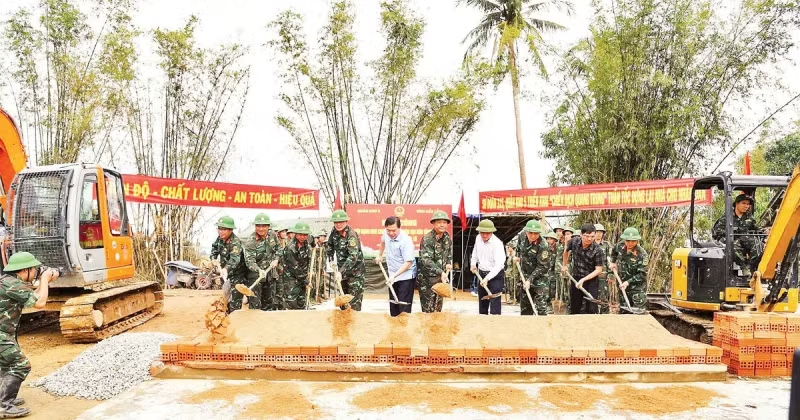
Lieutenant General Le Ngoc Hai, Commander of Military Region 5, stated that following the directives of the government and the Ministry of National Defence, Military Region 5 launched the “Quang Trung Campaign” with a spirit of speed, decisiveness, and utmost concentration on the task of rebuilding houses and stabilising people’s lives before the Lunar New Year 2026.
In the face of complex weather conditions and the urgent need for progress, units proactively adjusted plans, organised forces to stay on-site, and continuously carried out construction according to the motto “clear responsibilities, clear tasks, clear accountability.”
The entire Military Region mobilised tens of thousands of officers and soldiers; more than 48,500 troops directly went to the grassroots to assist the people. Each project completed ahead of schedule contributed to helping people stabilise their lives and strengthening their trust in the Party, State, and Army.
The “Quang Trung Campaign” was organised on a large scale, with a systematic approach, rapid progress, and practical effectiveness, addressing the urgent need for housing while creating a long-term stable foundation for the people after the natural disaster.
Many key units such as the 2nd Division, the 315th Division, brigades, and economic-defence units were assigned to directly work in Hoa Thinh Commune, following the “three together” principle, helping people clean up, disinfect, and ensure environmental protection, while simultaneously surveying and constructing and repairing houses, with the belief that “helping the people is a command from the heart.”
Progress was accelerated with the determination to complete and hand over the houses before the Lunar New Year 2026, helping people to stabilise their lives as soon as possible. Dozens of construction teams worked continuously day and night in shifts. 100% of the houses were started simultaneously, with many houses having their foundations, pillars, and walls completed just a few days after construction began.
Many structures were even built with sturdy flood-resistant floors, ensuring long-term safety for the people. Six households living in the Doi 3 field area, Phu Huu Village, whose houses were completely destroyed due to lack of access and transportation of construction materials, have been allocated resettlement land in new locations that are safer, more convenient, and better than their old homes.
The soldiers not only participated in construction but also assisted in transporting materials, provided technical guidance, and contributed labour, creating a sense of urgency throughout the area.
Thanks to the timely attention, leadership, and guidance of the Party and State, along with the practical support of officers and soldiers of Military Region 5 during the “Quang Trung Campaign,” Hoa Thinh Commune has gradually revived. Joy is returning to every home, and confidence is being built through concrete and practical actions. To date, 100% of the households affected by the floods have stable housing. Production, life, and daily activities of the people in the commune have basically returned to normal.
Nguyen Thi Luan happily shared: “My family has received support to rebuild our house, it’s very sturdy and solid. With the help of the soldiers from the Military Region, we feel safe now.” While listening to his mother, Tran Dong Tam, 24 years old, Don’s son, was helping his family repair two boats, the sounds of hammers and axes echoing joyfully. Tam said: “Yes, with the support of the soldiers from the Military Region, I’m trying my best to participate. It’s our house, after all. These two boats saved my family’s lives; now that they’re repaired, I’ll go back to fishing on the river.”
With its inherent nature and tradition of “originating from the people and fighting for the people,” and its function as a “fighting force and a working force,” ready to be present in the most difficult places, through the “Quang Trung Campaign,” the officers and soldiers of Military Region 5 not only helped the people overcome the consequences of natural disasters but also contributed to consolidating “the people’s support,” strengthening the people’s trust in the Party, State, and sssArmy, further tightening the solidarity between the military and the people, and contributing to beautifying the image of “Uncle Ho’s soldiers” in peacetime.