
Amid mountain peaks shrouded in cloud all year round, a quiet yet powerful revolution is taking place. Hands once accustomed only to holding hoes and sowing maize now glide across smartphone screens. Once held by the haunting grip of poverty and prejudice, farmers from ethnic minority communities have stepped beyond fear to write an inspiring story in the digital space.
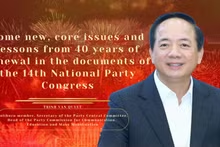
From January 19 to 23, 2026, the 14th National Congress of the Communist Party of Viet Nam was held with great success.
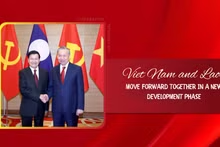
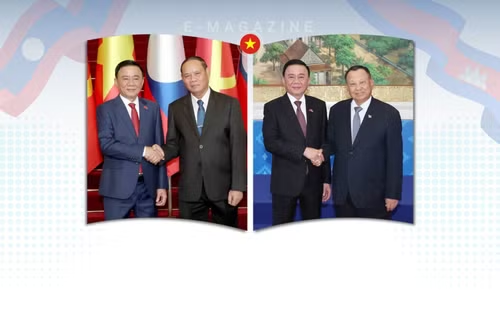
General Secretary of the Communist Party of Viet Nam To Lam led a high-level Vietnamese delegation on a State visit to Laos on February 5 at the invitation of General Secretary of the Lao People’s Revolutionary Party (LPRP) and President of Laos Thongloun Sisoulith.
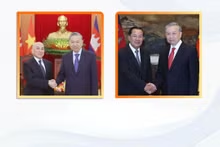
General Secretary of the Communist Party of Viet Nam (CPV) Central Committee, To Lam, will lead a high-ranking delegation of Viet Nam on a state visit to Cambodia on February 6, at the invitation of Cambodian King Preah Bat Samdech Preah Boromneath Norodom Sihamoni.
The period 2013–2025 marked a strong phase of development for the Viet Nam National Assembly in the context of the promulgation of the 2013 Constitution, the acceleration of the comprehensive renewal of the country, and the growing requirements for building a socialist rule-of-law state and deepening international integration. During this period, particularly in the term of the 15th National Assembly, the National Assembly’s legislative work underwent profound reforms.

Technology experts assert that 2026 marks a historic turning point, when smart glasses will no longer be a luxury tech toy but will gradually become an essential device, threatening the long-standing dominance of the smartphone. The explosion of artificial intelligence (AI), coupled with major advances in AR lens technology, has transformed slim-framed glasses into “supercomputers” worn on the face.

Resolution No. 80-NQ/TW of the Politburo on the development of Vietnamese culture is being hailed by experts and the artistic community as a “blueprint” of historic significance. This latest aspiration to revitalise culture has been translated into a system of clear and stringent quantitative targets. It marks an important milestone, signalling a fundamental shift towards an action-oriented mindset and strategic investment for sustainable development.
Resolution No.68-NQ/TW lays the foundation for a comprehensive transformation in the policy of developing the private economy: from “recognising” to “protecting, encouraging, and promoting,” from “supporting” to “leading development”. This is a correct and urgent strategic choice with a long-term vision, aimed at realising the aspiration for a strong and prosperous nation by the middle of the 21st century.
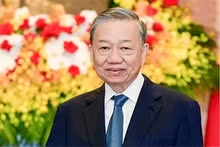
General Secretary To Lam has always been deeply concerned and devoted to the revolutionary cause of the Party and the nation. The General Secretary has issued many directions and delivered many thoughtful, profound and impressive remarks that have resonated in people’s daily lives... Nhan Dan Newspaper respectfully introduces a selection of the General Secretary’s heartfelt quotes.
Resolution No. 57-NQ/TW embodies strong, strategic and revolutionary guidelines and decisions aimed at creating new momentum. The resolution affirms that breakthroughs in the development of science, technology, innovation and digital transformation are a prerequisite for driving the country’s robust development in the new era, thereby contributing to the successful realisation of the goal that Viet Nam will become a developing country with modern industry and upper-middle income status by 2030.
Resolution No. 59-NQ/TW is a breakthrough policy, marking a historic turning point in the country’s process of international integration. It identifies integration as a strategic driving force enabling Viet Nam to enter a new era with confidence.
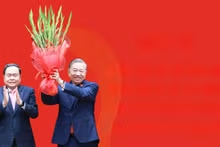
Nhan Dan Newspaper respectfully introduces an article by Tran Thanh Man, Politburo Member, Secretary of the Party Committee of the National Assembly and Chairman of the National Assembly, titled “The National Assembly is determined to institutionalise the Resolution of the 14th National Party Congress – swiftly putting the Party’s guidelines into practice.”

With regard to Resolution No. 70-NQ/TW, the core objective is to develop an energy system that is safe and stable, with reliable reserves; capable of adequately supplying production and daily life; transitioning towards a green, low-emissions pathway; operating intelligently on a digital platform; and ensuring reasonable and transparent costs.

Resolution No. 71-NQ/TW clearly affirms that education and training are the foremost national policy and a key driving force for national development.

The issuance of Resolution No. 72-NQ/TW marks a profound shift in awareness and action in the work of protecting, caring for and improving the people’s health. At the same time, it introduces comprehensive innovation with breakthrough solutions aimed at building a healthy Viet Nam, where all people receive healthcare, live longer, healthier and more wholesome lives, improve their physical wellbeing, raise awareness of health protection, and proactively prevent disease across society.
Resolution No. 80-NQ/TW was issued in the context of the country entering a new stage of development, with increasingly high requirements for rapid and sustainable growth, closely linking economic, political and social development with culture and people.
The 14th National Congress of the Communist Party of Viet Nam is identified as a historical milestone for the country in the Ho Chi Minh era. The preparation and drafting of the documents to be presented at the congress is of special importance.

Alongside the 80th anniversary of the nation’s founding, and through nearly 40 years of Doi Moi (Renewal), the state-owned economy has developed strongly, making a significant contribution to promoting economic growth, while also contributing to building and protecting the country.
Implementing the Politburo’s Resolution No. 66-NQ/TW, the work of law-making and law enforcement has undergone a strong transformation, leaving a clear breakthrough mark in the building and improvement of institutions and the legal system. In 2025 alone, a series of institutional bottlenecks were largely removed, while the system of legal documents was improved in a synchronous and timely manner, helping to unlock resources and create a solid legal foundation for national development.
In 2025, the agriculture and environment sector marked an important turning point, stabilising the organisational structure after the merger and reforming institutions to make the apparatus leaner yet more effective. Streamlining 25 out of 55 units under Decree No. 35/2025/ND-CP is not merely a matter of rearrangement; it is a prerequisite for policies to move faster, stay closer to the grassroots, and cut costs and time for citizens and businesses.