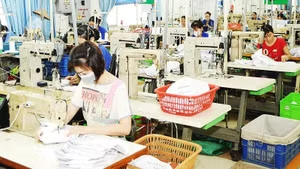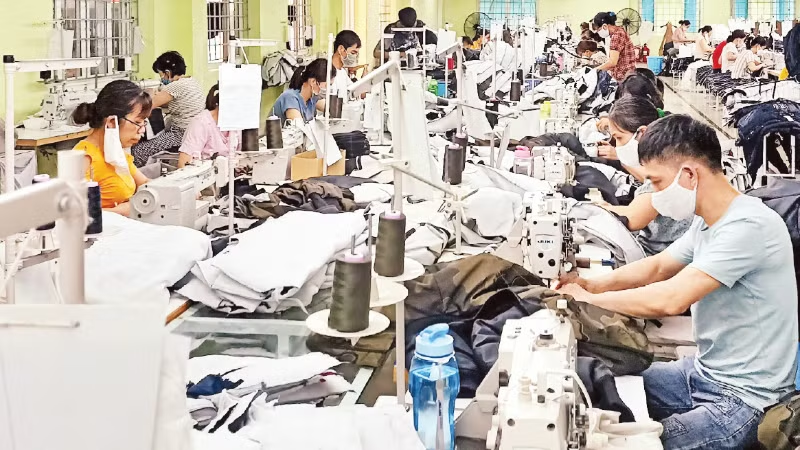
In recent years, Viet Nam's textile and garment industry has continued to diversify its export markets and customer base. However, alongside macroeconomic policy measures, the industry must proactively adopt appropriate strategies, strengthen linkages and pursue sustainable development while maximising opportunities arising from free trade agreements (FTAs).
Increasing the use of domestically sourced materials
Pham Quang Hai, Sales Director of Bao Minh Textile JSC, said that although Viet Nam's textile and garment exports generate tens of billions of US dollars each year, the industry's value added remains limited.
The main reason, he explained, is its dependence on imported raw materials and accessories, particularly premium fabrics and high-quality trims, with an estimated 50–60% of input materials sourced from overseas. This represents a substantial cost burden that could be significantly reduced if Viet Nam's supporting industries were more developed.
"When manufacturers rely on imported materials, they not only face extended delivery times but also substantially higher production costs, reducing their competitiveness for each export order," Hai said.
For example, importing a particular type of material typically requires 20 to 30 days, whereas sourcing it domestically would reduce lead times to 10–15 days, while cutting associated costs by approximately 7–10%.
According to Than Duc Viet, General Director of GARCO10 Corporation, the company has invested in and partnered with suppliers to establish a fully integrated vertical supply chain spanning from raw materials to finished garments, with GARCO10 serving as one link within the chain.
Whereas imported materials previously accounted for around 80% of inputs, that figure has now fallen to 60%. Alongside strengthening domestic supply chains, GARCO10 has increasingly shifted towards internationally certified materials, including GRS-certified recycled polyester and organic fibres, enabling the company to meet the increasingly stringent requirements of global markets and customers.
According to Vu Duc Giang, Chairman of the Viet Nam Textile and Apparel Association (VITAS), the industry has faced numerous challenges in recent years. Nevertheless, thanks to the proactive efforts of enterprises, Viet Nam has maintained its growth momentum and retained its position among the world's three largest textile and garment exporting nations.
The year 2025 marked a strong recovery for the industry, with export turnover exceeding 46 billion USD, up 6% from 2024. The sector generated a trade surplus of 21 billion USD, while the domestic value-added ratio rose to approximately 52%, reflecting significant progress in strengthening local supply chains and reinforcing the industry's role as a key contributor to Viet Nam's trade balance.
"Thanks to a strategy of diversifying markets, products and customers, Vietnamese textile and garment products are now exported to 138 countries and territories. Meanwhile, 28 Vietnamese textile and garment companies are expanding overseas investment to take advantage of favourable policies and tariff preferences, thereby reducing political risks as well as transport and labour costs," Giang said.
Green and sustainable production model
Vien Minh Dao, General Director of 8-3 Textile One Member Co., Ltd., said that with more than 40,000 modern spinning spindles installed, the company has an annual production capacity of approximately 14,000–15,000 tonnes of yarn.
In addition to improving product value and corporate governance, the company has accelerated its green transition by installing rooftop solar power systems at its factories. This has helped reduce electricity consumption from the national grid, lower greenhouse gas emissions and increase the share of renewable energy used in production, thereby enhancing the company's long-term competitiveness.
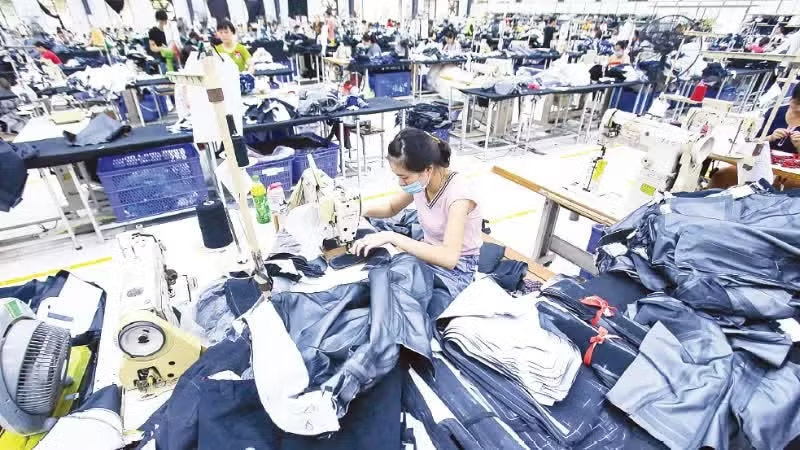
Pursuing a strategy of developing specialised textile industrial parks based on green, modern and sustainable principles, Pho Noi Textile Infrastructure Development JSC (Vinatex-ID)—the developer and operator of Pho Noi Textile and Garment Industrial Park—has established integrated infrastructure capable of supporting the entire production chain, from spinning, weaving and dyeing to garment manufacturing and supporting industries.
According to Vinatex-ID, after more than 20 years of development, Pho Noi has become one of Viet Nam's leading specialised textile industrial parks. Covering more than 120 hectares, it has attracted dozens of domestic and international enterprises.
Dr Nguyen Van Duc, Vice Rector of the Ha Noi University of Industry and Trade, said one of the weakest links in Viet Nam's textile industry remains the weaving and dyeing segment.
He described this as a long-standing bottleneck that requires urgent attention, noting that many localities remain reluctant to attract investment in dyeing projects because of environmental concerns.
"Viet Nam performs very well in spinning and garment manufacturing, with garment production ranking among the world's best. What is needed now is stronger integration of these segments into a complete value chain in order to improve competitiveness and generate greater value added," he said.