This bottleneck is obstructing efforts to convert culture into an intrinsic driver, soft power, and a key engine of national development. Party General Secretary and State President To Lam emphasised that, as the digital space increasingly shapes public perceptions, tastes, and lifestyles, the gap threatens Viet Nam's ability to transform its cultural assets into soft power. If left unaddressed, it could weaken the appeal of Vietnamese culture and create new challenges for preserving national identity and values.
According to the Digital 2026 report, by the end of 2025, Viet Nam had approximately 85.6 million internet users, accounting for 84.2% of the population. The number of social media user accounts reached around 79 million.
Every internet-connected smartphone or computer is now both a gateway to cultural content and a channel for sharing information with millions of others. A folk song, a traditional dish, or a scenic attraction can reach audiences around the world within minutes of being posted.
However, opportunities do not automatically translate into influence. In the digital environment, content must compete fiercely for attention, a dynamic largely dictated by algorithms.
Analysing this shortfall, Dr Nguyen Huy Phong of the Central Theoretical Council said it stemmed from both objective and subjective factors. Objectively, the rapid development of science, technology, and artificial intelligence (AI) is increasingly shaping behaviour in the digital space. Subjectively, he noted that since gaining internet access in 1997, Viet Nam has quickly become one of the fastest-growing internet markets in the region.
Meanwhile, cultural products created and promoted in the digital space remain scarce and rudimentary. This is partly due to the preference for foreign culture among some young people, which has led to traditional values being overlooked, and partly because we have yet to prioritise building a digital cultural ecosystem, from strategies to a legal framework that encourages creativity and the promotion of new works.
The transition from traditional management to smart governance in the digital environment also exhibits critical flaws, while there is still a shortage of professionals with expertise in both culture and technology. Although Viet Nam possesses abundant cultural resources, it has yet to deploy comprehensive strategies to transform them into competitive digital content capable of rivalling foreign products.
Many experts believe that the current gap stems from a limited capacity to transform cultural values into distinctive digital products. In many cases, digital transformation is still equated with digitising collections and archives, rather than creating compelling digital cultural content that can compete on a global scale.
Current realities reveal a stark dichotomy between Viet Nam's rich cultural heritage and its limited capacity to create modern cultural products; between its vast cultural assets and the ability to transform them into digital resources, knowledge, and intellectual property; between the policy ambition to develop cultural industries and an institutional and market framework that remains insufficiently aligned; and between the rapid growth of digital platforms and the appeal and reach of Vietnamese culture in the digital space.
Professor Dr Tu Thi Loan, Director of the Thang Long Institute of Cultural Studies, pointed out that digital transformation in the cultural sector is fundamentally different from that in economic and technical sectors. Its objective is not merely to improve economic efficiency or automation, but to preserve and promote cultural identity, historical depth, cultural traditions, and diverse forms of creative expression.
Digital transformation in the cultural sector is fundamentally different from that in economic and technical sectors. Its objective is not merely to improve economic efficiency or automation, but to preserve and promote cultural identity, historical depth, cultural traditions, and diverse forms of creative expression.
Another reason lies in the way stories are told. Many official cultural products still lean on a one-way approach to communication, providing comprehensive information but lacking characters, narratives, and emotions, making them less appealing to audiences.
In addition, the creative ecosystem remains disjointed. Cultural experts may lack technological expertise, while technology specialists often have limited knowledge of history and aesthetics. At the same time, artists, media companies, museums, schools, and government agencies have yet to establish sustainable partnerships, leaving many valuable cultural resources underutilised.
In many organisations, social media is still treated as a secondary channel for republishing content produced for print newspapers or television, rather than as a creative platform with its own language and dynamics. Evaluation also tends to focus on the number of news stories produced rather than their actual reach and impact.
Moreover, as most cultural content is distributed through cross-border digital platforms, even a minor change in platform policies or algorithms can significantly impair its ability to reach audiences.
To narrow this gap, it is first necessary to reconceptualise what constitutes a digital cultural product. Beyond digitising cultural materials, the focus should be on creating content that is discoverable, engaging, shared, and capable of inspiring further creativity. Cultural data should also be standardised, identified, protected by copyright, and designed to ensure interoperability and reusability.
Investment and commissioning mechanisms also need to be overhauled, with the State focusing its resources on foundational projects and works of high ideological and artistic value, while expanding public-private partnerships with businesses, artists, and independent creators. At the same time, evaluation should shift from counting output to assessing recognition level, interaction, and social impact.
Ministries, sectors, and local authorities should invest in a workforce with expertise in both traditional culture and digital technology, while prioritising the cultivation of young talent with passion, creativity, and ambition to help generate new cultural value, contributing to strengthening Viet Nam's cultural identity and sovereignty in the digital space.
Technology is impactful only when it enables cultural values to reach wider audiences in more engaging ways. This requires a workforce capable of connecting cultural knowledge with technology, design, and communication, as well as collaboration among researchers, artists, journalists, museum professionals, and the digital content creation community.
Alongside content creation, an effective distribution strategy is equally paramount. Positive content should not simply be published and left for audiences to discover on their own; data should be used to identify target audiences, select the right timing, format, and platform, build communities, and work with major digital platforms to promote Vietnamese culture. At the same time, greater investment is needed in domestic data repositories, search tools, and distribution channels, as self-reliance capability is not merely a matter of communication but also a crucial component of digital cultural sovereignty.
Families, schools, the media, and cultural institutions should collaborate to foster proactive cultural engagement, enabling individuals to make informed cultural choices and promote cultural values, turning them into soft power and value leadership.
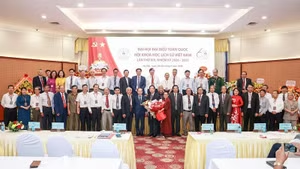
Speaking at the meeting of the Central Steering Committee for the development of Vietnamese culture, the Party General Secretary and State President urged the execution of three major shifts in cultural development: from viewing culture as a sector of development to recognising it as the spiritual foundation of society, a pillar of development, and a new driver of growth; from traditional cultural spaces to culture in both physical and digital environments; and from prioritising preservation to combining preservation with creativity.
While the “four gaps” help identify clear weaknesses, the “three major shifts” delineate the solutions. This is a transition from static preservation to dynamic development; from administrative management to ecosystem building; from investing in activities to investing in capabilities; and from measuring outputs to assessing real impact on people and society.
The top leader's directive speech serves a pivotal function, shifting Resolution No. 80 from a set of guiding principles, objectives, and strategic orientations into an action programme with clear priorities, defined responsibilities, outputs, timelines, and evaluation criteria.
The speech also outlines four key tasks to lay the foundation for cultural development in the years ahead.
First, continue improving the institution, spearhead breakthroughs to unleash the creative potential of society, mobilise, allocate, and effectively utilise all resources for cultural development.
Second, champion cultural sovereignty in the digital space, enhance the appeal and reach of Vietnamese culture while safeguarding its core values.
Third, accelerate the transformation of cultural heritage and cultural capital into knowledge, intellectual property, creative products, and resources for education, science and technology, cultural industries, and innovation.
Fourth, develop the cultural industries into a new driver of economic growth, transform cultural strength into national competitiveness.
These directions not only address the identified “gaps” but also point to a new approach. When culture is truly positioned appropriately and driven by creativity, technology, and market, the digital space will no longer be a challenge but a powerful platform for positive cultural values to spread widely, sustainably, and with the capacity to shape values.