To develop into a sufficiently strong successor force, young filmmakers need more opportunities for professional training, production resources, and an environment in which to bring their works to the public.
New faces, new ways of storytelling
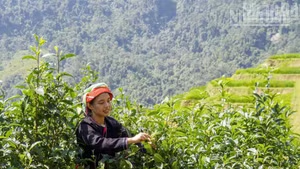
Over the past few years, when discussing the new face of Vietnamese documentary filmmaking, Ha Le Diem (born in 1992) has been a prominent name. She spent many years making “Children of the Mist”, following its main character, a H'Mong girl in Sa Pa, Lao Cai, from childhood through the early stages of adulthood, highlighting the local customs and traditions as well as profound human values.
The film appeared at numerous international film festivals. In 2021, Ha Le Diem won the Best Director award at the International Documentary Film Festival Amsterdam (IDFA). The work subsequently won Best International Film at Docaviv (Israel) and Best Asian Film at the first Da Nang Asian Film Festival. In 2023, the film was shortlisted among the 15 outstanding feature-length documentaries for the Oscars.
Through Ha Le Diem's journey, one can see a notable characteristic of the young generation of filmmakers: they often begin with stories that are very close to everyday life, before expanding the issues to encompass culture, communities, and more.
At the Central Documentary and Scientific Film Studio, several members of the new generation are gradually making their mark through familiar themes and flexible storytelling approaches. Director Le Anh Tuan (born in 1990), together with Dao Duy Tu, made the documentary “Above the Clouds”, which received a Silver Kite Award in 2023. Le Anh Tuan subsequently directed “A Journey of Love”, with screenwriter Tran Thi Ngoc Quynh. From the same generation, Do Thi Huyen Trang (born in 1991) has pursued both screenwriting and directing. “Postpartum Depression”, a science film which she co-directed, received the Golden Kite Award and the Best Director award.
Another name is Lan Nguyen, known for music documentary projects, among them “Brilliant Horizon”, about singer Ha Anh Tuan, which received the Jury Prize in the Documentary category at the 24th Viet Nam Film Festival. These cases show that young people are exploring a wide range of subject matter while gradually broadening their approaches to documentary filmmaking.
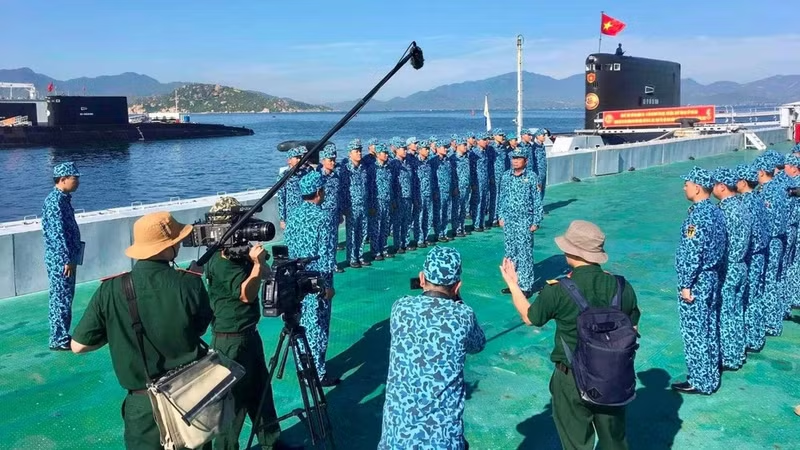
At the People's Army Cinema, the younger generation is also being given opportunities to explore major subjects concerning the country. Among the unit's young directors and screenwriters, many have made a clear mark with works on history, war, soldiers, science, and life. Nguyen Quang Quyet (born in 1986) wrote and directed “Sacred Image”, which won the Golden Kite Award in 2024 and a Grade C prize at the 19th National Press Awards; Ha Xuan Truong (born in 1990), with the film “Research into the Application of Technology in Firefighting”, won the Golden Lotus at the 23rd Viet Nam Film Festival and subsequently received a Silver Kite Award in 2024; Bui Thanh Hai (born in 1994), with “Hanoi's Sky Forever Blue – Episode 2: The Sky of Peace”, won a Silver Lotus in 2023, while “Awakening and Reconciliation” won the Golden Lotus for documentary film at the 24th Viet Nam Film Festival.
Paving the way for long-term projects
Over the years, several centres and training and development programmes have contributed to creating a practical environment for independent filmmaking. They have also provided a basis for young filmmakers to acquire filmmaking skills, develop ideas and find collaborators. The Da Nang Asian Film Festival has organised various training activities, workshops, and project incubators, with the participation of domestic and international experts and producers, creating opportunities for young people to develop projects, connect with producers, and seek resources.
In reality, documentary filmmaking requires many factors, including funding, human resources, equipment, and post-production. Ha Le Diem began filming “Children of the Mist” in 2017 and completed it at the end of 2021. Lan Nguyen's “The Faded Grass” also took around five years to make, while “Brilliant Horizon” involved more than two years of filming and gathering material. For independent works, this is no small pressure. Without stable investment, many projects can be prolonged, depending on the director's and crew's ability to find ways to keep them going.
Another important issue that needs to be promoted further is distribution. Documentary films include many good works, but the journey from film festivals to the mass audience is not always smooth. Organising festivals and thematic screenings, bringing documentaries into schools, libraries, cultural centres, and digital platforms, as well as incorporating them into heritage education activities, could open additional avenues for these works. A positive sign is that the public, including young audiences, now has more opportunities to access documentaries.
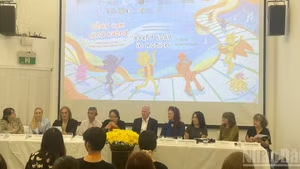
At the 16th European-Vietnamese Documentary Film Festival in 2026, the organisers said that audience numbers have increased, with notably greater interest from young audiences, who were seeking stories that are close to and truthful about everyday life.
At cinema seminars and discussions, assessments from industry professionals have recognised the commitment and subject-matter accessibility of the younger generation. They are strong in technology, quick to adapt their modes of expression, proactive in seeking new material, and unafraid to experiment. Their achievements at domestic and international awards also demonstrate the rapid maturation of the young filmmaking force.
Nevertheless, for sustainable development, what still needs to be nurtured is life experience, depth of source material, professional mettle, and the ability to master the language of cinema. Young people need to be given opportunities to pursue long-term projects, work alongside experienced generations, and have the conditions to experiment through multiple works. Alongside technical skills, they should be encouraged to develop their own voices, raise new questions about familiar subjects, and remain faithful to reality.
When youthful energy is supported by experience, broadened by life experience and given sufficient creative space, the successor force will become a lasting foundation for Vietnamese documentary filmmaking.