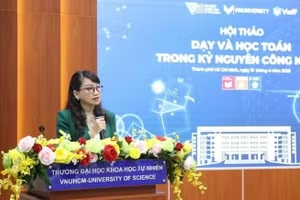

The Resolution of the 14th National Party Congress has inherited and developed the contents on safeguarding the Fatherland from previous congresses, while adding the objective of “ensuring and protecting the highest national and ethnic interests” as the top priority.

Strategic autonomy in science and technology is no longer a distant goal but an urgent requirement, now that the foundation is sufficient and the time for action is ripe. With unique advantages such as rare earth elements, tropical forests, and aquatic resources, Viet Nam has the basis to master technology from within, creating a distinct competitive advantage.
Intellectual property must become the soft infrastructure of the digital economy. To unlock innovation, it is essential to shift from a case-by-case handling approach to ecosystem governance: digitising enforcement, strengthening meaningful sanctions, and ensuring that all actors, including digital platforms, are held accountable.

Deputy Prime Minister Bui Thanh Son has signed Decision No. 540/QD-TTg approving a plan to implement the agreement on cooperation in science, technology and innovation between the Governments of Viet Nam and France.

In many countries, including Viet Nam, numerous development indicators still lack data reflecting the real-world experiences of communities, especially vulnerable groups. Without inclusive data, policies and innovations can hardly be truly people-centred.
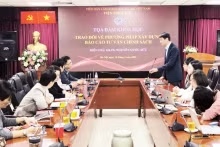
Social sciences play a leading role in guiding and orienting thinking, contributing arguments to policy planning, and creating a foundation for sustainable national development. Furthermore, in the current era of development, social science knowledge is increasingly integrated into technological products and services, promoting economic growth. This reality demands that social science and humanities research be more closely linked to real-life practice.

The PM requested a review of the development of core and strategic technologies, as well as the building and interconnection of databases.

A national training programme on cybersecurity for digital transformation has been launched as part of the “Viet Nam Cybersecurity Range”, marking a significant step towards strengthening information security and risk management capabilities.

Artificial intelligence (AI) is no longer a concept confined to high-tech industries. It is quietly making its way into every field, fish pond, and orchard. A question arises: in this era, will farmers be replaced, or will they become the ones in control?

In the context of rapid digital technological development, online fraud is becoming increasingly sophisticated, particularly with the emergence of deepfake technology, which is being exploited to impersonate relatives, organisations, and businesses in order to appropriate assets. This reality requires to strengthen management of digital platforms, improve legal frameworks, and enhance public awareness and vigilance to proactively prevent risks in cyberspace.

Known as Plan 428, Ha Noi Metro’s initiative to use digital identification and authentication, along with biometric recognition at metro stations, has delivered a more modern, secure and convenient travel experience for the capital’s residents, contributing to the development of a smart and sustainable public transport system.

In the context of Viet Nam’s drive to accelerate science, technology, and innovation, female scientists are finding increasing opportunities to engage more deeply in key research fields. With equal conditions and opportunities, they are capable of taking leading roles in the development of cutting-edge technologies.

A new wave is taking shape in Viet Nam. Localities across the country are stepping up the implementation of policies, institutions, and new models, turning innovation from a slogan into concrete action.

Viet Nam and Germany are stepping up efforts to connect their innovation and startup ecosystems following the signing of a memorandum of understanding (MoU) between Viet Nam's National Innovation Centre (NIC) and the Centre for Entrepreneurship (CfE) of the Technical University of Berlin (TU Berlin).

Deputy Prime Minister Nguyen Chi Dung paid a working visit to Italy and Germany from March 18 to 25, 2026, with the aim to promote a wide range of cooperative activities in innovation and technology start-ups.
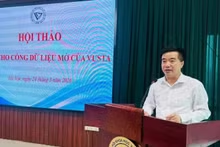
According to Nguyen Quyet Chien, Secretary-General of the Viet Nam Union of Science and Technology Associations, the building of a centralised digital data platform not only meets urgent requirements but also opens up the ability to effectively exploit “digital resources”, towards forming a shared data repository to serve governance and operations, and create additional momentum for the development of the entire system.

The development and completion of national databases is a cornerstone in the digital transformation process. When data is standardised, interconnected, and effectively utilised, it becomes a critical foundation for modern governance, digital economic growth, and enhanced national competitiveness.
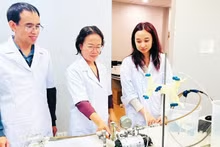
Over 41 years of operation, the Kovalevskaia Award has been presented to 23 collectives and 58 female scientists with outstanding achievements, whose research has made significant scientific and practical contributions.

Deputy Prime Minister Tran Hong Ha recently signed Decision No. 456/QD-TTg approving the project on building a data centre for the management, monitoring, and handling of violations and traffic management in the 2026-2030 period, with a vision to 2050.

Vietnamese enterprises are making concerted efforts to gradually master manufacturing technologies in several emerging industries, with the aim of moving up the value chain.