The increasing role assumed by countries such as Türkiye, Qatar, Brazil and Saudi Arabia as “middlemen” in international conflicts and crises reflects profound changes in the structure of global power.
The post–Cold War international order was once shaped by the clear leadership of Western powers. However, over the past decade, the world has witnessed the strong emergence of new centres of power, leading to a relative decline in Western leadership. This fierce competition has created a “leadership vacuum” in global governance.
Multilateral mechanisms continue to face challenges in fully asserting their role, while bilateral diplomacy among major powers is often dominated by confrontation. This stalemate has opened up space for countries that are not superpowers, but possess sufficient capacity, credibility and flexibility, to step in as mediators.
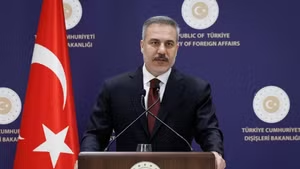
A prominent example of mediator diplomacy today is Türkiye. With its strategic crossroads position, bridging Europe, the Middle East and the Black Sea, Türkiye is both a NATO member and a country that maintains pragmatic relations with Russia, Ukraine, and Middle Eastern states.
This “bridging” position enables Ankara to act as a mediator on many sensitive issues, as demonstrated by the Black Sea Grain Initiative, which helped reduce the growing risk of a global food crisis.
If Türkiye represents mediator diplomacy grounded in geostrategic location, Qatar exemplifies another model — building a mediating role based on soft power and an extensive diplomatic network.
Qatar has invested heavily in mediation diplomacy by keeping channels of dialogue open with actors that Western countries often face barriers in engaging, thereby enhancing its role in promoting negotiations and ceasefires in the Middle East.
Through this, Qatar has shown that in a polarised world, the ability to engage in dialogue with multiple sides is a valuable asset. Brazil, meanwhile, represents yet another form of mediator diplomacy, often seen as a voice of the Global South on global issues.
In multilateral forums, Brazil frequently advances independent perspectives and calls for diplomatic solutions to conflicts. The country also plays an active role in mechanisms such as BRICS and the G20, where developing nations seek to amplify their voices.
Brazil’s mediator diplomacy reflects its aspiration to help build a more inclusive international order, one in which the interests of developing countries are not overshadowed by competition among major powers. Clearly, mediator diplomacy today is no longer the “privilege” of traditionally neutral states.
In a world where major powers are locked in intense rivalry, the role of mediators has emerged between opposing blocs. Many countries have come to view mediator diplomacy as a strategic lever to enhance their international standing, at a lower cost than military competition or economic confrontation.
However, mediator diplomacy does not always proceed smoothly. “Middle countries” often depend heavily on the goodwill of the conflicting parties. Maintaining balance among opposing partners also entails political and strategic risks.
Not every mediation effort is successful, and the mediating role can be quickly weakened if the geopolitical environment shifts.
Nevertheless, in a world where numerous flashpoints remain unresolved and the risk of escalation persists, mediator diplomacy has become a necessary “lubricant” for the international system.