In recent years, natural disasters in Viet Nam have been tending to increase in both frequency and intensity, becoming ever more extreme and unpredictable.
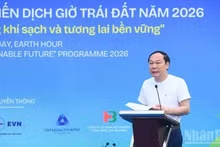
The Ministry of Agriculture and Environment, in collaboration with UNICEF in Viet Nam and various domestic and international agencies and organisations, launched a programme themed “Children and Youth Action for Clean Air and a Sustainable Future” in Ha Noi on March 21, in response to World Water Day, World Meteorological Day, and Earth Hour 2026.
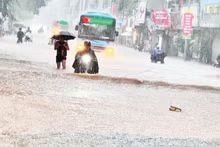
Under increasing pressure from climate change and overloaded infrastructure, the application of technology — from flood mapping to early warning systems and smart drainage management — is seen as an optimal solution to improve forecasting and minimise damage caused by current urban flooding.

Dong Thap province is striving to become a representative economic hub for the rice sector in the Mekong Delta region, playing a core role in linking and spreading the model of ecological, circular and low-emission rice production.

With the message “Green Innovation – Green Future”, on the morning of March 21, 2026, in Ha Noi, the Ministry of Industry and Trade will officially launch the Earth Hour 2026 campaign. The highlight of the event is a running race attracting more than 2,000 participants, aiming to inspire the spirit of energy saving and to form civilised consumption habits within the community.
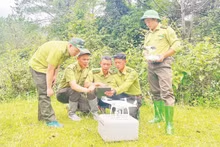
In the context of emission reduction efforts and the pursuit of net-zero emissions, the forest carbon market is becoming an important green financial channel. With its strong carbon sequestration potential, Viet Nam has many opportunities to engage more deeply in this market. However, to harness it effectively, it is necessary to continue improving policies and attracting investment resources.
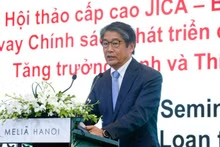
A high-level workshop on next-generation Official Development Assistance (ODA) was held in Ha Noi on March 18, highlighting deepening cooperation between Viet Nam and Japan in promoting green growth and strengthening climate resilience.
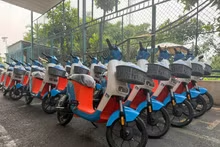
The Ho Chi Minh City Management Centre of Public Transport under the municipal Department of Construction launched a public electric bicycle service on March 15, marking a new step in efforts to expand green urban mobility.
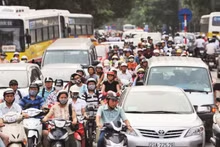
As Viet Nam aims for the net-zero emission target by 2050 and to reduce sources of urban air pollution, controlling engine emissions from road vehicles is considered one of the most effective measures.
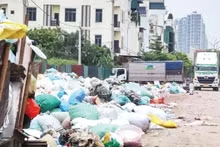
In 2025, the amount of municipal solid waste generated in Viet Nam was about 70 thousand tonnes per day, mainly from urban areas. The waste picture shows that household waste has very diverse components, but food waste accounts for the largest proportion, while the remainder consists of recyclable materials, hazardous waste and other types.

Transport is a major source of greenhouse gas emissions, accounting for around 30% of the total. It is also a leading cause of fine particulate pollution and other harmful gases. Reducing emissions is therefore an urgent task in achieving the Net Zero target by 2050, while also serving as a crucial solution for protecting human health and the living environment.
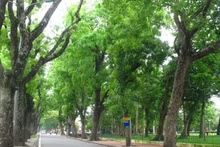
In recent years, Ha Noi has paid increasing attention to the development of its urban green system. However, these efforts have not always been scientific nor guided by a long-term vision, and in some cases have even been implemented in a campaign-style manner.
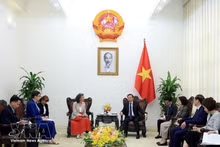
Deputy Prime Minister Tran Hong Ha met with UNDP Resident Representative Ramla Khalidi and WHO Representative in Viet Nam Angela Pratt in Ha Noi on March 11 to discuss ways to strengthen cooperation in improving air pollution and addressing air quality in Viet Nam.

A rare parasitic plant species, the Himalayan sapria (Sapria himalayana), has been recorded in the Phong Nha – Ke Bang National Park, according to the park’s management board.
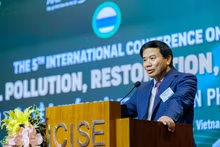
The 5th International Conference on Environmental Pollution, Restoration and Management (ICEPROM) opened in Quy Nhon Nam ward of the central province of Gia Lai on March 9, bringing together nearly 90 scientists and environmental managers from universities, research institutes, enterprises and government agencies representing 22 countries.
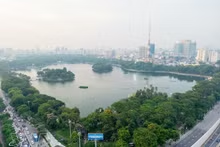
Prime Minister Pham Minh Chinh has issued Directive No. 04/CT-TTg to accelerate the implementation of the scheme on development of urban areas in Viet Nam in response to climate change in the 2021-2030 period.
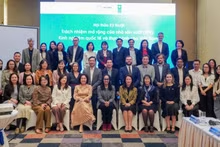
The United Nations Development Programme (UNDP) in Viet Nam, in collaboration with the Department of Environment under the Ministry of Agriculture and Environment, organised a technical consultation workshop in Ha Noi on March 6 on Extended Producer Responsibility (EPR) through the National Plastics Action Partnership (NPAP) programme in Viet Nam.
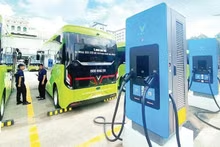
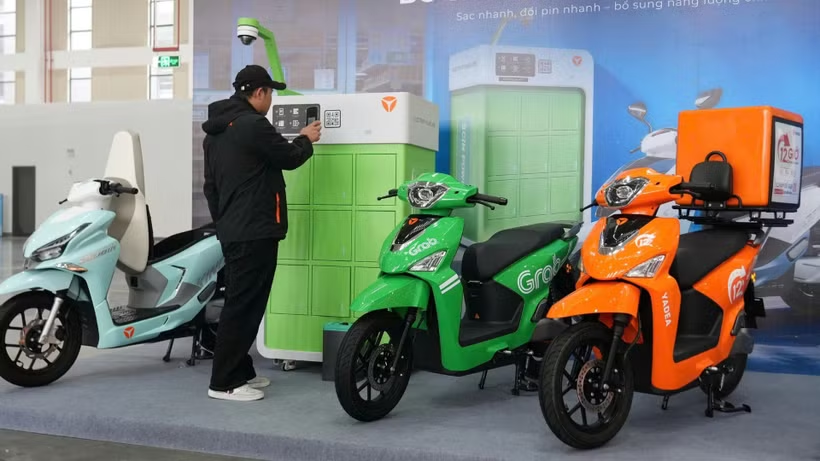
At present, Ho Chi Minh City is not only focusing on the transition of transport vehicles but is also gradually improving its environmental policy framework. These efforts aim to reduce air pollution, encourage the development of clean vehicles, and increase the use of public transport.
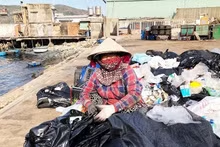
Discarded fishing gear waste is not merely floating debris on the sea surface; it poses a prolonged threat to marine ecosystems, resources, and the livelihoods of coastal communities. The situation calls for urgent measures to reduce discarded fishing gear in order to safeguard the blue ocean.
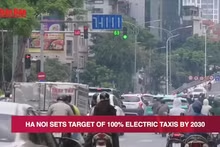
The People’s Committee of Ha Noi has issued a plan to convert all petrol- and diesel-powered taxis to electric and green-energy vehicles before 2030, accompanied by a range of support mechanisms and policies for businesses.